Planetary nebula
Last updated
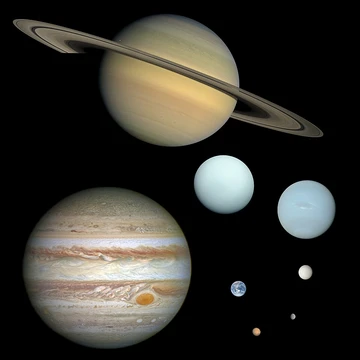
A planetary nebula is an expanding, glowing shell of ionized gas ejected from red giant stars late in their lives.[1] Early telescope users saw these objects as having a round shape similar to planets, which led to the name "planetary nebula," even though they have no connection to actual planets.[2] Stars with masses between about one and eight times that of the Sun produce planetary nebulae when they reach the final stage of their lives.[3]
Key facts and history
The first planetary nebula discovered was the Dumbbell Nebula, observed by Charles Messier on July 12, 1764.[1] William Herschel created the term "Planetary Nebula" in 1785 for objects looking like a planet's disk, possibly adopting Darquier's description.[4] The first UV observations of a planetary nebula were performed from space with the Orion 2 Space Observatory in December 1973.[5] Herschel placed these objects into Class IV within his nebula catalog, ultimately recording 78 entries as "planetary nebulae".[6]
Before the middle of the 19th century, when the first spectroscopic observations occurred, what planetary nebulae actually were remained a mystery.[1] Huggins examined the Cat's Eye Nebula's spectrum on August 29, 1864, making him the first person to analyze a planetary nebula's spectrum.[1] During the 1920s, physicists demonstrated that the 500.7 nm line arises from forbidden transitions occurring in gas of very low density.[1]
What the research sources say
The Smithsonian Magazine account by Daley reports that a new model suggests the sun will create a planetary nebula visible from millions of light-years away.[7] According to Daley, the sun is right on the lower limit of being able to form a planetary nebula, and stars just a few percent less massive will not produce one.[7] The Wolfgang Steinicke account notes that Herschel created the term "Planetary Nebula" in 1785, possibly adopting Darquier's description and still impressed by his finding of Uranus in 1781.[4]
References
- Wikipedia, "Planetary nebula" (CC BY-SA 4.0) en.wikipedia.org
- Wikipedia, "Planetary nebula" (CC BY-SA 4.0), which cites: Darquier, "Observations astronomiques, faites à Toulouse (Astronomical observations, made in Toulouse)", Avignon: J. Aubert; (and Paris: Laporte, etc.), 1777; Olson, "Who Discovered the Ring Nebula?", June 2017, p. 32–37; Wolfgang Steinicke, "Antoine Darquier de Pellepoix" (we also read that source) en.wikipedia.org
- Wikipedia, "Planetary nebula" (CC BY-SA 4.0), which cites: Daley, "The Sun Will Produce a Beautiful Planetary Nebula When It Dies", Smithsonian Magazine, May 8, 2018; They are created after the red giant phase, when most of the outer layers of the star have been expelled by strong stellar winds; (we also read that source) en.wikipedia.org
- Wolfgang Steinicke, "Antoine Darquier de Pellepoix". facts only, no text reused. klima-luft.de
- Wikipedia, "Planetary nebula" (CC BY-SA 4.0), which cites: Gurzadyan, "The ultraviolet spectrum of planetary nebula IC 2149", MNRAS, 1975, p. 249–256; Gurzadyan, "Two-photon emission in planetary nebula IC 2149", Publications of the Astronomical Society of the Pacific, 1976, p. 891; ; (original not read by us) en.wikipedia.org
- Wikipedia, "Planetary nebula" (CC BY-SA 4.0), which cites: Mullaney, "The Herschel Objects and How to Observe Them", 2007 (we also read that source) en.wikipedia.org
- Daley, "The Sun Will Produce a Beautiful Planetary Nebula When It Dies", Smithsonian Magazine, May 8, 2018. facts only, no text reused. smithsonianmag.com
Each numbered sentence above was checked against the source it cites before publication. Sentences citing Wikipedia adapt text from the English Wikipedia article Planetary nebula (contributors), used under CC BY-SA 4.0; this entry is available under the same licence. Other sources were used for facts only; no text or images are copied from them.
More in Planets & Stellar Astronomy
Sources
Compiled from Wikipedia and the sources listed below. Text from Wikipedia is available under CC BY-SA 4.0; this entry is adapted from it.
- Wikipedia: Planetary nebula (CC BY-SA 4.0).
- Word definitions: the Codexery glossary, each quoted from its Wikipedia article.
Spotted an error? Know more?
Reader corrections go straight into our review queue. Suggest an edit · How this site is sourced