Planetary system
Last updated
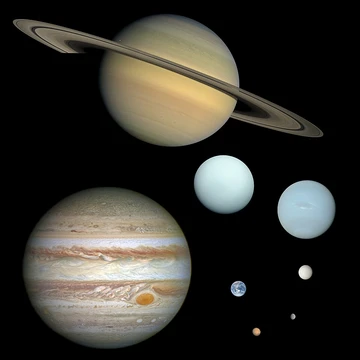
The Solar System, with Earth and seven other planets orbiting the Sun, is one example of a planetary system.[1] A star or star system, along with any non-stellar bodies like planets, dwarf planets, asteroids, and comets that are gravitationally bound to it and orbit it, constitutes a planetary system.[2] One or more stars, brown dwarfs, or stellar remnants being orbited by a system of planets is what the International Astronomical Union defines as a planetary system.[3]
Key facts and history
In the 16th century, Giordano Bruno suggested that fixed stars are similar to the Sun and are accompanied by planets.[4] Isaac Newton mentioned the same possibility in the "General Scholium" of his Principia, comparing the Sun's planets to other star systems.[5] Most known exoplanets orbit main-sequence stars of spectral categories F, G, or K, partly because search programs have focused on such stars.[6] The Kepler space telescope discovered several tens of planets around red dwarfs using the transit method.[6]
Exoplanetary systems can feature Hot Jupiters, Hot Neptunes, and Super-Earths, which are very different from Solar System planets.[7] Exocomets were initially observed in 1987, with the young A-type main-sequence star Beta Pictoris being the host.[8]
What the research sources say
The same NASA release noted that the conventional wisdom that planetary systems remain co-planar is not always the case.[9] A 2011 article on Kepler discoveries described a system, KOI 730, that appears to have two planets sharing the same orbit.[10] The blog "planetplanet" from 2021 estimated that only about 1 percent of systems have as many planets as our Solar System.[11] That blog also stated that gas giants with masses similar to Jupiter's are found around approximately 1 in 10 Sun-like stars.[11]
A 2010 NASA press release stated that, according to data from the Hubble Space Telescope and ground-based telescopes, the orbital planes of planets c and d in the Upsilon Andromedae system are tilted 30 degrees relative to each other.[9]
References
- Wikipedia, "Planetary system" (CC BY-SA 4.0), which cites: p. 382, Collins Dictionary of Astronomy.; "A dictionary of astronomy", Oxford University Press, 2003, p. 420 (original not read by us) en.wikipedia.org
- Wikipedia, "Planetary system" (CC BY-SA 4.0), which cites: Darling, "The universal book of astronomy: from the Andromeda Galaxy to the zone of avoidance", Wiley, 2004, p. 394; "Collins dictionary astronomy", HarperCollins, 2000, p. 314 (we also read that source) en.wikipedia.org
- Wikipedia, "Planetary system" (CC BY-SA 4.0), which cites: "IAU Office of Astronomy for Education", IAU Office of Astronomy for Education; "Solar System: Facts", NASA Science, November 13, 2017 (original not read by us) en.wikipedia.org
- Wikipedia, "Planetary system" (CC BY-SA 4.0), which cites: "Cosmos" in The New Encyclopædia Britannica (15th edition, Chicago, 1991) 16:787:2a. "For his advocacy of an infinity of suns and earths, he was burned at the s (original not read by us) en.wikipedia.org
- Wikipedia, "Planetary system" (CC BY-SA 4.0), which cites: Newton, "The Principia: A New Translation and Guide", University of California Press, 1999, p. 940 (we also read that source) en.wikipedia.org
- Wikipedia, "Planetary system" (CC BY-SA 4.0), which cites: Andrew Cumming, "The Keck Planet Search: Detectability and the Minimum Mass and Orbital Period Distribution of Extrasolar Planets", Publications of the Astronomical Society of the Pacific, 2008, p. 531–554; Bonfils, "The HARPS search for southern extra-solar planets VI: A Neptune-mass planet around the nearby M dwarf Gl 581", Astronomy and Astrophysics, 2005, p. L15–L18 (original not read by us) en.wikipedia.org
- Wikipedia, "Planetary system" (CC BY-SA 4.0), which cites: "The Different Kinds of Exoplanets You Meet in the Milky Way", The Planetary Society; Fortney, "Hot Jupiters: Origins, Structure, Atmospheres", Journal of Geophysical Research: Planets, 2021 (original not read by us) en.wikipedia.org
- Wikipedia, "Planetary system" (CC BY-SA 4.0), which cites: "The Beta Pictoris circumstellar disk. V - Time variations of the CA II-K line", Astronomy and Astrophysics, 1987, p. 267–270; Beust, "The Beta Pictoris circumstellar disk. X - Numerical simulations of infalling evaporating bodies", Astronomy and Astrophysics, 1990, p. 202–216 (original not read by us) en.wikipedia.org
- "NASA – Out of Whack Planetary System Offers Clues to a Disturbed Past", Nasa.gov, 2010-05-25. facts only, no text reused. nasa.gov
- Emspak, "Kepler Finds Bizarre Systems", International Business Times, March 2, 2011. facts only, no text reused. ibtimes.com
- "We're in the cosmic 1% – planetplanet", 2021-02-08. facts only, no text reused. planetplanet.net
Each numbered sentence above was checked against the source it cites before publication. Sentences citing Wikipedia adapt text from the English Wikipedia article Planetary system (contributors), used under CC BY-SA 4.0; this entry is available under the same licence. Other sources were used for facts only; no text or images are copied from them.
More in Planets & Stellar Astronomy
Sources
Compiled from Wikipedia and the sources listed below. Text from Wikipedia is available under CC BY-SA 4.0; this entry is adapted from it.
- Wikipedia: Planetary system (CC BY-SA 4.0).
- Word definitions: the Codexery glossary, each quoted from its Wikipedia article.
Spotted an error? Know more?
Reader corrections go straight into our review queue. Suggest an edit · How this site is sourced