Giant-impact hypothesis
Leading hypothesis for the Moon's formation via a giant collision.
Last updated
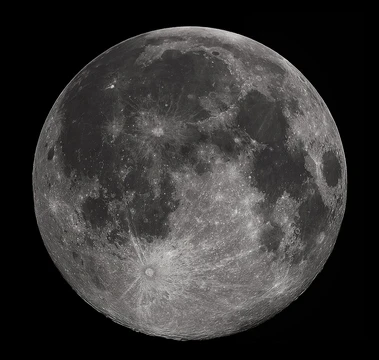
The giant-impact hypothesis proposes that the Moon formed from debris ejected when a Mars-sized protoplanet collided with the early Earth roughly 4.5 billion years ago. It is the leading explanation among astronomers for the Moon's origin, supported by evidence such as identical isotopic ratios between lunar and terrestrial rocks and the Moon's small iron core.
Quick Facts
- First proposed
- 1946
- Proposed by
- Reginald Daly
- Impactor name
- Theia
- Estimated impact time
- 4.4 to 4.45 billion years ago
- Impact velocity at infinity
- below 4 km/s
- Impact velocity at collision
- over 9.3 km/s
- Impact angle
- about 45°
Facts from the source article.
Basic model
Around 4.4 to 4.45 billion years ago, roughly a hundred million years after the solar system started taking shape, astronomers believe Earth was hit by a body called Theia. The collision was not exceptionally violent by cosmic standards, and it happened at a slant, with Earth already nearly fully formed. Computer models of this late impact suggest Theia was moving slower than 4 kilometers per second when far from Earth, then sped up to over 9.3 kilometers per second by the moment of impact, hitting at an angle of about 45 degrees.
But oxygen isotopes in Moon rocks point to a much steeper angle, indicating the two bodies mixed thoroughly. Theia’s iron core likely sank into Earth’s core, while most of its mantle merged with Earth’s.
A good chunk of mantle from both worlds was thrown into orbit around Earth or, if moving fast enough, sent into its own path around the Sun. The orbiting debris is thought to have built the Moon in three stages. First, material outside Earth’s Roche limit clumped together, trapping the inner disk inside that boundary.
Over tens of years, the inner disk slowly spread back out, pushing outer clumps through gravitational tugs. After a few decades, the disk expanded past the Roche limit, creating new objects that kept adding to the Moon until the inner disk ran out of material a few hundred years later. Some of the stuff in stable orbits later crashed into the Earth-Moon system. Simulations estimate that about 20 percent of Theia’s mass became a ring of debris around Earth, and roughly half of that ring eventually formed the Moon.
Earth picked up a lot of spin and extra mass from the crash. No matter how fast or tilted Earth was spinning before, afterward a day lasted only about five hours, and the Moon’s orbit lined up with Earth’s equator.
Composition
In 2001, a team at the Carnegie Institution of Washington reported that Apollo program rocks carried an isotopic signature identical to Earth rocks, differing from almost all other Solar System bodies. A 2014 German team found a slight but statistically significant difference, suggesting Theia may have formed near Earth. The close compositional similarity is explained by the standard giant-impact hypothesis, as two bodies with such identical signatures prior to collision would be extremely unlikely.
In 2007, California Institute of Technology researchers proposed that after the impact, while Earth and the proto-lunar disc were molten and vaporised, they were connected by a common silicate vapor atmosphere and homogenised by convective stirring. This equilibration scenario requires the proto-lunar disc to endure for about 100 years. Research in 2012 suggested Theia collided directly with Earth at a higher velocity, totally destroying Theia and allowing a composition of up to 50% water ice.
Evidence
Indirect evidence for the giant impact scenario comes from Apollo Moon rocks, which show oxygen isotope ratios nearly identical to Earth's. The highly anorthositic composition of the lunar crust and the presence of KREEP-rich samples suggest a large portion of the Moon was once molten, consistent with a giant impact supplying the energy for a magma ocean. The Moon's small iron-rich core, with a radius less than about 25% of the Moon's radius compared to about 50% for other terrestrial bodies, aligns with impact conditions where the core of the impactor accretes to Earth.
Earth's high density among Solar System planets is explained by absorption of the impactor's core. Comparison of zinc isotopic composition in lunar samples with Earth and Mars rocks provides further evidence: Moon rocks contain more heavy zinc isotopes and less total zinc, consistent with evaporation during the giant impact. Collisions between ejecta escaping Earth's gravity and asteroids have left impact heating signatures in stony meteorites, used to date the impact event to 4.47 billion years ago.
Difficulties
The giant-impact hypothesis has unresolved difficulties. It implies a surface magma ocean would have formed after the impact, yet there is no evidence Earth ever had such an ocean, and material likely exists that was never processed in one. Compositional inconsistencies remain: the ratios of the Moon's volatile elements are not explained by the hypothesis, and the presence of volatiles such as water trapped in lunar basalts and carbon emissions from the lunar surface is difficult to reconcile with a high-temperature impact.
The Moon's iron oxide content of 13%, intermediate between Mars's 18% and the terrestrial mantle's 8%, rules out most of the proto-lunar material coming from Earth's mantle. If the bulk of the material came from the impactor, the Moon should be enriched in siderophilic elements, but it is deficient in them. The Moon's oxygen isotopic ratios are essentially identical to Earth's, whereas a separate protoplanet Theia would likely have had a different signature.
The Moon's titanium isotope ratio (50Ti/47Ti) is so close to Earth's (within 4 ppm) that little of the colliding body's mass could have been part of the Moon. If such an impact occurred, other inner planets may have experienced comparable events; a moon formed around Venus would have been unlikely to escape, possibly due to a second collision or tidal forces from the Sun.
Did You Know?
- The name Theia comes from the Greek Titan who was the mother of Selene, the goddess of the Moon.
- In 1898, George Darwin suggested Earth and the Moon were once a single body, with the Moon spun off by centrifugal forces.
- Theia is hypothesized to have orbited in the L4 or L5 Lagrangian point relative to Earth, similar to a trojan asteroid.
More in Lunar Science
Sources
Compiled from Wikipedia and the sources listed below. Text from Wikipedia is available under CC BY-SA 4.0; this entry is adapted from it.
- Wikipedia: Giant-impact hypothesis (CC BY-SA 4.0).
Spotted an error? Know more?
Reader corrections go straight into our review queue. Suggest an edit · How this site is sourced