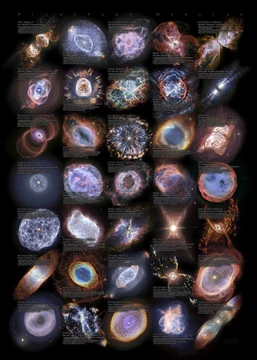
DdDm 1
The only known oxygen-rich halo planetary nebula.

DdDm 1 (Dolidze-Dzimselejsvili 1) is a planetary nebula located in the galactic halo, discovered in 1966 by Soviet astronomers Dolidze M. V. and Dzimselejsvili G. N. It is notable as the only known oxygen-rich halo planetary nebula, exhibiting a blue, stellar-like appearance with an elliptical gas and dust structure. Its metal-deficient and highly carbon-poor composition distinguishes it from other halo planetary nebulae.
- Discovery year
- 1966
- Discoverers
- Dolidze M. V., Dzimselejsvili G. N.
- Location
- galactic halo
- Heliocentric radial velocity
- -309.14±1.22 km/s
- Central star effective temperature
- 38,000–55,000 K
- Central star luminosity
- 1000–3000 L☉
- Progenitor initial mass
- ~1 M☉
Lore & Background
DdDm 1 was discovered in 1966 by Soviet astronomers Dolidze M. V. and Dzimselejsvili G. N., and its name stands for Dolidze-Dzimselejsvili 1. It is a rare field halo planetary nebula, differing from other halo PNe by being metal-deficient and highly carbon-poor. The nebula exhibits emission lines including O III, O II, O I, and Fe III, with the Fe III 5270 Å emission being more compact (major-axis radius 0.61 arcsec) than the O III 4959 Å emission (1.03 arcsec). Abundances from recombination lines are larger than those from forbidden lines by a factor of 10 to 100. The nebula is enriched in nitrogen, oxygen, sulfur, neon, and argon.
Reader's Guide
DdDm 1 holds significant importance as the only known oxygen-rich halo planetary nebula, suggesting it experienced neither efficient third dredge-up events nor hot bottom burning during its asymptotic giant branch phase. Its high heliocentric radial velocity of approximately -310 km/s confirms its membership in the galactic halo population rather than the galactic disc, though some studies suggest it could be extragalactic. The central star has an effective temperature of 38,000–55,000 K and a luminosity of 1000–3000 L☉, corresponding to an initial mass of about 1 M☉. However, if the progenitor evolved from a single star with an initial mass of ~0.9 M☉—typical of halo stars—its evolutionary timescale would be too slow to produce a planetary nebula, and such a star should end as a white dwarf of ~0.56 M☉. This tension underscores the nebula's unique status and the challenges in modeling its evolution.
Did You Know?
- Its Fe III 5270 Å emission is more compact than its O III 4959 Å emission, with radii of 0.61 and 1.03 arcsec respectively.
- The nebula's heliocentric radial velocity is -309.14±1.22 km/s, confirming its halo population membership.
- Abundances from recombination lines are 10 to 100 times larger than those from forbidden lines.
Frequently Asked Questions
What is DdDm 1 and who found it?
DdDm 1, also called Dolidze-Dzimselejsvili 1, is a planetary nebula residing in the Milky Way's galactic halo. It was identified in 1966 by Soviet astronomers M. V. Dolidze and G. N. Dzimselejsvili.
Why is DdDm 1 considered so special among halo nebulae?
It holds the distinction of being the sole confirmed oxygen-rich planetary nebula found in the galactic halo. That single trait sets it apart from every other known halo PN and makes it a key object for studying halo stellar evolution.
What does DdDm 1 actually look like through a telescope?
Observers describe it as having a strikingly blue, star-like glow rather than the typical colorful ring shapes of brighter PNe. Its gas and dust are arranged in a distinctly elliptical outline.
How does DdDm 1's chemical makeup differ from other halo planetary nebulae?
Its spectrum reveals a composition that is both metal-poor and extremely low in carbon. This combination is unusual for a halo PN and points to a progenitor star with a very different nucleosynthetic history than its halo neighbors.
What do we know about the central star of DdDm 1?
The white dwarf at its core is estimated to have an effective temperature between roughly 38,000 K and 55,000 K, making it a hot, blue-white emitter. Its luminosity is estimated at around 1,000 to 3,000 times that of the Sun.
More in Planetary Nebulae 1-24
Spotted an error? Know more?
Reader corrections go straight into our review queue. Suggest an edit · How this site is sourced