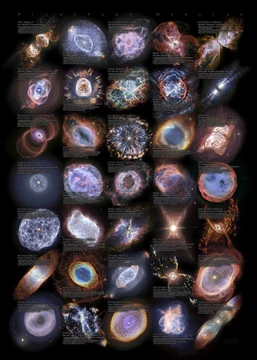
Humason 1-2
Bipolar hourglass nebula with high-velocity knots and uncertain distance.

Humason 1-2 (Hu 1-2) is a bipolar hourglass shaped planetary nebula discovered by astronomer Milton L. Humason on October 11, 1920. It is notable for its uncertain distance, Type I classification, and the presence of high-velocity bipolar knots with distinct emission line characteristics.
- Discoverer
- Milton L. Humason
- Discovery date
- October 11, 1920
- Type
- bipolar hourglass shaped planetary nebula
- Distance lower limit
- ~1.17 kpc
- Galactocentric distance estimate
- ~9 kpc
- Height above galactic plane
- 8.8°
- Polar expansion velocity
- ~150 km/s
- Lower limit expansion age
- ≤1100 yr
Lore & Background
Humason 1-2 (Hu 1-2) was discovered by astronomer Milton L. Humason on October 11, 1920. Its distance has never been confirmed; one study gave a lower limit of ~1.17 kpc, while the galactocentric distance might be ~9 kpc, estimated from ~3.5 kpc. The nebula lies 8.8° above the galactic plane, corresponding to 150-300 pc.
A study identified two bipolar knots moving at velocities greater than 340 km/s. These knots contain N II and O III emission lines; the N II line appears larger farther from the central star than the O III line. The N II emission implies shock-excitation, while the O III emissions are more like irradiation. The kinematical structure of the faint bipolar lobes remains completely unknown, but the lobes have an inclination of ≤10° and a polar expansion velocity of ~150 km/s, resulting in a lower-limit expansion age of ≤1100 years.
The high abundance of He/H and N/O ratios in the bright inner regions suggest Hu 1-2 is a Type I PN, though analysis found abundances of α elements. The nebula could be a halo PN, but this is unconfirmed. It is enriched in α elements, especially hydrogen and helium. The NW structure/knot shows O II/O III and He II/Hα ratios different from those typically seen in low-ionization structures and outflows of other PNe.
Reader's Guide
Humason 1-2 is significant as a Type I planetary nebula, indicating a massive intermediate-mass progenitor star, though the α element abundances may also result from a metal-poor progenitor. Its uncertain distance and potential halo status make it a subject of ongoing study. The high-velocity bipolar knots (over 340 km/s) with distinct shock-excited N II and irradiated O III emissions provide insight into the dynamics and excitation mechanisms within bipolar nebulae. The unknown kinematical structure of the faint lobes and the low inclination (≤10°) highlight the complexity of its morphology. The nebula's enrichment in α elements, particularly hydrogen and helium, and its unusual emission line ratios in the NW knot distinguish it from typical low-ionization structures in other planetary nebulae. Its legacy lies in challenging models of PN formation and evolution, especially regarding progenitor mass and metal content.
Did You Know?
- Hu 1-2 was discovered by Milton L. Humason on October 11, 1920.
- Two bipolar knots in Hu 1-2 move at velocities greater than 340 km/s.
- The N II emission in the knots implies shock-excitation, while O III emissions are more like irradiation.
- The nebula's expansion age has a lower limit of ≤1100 years.
Frequently Asked Questions
What is Humason 1-2?
Humason 1-2 (abbreviated Hu 1-2) is a planetary nebula with a distinctive bipolar hourglass morphology, first identified by Milton L. Humason in 1920. It is classified as a Type I object and is recognized for its fast-moving bipolar knots that show unique emission-line signatures.
Who discovered Humason 1-2 and when?
Astronomer Milton L. Humason first recorded this nebula on October 11, 1920. The object carries his name as a direct result of that initial identification.
What does Humason 1-2 look like?
It presents as a bipolar hourglass-shaped nebula, meaning its ionized gas extends in two opposing lobes along a central axis. Within those lobes, astronomers have detected high-velocity knots that emit light with characteristic spectral-line patterns distinct from the surrounding material.
How far away is Humason 1-2?
The precise distance to this nebula remains unresolved, though estimates set its lower bound at roughly 1.17 kiloparsecs. It is thought to sit about 9 kiloparsecs from the galactic center and approximately 8.8 degrees above the galactic plane.
Why is Humason 1-2 interesting to researchers?
Its high-velocity bipolar knots display emission-line properties that set them apart from typical planetary nebula outflows, making the object a useful case study for understanding fast gas dynamics. Combined with its still-uncertain distance, it remains a challenging and intriguing target for follow-up observations.
More in Planetary Nebulae 1-24
Spotted an error? Know more?
Reader corrections go straight into our review queue. Suggest an edit · How this site is sourced