Daniel David Palmer
Creator of chiropractic and spiritualist magnetic healer
Last updated

Dillan Payne · CC BY-SA 4.0
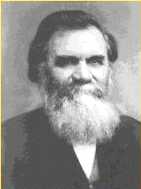
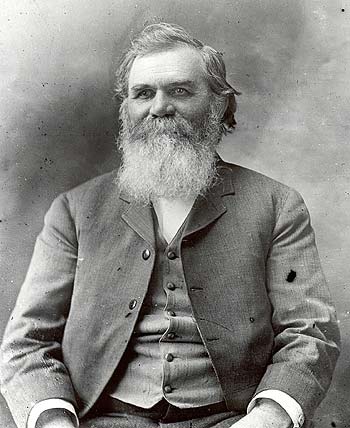
Daniel David Palmer (March 7, 1845 – October 20, 1913) was born in Canada West and later moved to the United States, where he became a spiritualist and activist. He is most famous for founding chiropractic.
Founding of chiropractic
Palmer also strongly supported magnetic healing, a form of alternative medicine considered pseudoscientific, and he rejected mainstream medical practices like vaccination. He believed the human body could heal itself through the nervous system, and that illness in any organ was due to a lack of normal "nerve supply" caused by what he called a "spinal misalignment" or subluxation. For Palmer, chiropractic was a method of realigning the spine to restore that supply.
Early life
Palmer grew up in the hamlet of Brown's Corners (later Audley) in Pickering Township, now part of Ajax, Ontario. His parents were Thomas Palmer and Katherine McVay, and his great-great-grandparents came from the United States. He attended Audley School until age 11 and was later raised in Port Perry. At 20, he moved to the United States with his family.
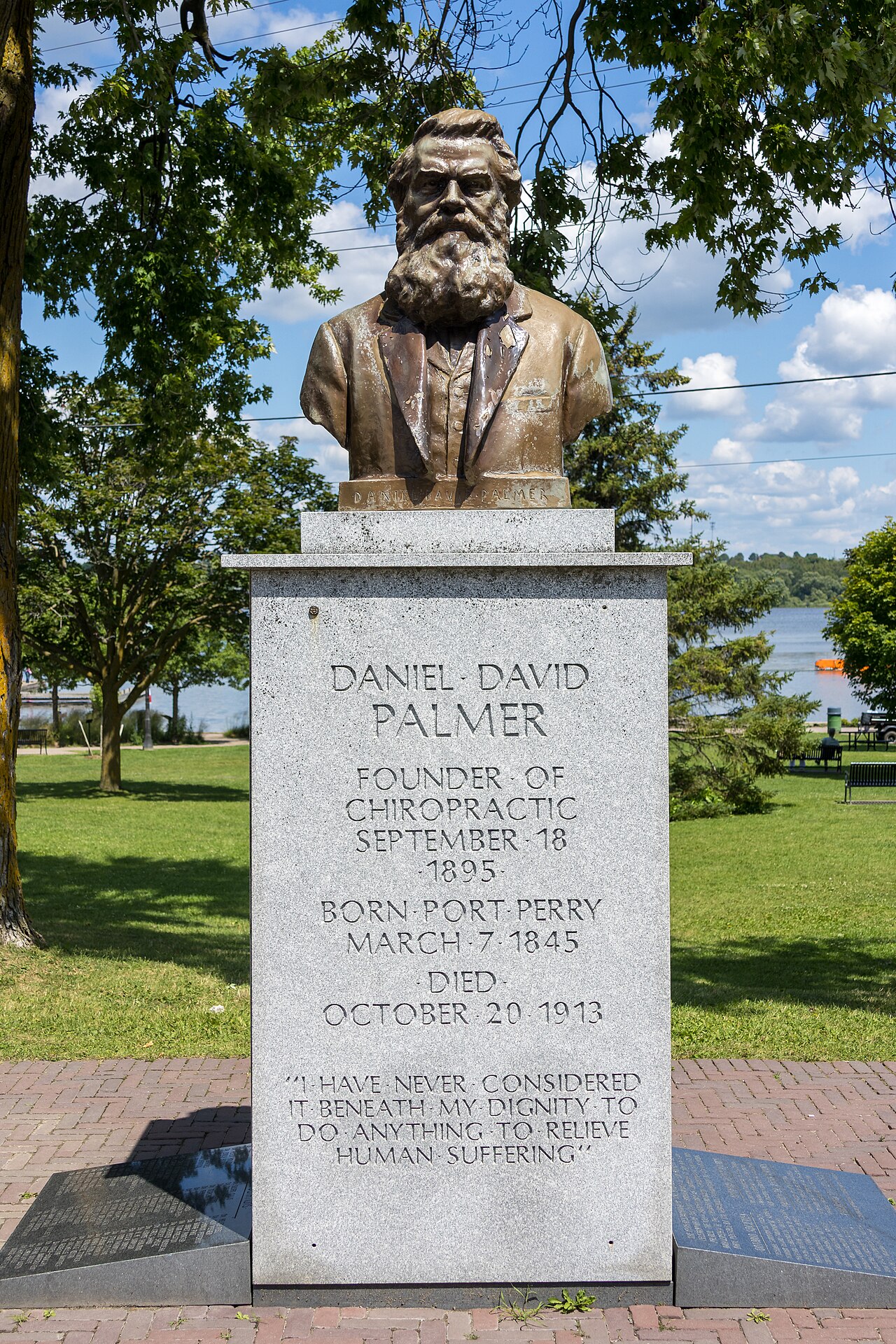
Over the years, he worked as a beekeeper, schoolteacher, and grocery store owner, and he took an interest in health philosophies of the time, including magnetic healing and spiritualism. By 1870, he was likely studying metaphysics. He began practicing magnetic healing in the mid-1880s in Burlington and Davenport, Iowa.
Magnetic healer
The founding of chiropractic came in 1895, when Palmer was working as a magnetic healer in Davenport. The building’s janitor, Harvey Lillard, had a severe hearing impairment.
Palmer noticed a lump on Lillard’s back and suggested it might be connected. He manipulated Lillard’s back and later claimed the man’s hearing was restored—a key story in chiropractic history. However, Lillard’s daughter recalled a different version: Palmer overheard her father telling a joke, slapped him on the back after the punchline, and Lillard mentioned his hearing improved days later, inspiring Palmer to explore spinal manipulation as a cure.
In 1896, Palmer’s early descriptions of chiropractic philosophy closely resembled Andrew Taylor Still’s osteopathy, established a decade earlier. Both viewed the body as a "machine" that could be manipulated for drugless healing. Both used spinal manipulation to treat joint problems and improve health. Chiropractors called the manipulable issue a "vertebral subluxation," claiming it interfered with the nervous system; osteopaths called it "somatic dysfunction," believing it affected circulation.
Palmer distinguished his method by using short-lever techniques on the spinous and transverse processes. Osteopaths soon campaigned against chiropractic as a bastardized version of their field and sought licensure to separate the two. Although Palmer initially denied training under osteopathy founder A. T. Still, in 1899 he wrote that he had taken a costly course in osteopathy, which gave him confidence, and stated, "Chiropractic is osteopathy gone to seed." His theory held that altered nerve flow caused all disease, with misaligned vertebrae disrupting that flow. He claimed that a subluxated vertebra was the cause of 95 percent of all diseases, with the remaining 5 percent from other displaced joints.
Spread of chiropractic
Palmer began teaching his methods. In 1897, he founded the Palmer School and Cure in Davenport, later renamed Palmer College of Chiropractic. His early students included his son, B.J. Palmer.
In 1906, Iowa prosecuted Palmer under a new medical arts law for practicing medicine without a license. He chose jail over paying the fine, spending 17 days incarcerated before paying it. Soon after, he sold the school to his son and moved to the western United States, where he helped establish chiropractic schools in Oklahoma, California, and Oregon.
As an active spiritualist, Palmer said he "received chiropractic from the other world" from a deceased physician named Dr. Jim Atkinson. His son B.J. Palmer noted that his father often attended the Mississippi Valley Spiritualists Camp Meeting, where he first claimed to receive messages from Dr. Atkinson on chiropractic principles. Palmer wrote that the knowledge and philosophy given by this spiritual being appealed to his reason, and that he obtained explanations of physical phenomena from an intelligence in the spiritual realm.
Last updated 2026-09-28 from the source article.
Lore & Background
Palmer believed the human body had ample natural healing power transmitted through the nervous system. He suggested that if any one organ was affected by an illness, it merely must not be receiving its normal 'nerve supply' which he dubbed a 'spinal misalignment', or subluxation. He saw chiropractic as a form of realigning to reestablish the supply. Palmer was born in the hamlet of Brown's Corners (later Audley) of Pickering Township, in what is now Ajax, Ontario.
He received formal education until the age of 11 years, at the Audley School, and was subsequently raised in Port Perry. At age 20, he moved to the United States with his family. Palmer held various jobs, including beekeeper, schoolteacher, and grocery store owner, and had an interest in the various health philosophies of his day, including magnetic healing and spiritualism. In 1870, Palmer was probably a student of metaphysics.
Palmer practiced magnetic healing beginning in the mid-1880s in Burlington and Davenport, Iowa. In 1895, Palmer was practicing magnetic healing from an office in Davenport when he encountered the building's janitor, Harvey Lillard. Lillard had a severe hearing impairment, and Palmer suggested that a noticeable lump on his back might be linked to it. Palmer then manipulated Lillard's back and claimed to have successfully restored his hearing.
This account of how the first adjustment occurred would later be countered by Lillard's daughter, who recalls a different interaction. She claims that Palmer overheard her father telling a joke just outside his office and joined the group to catch the end of it. Upon hearing the punchline, Palmer heartily slapped Lillard on the back. A few days later, Lillard remarked that his hearing had improved since the incident, inspiring Palmer to pursue vertebral manipulation as a means to cure illness.
In 1896, D. D. Palmer's first descriptions of underlying chiropractic philosophy were strikingly similar to Andrew Taylor Still's principles of osteopathy established a decade earlier. Both described the body as a 'machine' whose parts could be manipulated to produce a drugless cure. Both professions advocated using spinal manipulation to treat joint dysfunction and enhance health. Chiropractors referred to this manipulable 'lesion' as 'vertebral subluxation,' which they claimed interfered with the nervous system.
Did You Know?
- Palmer was born in Pickering Township, Canada West, and emigrated to the United States in 1865.
- He was married six times.
- The official cause of his death was typhoid fever, though some believe it was from injuries sustained in a parade incident.
The Act of Founding
Within the broad catalog of figures who have shaped alternative medicine, Daniel Palmer occupies a singular and foundational position: he is identified as the founder of chiropractic. Unlike those credited merely as promoters or practitioners, Palmer's designation as 'founder' signals that chiropractic is understood to have originated from his specific initiative.
He stands in the same categorical company as Samuel Hahnemann, who founded homeopathy, and Andrew Taylor Still, who founded osteopathy, and Benedict Lust, who established naturopathic medicine in the United States. Each of these entries represents a person whose name is inextricably bound to the very existence of a discipline. Palmer's entry, though brief in the source, carries the weight of that origin: without the act of founding attributed to him, chiropractic would not appear in the landscape of alternative medicine at all.
Frequently Asked Questions
What did Daniel David Palmer create?
Palmer founded chiropractic, a practice centered on manual spinal adjustment that he developed in the late 19th century. His work laid the groundwork for what eventually grew into one of the largest alternative-health movements in the Western world.
What other beliefs and practices was Daniel David Palmer associated with?
Beyond chiropractic, Palmer was a committed spiritualist and an advocate of magnetic healing, both of which are classified as pseudoscientific alternative medicine. He also publicly opposed mainstream medical interventions, most notably vaccination.
More in Pioneers Of Alternative Medicine And Pseudoscience
Related in Pioneers Of Alternative Medicine And Pseudoscience
Links follow this subject's own source article.
Sources
Compiled from Wikipedia and the sources listed below. Text from Wikipedia is available under CC BY-SA 4.0; this entry is adapted from it.
- Wikipedia: Daniel David Palmer (CC BY-SA 4.0).
- Word definitions: the Codexery glossary, each quoted from its Wikipedia article.
Spotted an error? Know more?
Reader corrections go straight into our review queue. Suggest an edit · How this site is sourced