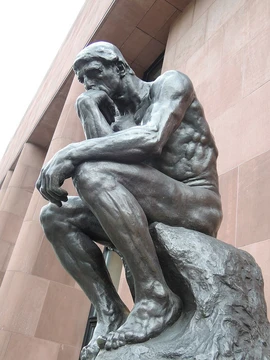
Gaston Bachelard
French philosopher who contributed to poetics and the philosophy of science.

Gaston Louis Pierre Bachelard (27 June 1884 – 16 October 1962) was a French thinker who worked in both poetics and the philosophy of science. He is known for introducing the ideas of the epistemological obstacle and the epistemological break. His work left a mark on later French philosophers like Michel Foucault, Louis Althusser, Dominique Lecourt, and Jacques Derrida, as well as sociologists Pierre Bourdieu and Bruno Latour.
Bachelard was born in Bar-sur-Aube, France, in 1884. Before turning to philosophy, he worked as a postal clerk and studied physics and chemistry. He earned his doctorate in 1927 with two theses: a main one on approximate knowledge, supervised by Abel Rey, and a complementary one on thermal propagation in solids, supervised by Léon Brunschvicg.
His early career included a brief teaching stint at the college of Sézanne from 1902 to 1903, but he left to consider telegraphy. After military discharge in March 1919, he found himself unemployed before landing a job that October as a physics and chemistry professor at the college of Bar-sur-Aube. At age 36, he began an unexpected shift into philosophy. He obtained his doctorate in 1927, then became a lecturer at the Faculty of Letters of Dijon that October, though he kept teaching at Bar-sur-Aube until 1930. He even ran in the 1929 municipal elections to support a college-for-all project. He accepted a professorship at the University of Burgundy once his daughter Suzanne entered secondary school. From 1930 to 1940 he taught at the University of Dijon, then was appointed chair in the history and philosophy of science at the University of Paris. He was made a Knight of the Legion of Honor on 25 August 1937. He held the Sorbonne chair from 1940 to 1954, succeeding Abel Rey as director of the Institute of History and Philosophy of Science and Technology. In 1958, he became a member of the Royal Academy of Science, Letters and Fine Arts of Belgium.
Bachelard married schoolteacher Jeanne Rossi in 1914. Their daughter Suzanne was born on 18 October that year. Jeanne died in June 1920, leaving Bachelard to raise Suzanne alone. Despite the era’s gender expectations, he actively supported her academic development, aiming to make her a scholar. Suzanne went on to become a mathematician and philosopher. Bachelard died in Paris in 1962.
For Bachelard, the scientific object is something that must be constructed, not simply given—a view that set him apart from positivist science. He saw information as always in the process of being built. Empiricism and rationalism, in his view, were not opposites but complementary; studying both a priori and a posteriori reasoning, or reason and dialectic, was essential to scientific research.
In works like *The New Scientific Spirit* (1934) and *The Formation of the Scientific Mind* (1938), Bachelard treated the history and philosophy of science as a kind of psychoanalysis of the scientific mind. He showed how certain mental patterns could block scientific progress, coining the term “epistemological obstacle.” One job of epistemology, he argued, was to clarify these patterns so scientists could overcome them. Another was to give human reason a more aggressive, restless function.
Bachelard rejected Auguste Comte’s positivism, which saw science as a steady, continuous march forward. Developments like Einstein’s theory of relativity, Bachelard argued, proved that scientific history is full of breaks and discontinuities. The concept of the “epistemological break” highlights this discontinuity, though the term itself was rarely used by Bachelard and became famous through Louis Althusser. New theories, Bachelard showed, absorb old ones into new frameworks, changing the meaning of concepts along the way.
- born
- 27 June 1884
- died
- 16 October 1962
- field
- Philosophy
- nationality
- French
- known_for
- Epistemological obstacle, epistemological break, philosophy of science, poetics
Verified Timeline
Lore & Background
Bachelard was born in Bar-sur-Aube, France in 1884. He was a postal clerk in Bar-sur-Aube, and then studied physics and chemistry before finally becoming interested in philosophy. To obtain his doctorate in 1927, he wrote two theses: the main one, Essai sur la connaissance approchée, under the direction of Abel Rey, and the complementary one, Étude sur l'évolution d'un problème de physique: la propagation thermique dans les solides, supervised by Léon Brunschvicg. He first taught from 1902 to 1903 at the college of Sézanne, but turned away from teaching to consider a career in telegraphy. Discharged in March 1919 and unemployed, Bachelard searched and obtained a job in October as a professor of physics and chemistry at the college of Bar-sur-Aube. At the age of thirty-six he began a completely unexpected philosophical career. Starting decisively in 1922, he acquired the title of Doctor of Letters at the Sorbonne in 1927. He became a lecturer at the Faculty of Letters of Dijon from October 1927, but remained at the college of Bar-sur-Aube until 1930. From 1930 to 1940 he was a professor at the University of Dijon and then was appointed chair in the history and philosophy of science at the University of Paris. On 25 August 1937 he was made a Knight of the Legion of Honor. He became a professor at the Sorbonne from 1940 to 1954, holding the chair of the history and philosophy of science, where he succeeded Abel Rey. In 1958, he became a member of the Royal Academy of Science, Letters and Fine Arts of Belgium. Bachelard married Jeanne Rossi, a schoolteacher, in 1914. Jeanne died in June 1920, and Bachelard raised his daughter alone. He wanted to make his daughter, Suzanne, a scholar. Suzanne became a mathematician and philosopher involved in phenomenological and epistemological research of high standing. In 1962, he died in Paris.
Reader's Guide
Bachelard's studies of the history and philosophy of science in such works as Le nouvel esprit scientifique (1934) and La formation de l'esprit scientifique (1938) were based on his vision of historical epistemology as a kind of psychoanalysis of the scientific mind. He demonstrated how the progress of science could be blocked by certain types of mental patterns, creating the concept of epistemological obstacle. He was critical of Auguste Comte's positivism, which considered science as a continual progress. To Bachelard, scientific developments such as Einstein's theory of relativity demonstrated the discontinuous nature of the history of sciences. Through his concept of 'epistemological break,' Bachelard underlined the discontinuity at work in the history of sciences. He showed that new theories integrated old theories in new paradigms, changing the sense of concepts (for instance, the concept of mass, used by Newton and Einstein in two different senses). One of his main theses in The New Scientific Mind was that modern sciences had replaced the classical ontology of the substance with an 'ontology of relations.' In non-Cartesian epistemology, there is no 'simple substance' as in Cartesianism, but only complex objects built by theories and experiments and continuously improved. These themes led Bachelard to support a sort of constructivist epistemology. In addition to epistemology, Bachelard's work deals with many other topics, including poetry, dreams, psychoanalysis, and the imagination. The Psychoanalysis of Fire (1938) and The Poetics of Space (1958) are among the most popular of his works.
Did You Know?
- Bachelard was a postal clerk in Bar-sur-Aube before studying physics and chemistry and finally becoming interested in philosophy.
- He obtained his doctorate in 1927 with two theses: one on knowledge directed by Abel Rey, and one on thermal propagation in solids supervised by Léon Brunschvicg.
- He began his philosophical career at age thirty-six, after working as a professor of physics and chemistry at the college of Bar-sur-Aube.
- Bachelard was made a Knight of the Legion of Honor on 25 August 1937.
- His daughter Suzanne became a mathematician and philosopher involved in phenomenological and epistemological research.
Frequently Asked Questions
Who is Gaston Bachelard?
Gaston Bachelard was a French philosopher active in the twentieth century, best remembered for reshaping how we think about the philosophy of science and the poetics of language.
What are Gaston Bachelard's key concepts?
He is most associated with the ideas of the epistemological obstacle and the epistemological break, which describe how entrenched assumptions block scientific progress and how genuine conceptual ruptures make new knowledge possible.
What field did Gaston Bachelard work in?
His work sat at the intersection of philosophy of science and poetics, meaning he examined both the logic of scientific discovery and the imaginative structures of literary language.
Who did Gaston Bachelard influence?
His thinking on epistemological rupture and obstacles was picked up by major post-war French thinkers including Michel Foucault, Louis Althusser, and Pierre Bourdieu, all of whom built on his framework in their own disciplines.
When was Gaston Bachelard born and when did he die?
He was born on 27 June 1884 in France and died on 16 October 1962, giving him a productive philosophical career spanning much of the early-to-mid twentieth century.
More in Philosophers 1-24
Spotted an error? Know more?
This is a living reference — every entry is fact-audited, and reader corrections feed straight into our audit queue. Suggest an edit · See this site's audit record