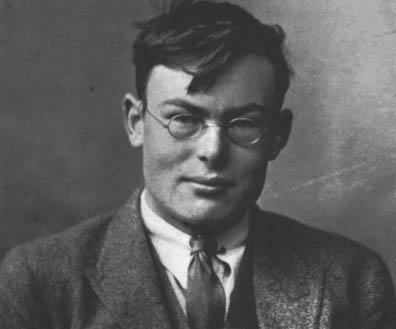
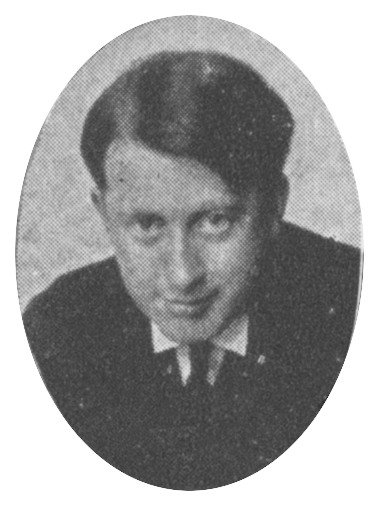
Frank P. Ramsey
British philosopher, mathematician, and economist who died at 26.

ELApro · CC BY-SA 4.0
Frank Plumpton Ramsey was a British philosopher, mathematician, and economist whose work reshaped all three disciplines, despite his life ending at 26. He was a close associate of Ludwig Wittgenstein, translating Wittgenstein’s *Tractatus Logico-Philosophicus* into English while still an undergraduate, and later helped convince Wittgenstein to resume his philosophical work and return to Cambridge. Ramsey was also, like Wittgenstein, a member of the Cambridge Apostles from 1921.
Born in Cambridge on 22 February 1903, Ramsey was the eldest of four children. His father, Arthur Stanley Ramsey, was a mathematician and President of Magdalene College; his mother was Mary Agnes Stanley. His brother Michael later became Archbishop of Canterbury, the only sibling to remain Christian. Ramsey attended Winchester College in 1915 before returning to Cambridge to study mathematics at Trinity College, where he became a student of John Maynard Keynes and an active Apostle. He earned his bachelor’s degree in 1923 with first-class distinction, finishing as Senior Wrangler. Described as easy-going, simple, and modest, Ramsey had wide-ranging interests: he read deeply in English literature, enjoyed classics, kept up with politics, and held left-leaning views sympathetic to the underdog.
In 1923, Ramsey became close to Geoffrey and Margaret Pyke, who were founding the Malting House School. They took him into their family, invited him on holiday, and asked him to be godfather to their son. Ramsey developed feelings for Margaret, which he expressed bluntly. She asked for time to consider, and the resulting tension contributed to depressive moods that led Ramsey to Vienna for psychoanalysis in early 1924. His analyst was Theodor Reik, a Freud disciple. While in Vienna, Ramsey visited Wittgenstein in Puchberg, befriended the Wittgenstein family, and toured A.S. Neill’s experimental school. That summer, he continued analysis with Reik in Dobbiaco. Returning to England in October 1924, he became a fellow of King’s College, Cambridge, with Keynes’s support. He also joined a Cambridge psychoanalysis group whose members included Arthur Tansley, Lionel Penrose, and James Strachey.
Ramsey married Lettice Baker in August 1925 in a Register Office, as he was a militant atheist. They had two daughters. After his death, Lettice opened a photography studio with Helen Muspratt. Despite his atheism, Ramsey was tolerant of his brother’s decision to become a priest. In 1926, he became a university lecturer in mathematics and later Director of Studies in Mathematics at King’s College. The Vienna Circle’s 1929 manifesto listed three of his publications in a bibliography of related authors.
Ramsey’s connection with Wittgenstein deepened early. After expressing interest in learning German, he mastered the language quickly—according to one account, in about a week—and at age 19 produced the first draft of the *Tractatus* translation. After graduating as Senior Wrangler in 1923, he reviewed the work for *Mind* and traveled to Austria to discuss it with Wittgenstein, then teaching in Puchberg. Over two weeks, they clarified difficulties in the text, and Wittgenstein made corrections and annotations that later appeared in the 1933 second edition. Ramsey and Keynes worked together to bring Wittgenstein back to Cambridge; once there, Ramsey served as his nominal supervisor.
- known_for
- Ramsey's theorem, translation of Wittgenstein's Tractatus, contributions to deci
Verified Timeline
Lore & Background
Ramsey was born on 22 February 1903 in Cambridge, where his father Arthur Stanley Ramsey was President of Magdalene College. He entered Winchester College in 1915 and later studied mathematics at Trinity College, Cambridge. There he became a student of John Maynard Keynes and an active member in the Apostles. In 1923, he received his bachelor's degree in mathematics, passing with first class with distinction and was named Senior Wrangler (top of his class). Easy-going, simple and modest, Ramsey had many interests; his brother attested he was 'interested in almost everything' and had 'a sort of left-wing caring-for-the-underdog kind of outlook about politics'. In 1923, he was befriended by Geoffrey and Margaret Pyke, and recorded in his diary a proposition to Margaret: 'Margaret will you fuck with me?' This contributed to depressive moods, and he travelled to Vienna for psychoanalysis with Theodor Reik. While in Vienna, he visited Wittgenstein at Puchberg. He married Lettice Baker in August 1925 in a Register Office, since Ramsey was a 'militant atheist'. The marriage produced two daughters. In 1926 he became a university lecturer in mathematics and later a Director of Studies in Mathematics at King's College. Suffering chronic liver problems, Ramsey developed jaundice after an abdominal operation and died on 19 January 1930 at Guy's Hospital in London at the age of 26. There is a suspicion that the cause might be an undiagnosed leptospirosis with which he could have become infected while swimming in the Cam. He is buried in the Parish of the Ascension Burial Ground in Cambridge.
Reader's Guide
Ramsey's significance lies in his contributions across philosophy, mathematics, and economics, all before his death at 26. In mathematical logic, his 1928 paper proved Ramsey's theorem, a minor lemma that became a foundational result in combinatorics, leading to the entire branch of Ramsey theory. He also solved a special case of the decision problem for first-order logic, now called the Bernays–Schönfinkel–Ramsey class. In philosophy, his translation of Wittgenstein's Tractatus and his critical conversations with Wittgenstein helped Wittgenstein realize 'grave mistakes' in that work, as acknowledged in Philosophical Investigations. Ramsey was also listed in the bibliography of the Vienna Circle manifesto (1929) as a closely related author. His notes and manuscripts are held at the University of Pittsburgh and King's College, Cambridge.
Did You Know?
- Ramsey mastered German 'in almost hardly over a week' according to I. A. Richards, enabling him to translate Wittgenstein's Tractatus at age 19.
- He was named Senior Wrangler (top of his class) in the Mathematical Tripos of 1923.
- Ramsey's analyst in Vienna was Theodor Reik, a disciple of Freud.
- He proposed to Margaret Pyke with the direct question 'Margaret will you fuck with me?' as recorded in his diary.
- There is a suspicion that Ramsey's death at 26 was caused by undiagnosed leptospirosis from swimming in the Cam.
Gallery

Frequently Asked Questions
Who is Frank P. Ramsey?
Frank Plumpton Ramsey was a British thinker who produced significant work across philosophy, mathematics, and economics. He is remembered as one of the most prodigiously gifted young minds of the early twentieth century.
What is Frank P. Ramsey's most famous contribution?
He is best known for Ramsey's theorem in combinatorics, which demonstrates that sufficiently large structures inevitably contain order. The result became a foundational pillar of combinatorial mathematics.
What was Frank P. Ramsey's connection to Wittgenstein?
As an undergraduate, Ramsey helped C. K. Ogden render Wittgenstein's Tractatus Logico-Philosophicus into English. He was also a close personal friend of Wittgenstein and played a key role in convincing him to return to philosophy and to Cambridge.
How did Frank P. Ramsey's life end?
Ramsey died in 1930 at just 26 years old, cutting short what many expected to be a long and influential career. His early death made his already substantial body of work all the more remarkable to his peers.
What did Frank P. Ramsey contribute to mathematical logic?
He made important contributions to the decision problem for first-order logic, addressing whether a general algorithm could determine the validity of logical formulas. His work in this area helped shape the direction of mathematical logic in the 1920s.
More in Philosophers 1-24
Spotted an error? Know more?
This is a living reference — every entry is fact-audited, and reader corrections feed straight into our audit queue. Suggest an edit · See this site's audit record