Ibn Khaldun
Last updated

Reda Kerbush · CC BY-SA 4.0
He is considered a major forerunner of historiography, sociology, economics, and demography studies.[1] Born on 27 May 1332 and dying on 17 March 1406, ʿAbd al-Raḥmān ibn Khaldūn was a scholar whose fields included history, philosophy, sociology, and Arab studies.[1] The Muqaddimah, his most famous work, was composed over a six-month period, according to his own autobiographical account.[2]
Life and work
Ibn Khaldun was born in Tunis into an upper-class Andalusian family of Yemeni Arab descent.[3] The Black Death killed both his parents when he was 17.[4] He began his political career at age 20 as a seal-bearer for the Tunisian ruler.[5] In 1384 the Egyptian Sultan made him professor of the Qamhiyyah Madrasah and Grand qadi of the Maliki school.[6]
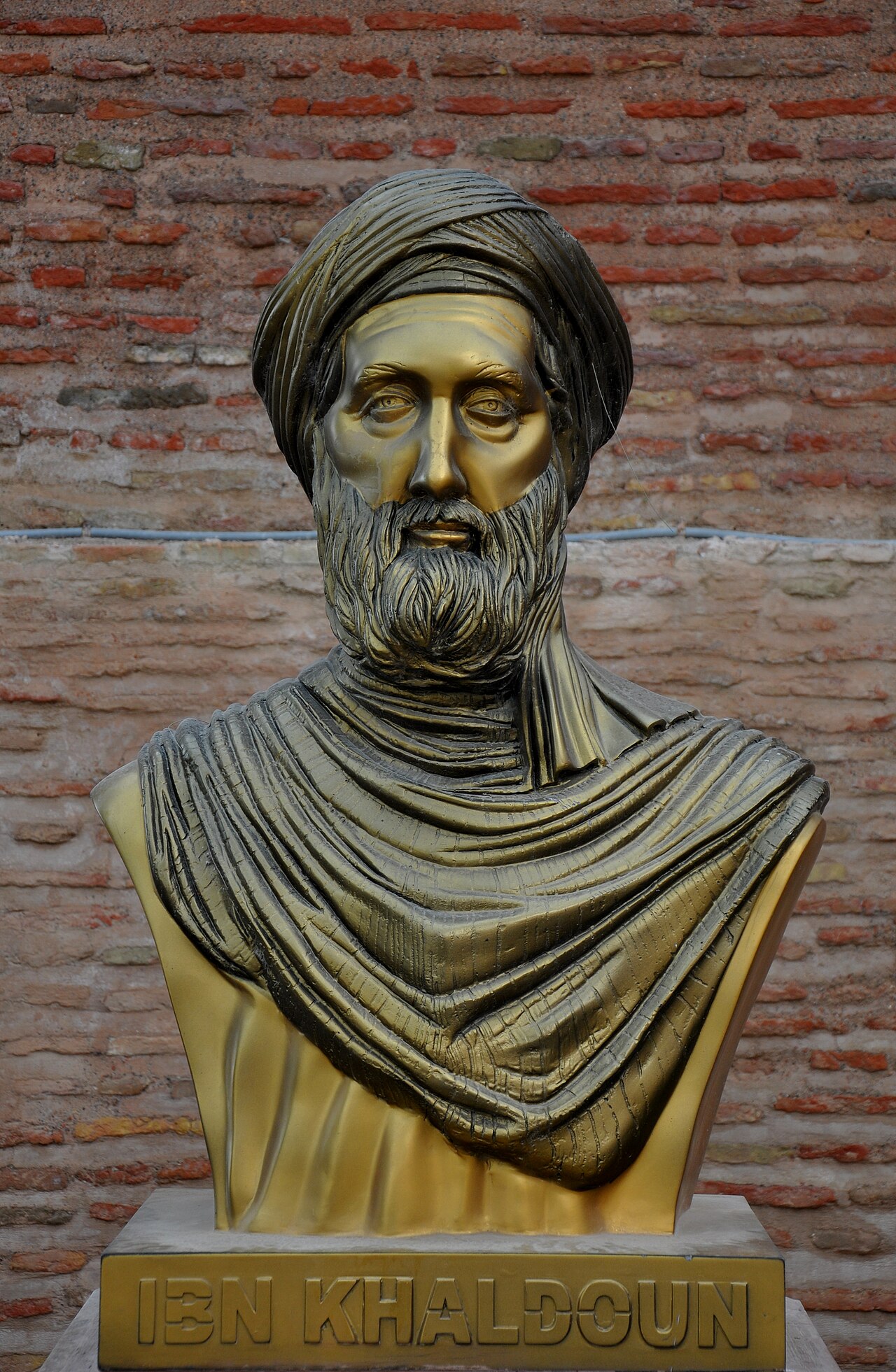
Because Ibn Khaldun authored an autobiography, many details of his life are known.[7] While living there under the tribe's protection, he composed the Muqaddimah, which serves as the introduction to his planned universal history.[8] For seven weeks Ibn Khaldūn stayed in the city under siege, being lowered over its walls by ropes to conduct negotiations with Timur.[9]
What the cited sources add
The account "Ibn Khaldun's Political and Economic Realism" states that since the 1950s academia has hailed him as the greatest social scientist of medieval Islam.[10] Erwin Rosenthal called Ibn Khaldun the first medieval thinker to see the importance of economics for politics.[10] Muhammad Hozien's biography describes Ibn Khaldun as the most important figure in History and Sociology in Muslim History.[11]
References
- Wikipedia, "Ibn Khaldun" (CC BY-SA 4.0), which cites: Savant, "Genealogy and Knowledge in Muslim Societies: Understanding the Past", Edinburgh University Press, 2014, p. 77; Barakat, "The Arab World: Society, Culture, and State", University of California Press, 1993, p. 48; Cheddadi, Abdesselam (auth).; Muhammad Hozien, "Ibn Khaldun: His Life and Work", Islamic Philosophy Online; "Ibn Khaldūn – The Muqaddimah: Ibn Khaldūn's philosophy of history", Encyclopedia Britannica; Bernard Lewis: "Ibn Khaldun in Turkey", in: Ibn Khaldun: The Mediterranean in the 14th Century: Rise and Fall of Empires, F en.wikipedia.org
- Wikipedia, "Ibn Khaldun" (CC BY-SA 4.0), which cites: Ali Zaidi, Islam, Modernity, and the Human Sciences, Springer, 2011, p. 84; Lewis, "Studies in Islamic history and civilization: in honour of Professor David Ayalon", Brill, 1986, p. 527–530 (original not read by us) en.wikipedia.org
- Wikipedia, "Ibn Khaldun" (CC BY-SA 4.0), which cites: Cheddadi, Abdesselam (auth).; Cheddadi, Abdesselam (auth).; ; ; ; Alatas, "The Wiley-Blackwell Companion to Major Social Theorists", John Wiley & Sons, 2011-03-31 (original not read by us) en.wikipedia.org
- Wikipedia, "Ibn Khaldun" (CC BY-SA 4.0), which cites: "Saudi Aramco World: Ibn Khaldun and the Rise and Fall of Empires", archive.aramcoworld.com (original not read by us) en.wikipedia.org
- Wikipedia, "Ibn Khaldun" (CC BY-SA 4.0), which cites: "Ibn Khaldun: His Life and Works Muslim Heritage", muslimheritage.com (original not read by us) en.wikipedia.org
- Wikipedia, "Ibn Khaldun" (CC BY-SA 4.0), which cites: al-Sakhāwī, "al-Ḍawʾ al-Lāmiʿ li-Ahl al-Qarn al-Tāsiʿ", Dār Maktabat al-Ḥayāh, p. 145–148 (original not read by us) en.wikipedia.org
- Wikipedia, "Ibn Khaldun" (CC BY-SA 4.0), which cites: Brown, "Historical Dictionary of Medieval Philosophy and Theology", Bloomsbury Publishing PLC, 2018-08-10, p. 174; van Ditmarsch, "The Unity of Science in the Arabic Tradition: Science, Logic, Epistemology and their Interactions", Springer Science & Business Media, 2008-07-15, p. 281; (original not read by us) en.wikipedia.org
- Wikipedia, "Ibn Khaldun" (CC BY-SA 4.0), which cites: "Ibn Khaldun's Political and Economic Realism", google.com/+AlhassanainOrgNetwork, 26 March 2016 (we also read that source) en.wikipedia.org
- Wikipedia, "Ibn Khaldun" (CC BY-SA 4.0), which cites: Bent, ""None of the Kings on Earth is Their Equal in ʿaṣabiyya:" The Mongols in Ibn Khaldūn's Works", Al-Masāq, 3 May 2016, p. 171–186 (original not read by us) en.wikipedia.org
- "Ibn Khaldun's Political and Economic Realism", google.com/+AlhassanainOrgNetwork, 26 March 2016. alhassanain.org
- Muhammad Hozien, "Ibn Khaldun: His Life and Work", Islamic Philosophy Online. muslimphilosophy.com
Each numbered sentence above was checked against the source it cites before publication. Sentences citing Wikipedia adapt text from the English Wikipedia article Ibn Khaldun (contributors), used under CC BY-SA 4.0; this entry is available under the same licence. Other sources were used for facts only.
More in Philosophers & Thinkers
Related in Philosophers & Thinkers
Links follow this subject's own source article.
Sources
Compiled from Wikipedia and the sources listed below. Text from Wikipedia is available under CC BY-SA 4.0; this entry is adapted from it.
- Wikipedia: Ibn Khaldun (CC BY-SA 4.0).
Spotted an error? Know more?
Reader corrections go straight into our review queue. Suggest an edit · How this site is sourced