Jacques Derrida
French philosopher who developed deconstruction, influencing humanities and social sciences.
Last updated

Frege-Pierre Dubois · CC BY-SA 4.0
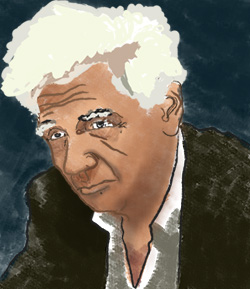
Jacques Derrida was a French philosopher who developed deconstruction, a method of critical analysis he applied through close readings of Saussure's linguistics and Husserlian and Heideggerian phenomenology. He is a major figure associated with post-structuralism and postmodern philosophy, though he distanced himself from post-structuralism and disavowed the word "postmodernity." Over his career, he published over 40 books and hundreds of essays and public presentations, influencing the humanities and social sciences including philosophy, literature, law, anthropology, historiography, applied linguistics, sociolinguistics, psychoanalysis, music, architecture, and political theory. Into the 2000s, his work retained major academic influence in the United States, continental Europe, South America, and other regions where continental philosophy is predominant, particularly in debates on ontology, epistemology, ethics, aesthetics, hermeneutics, and the philosophy of language.
Lore & Background
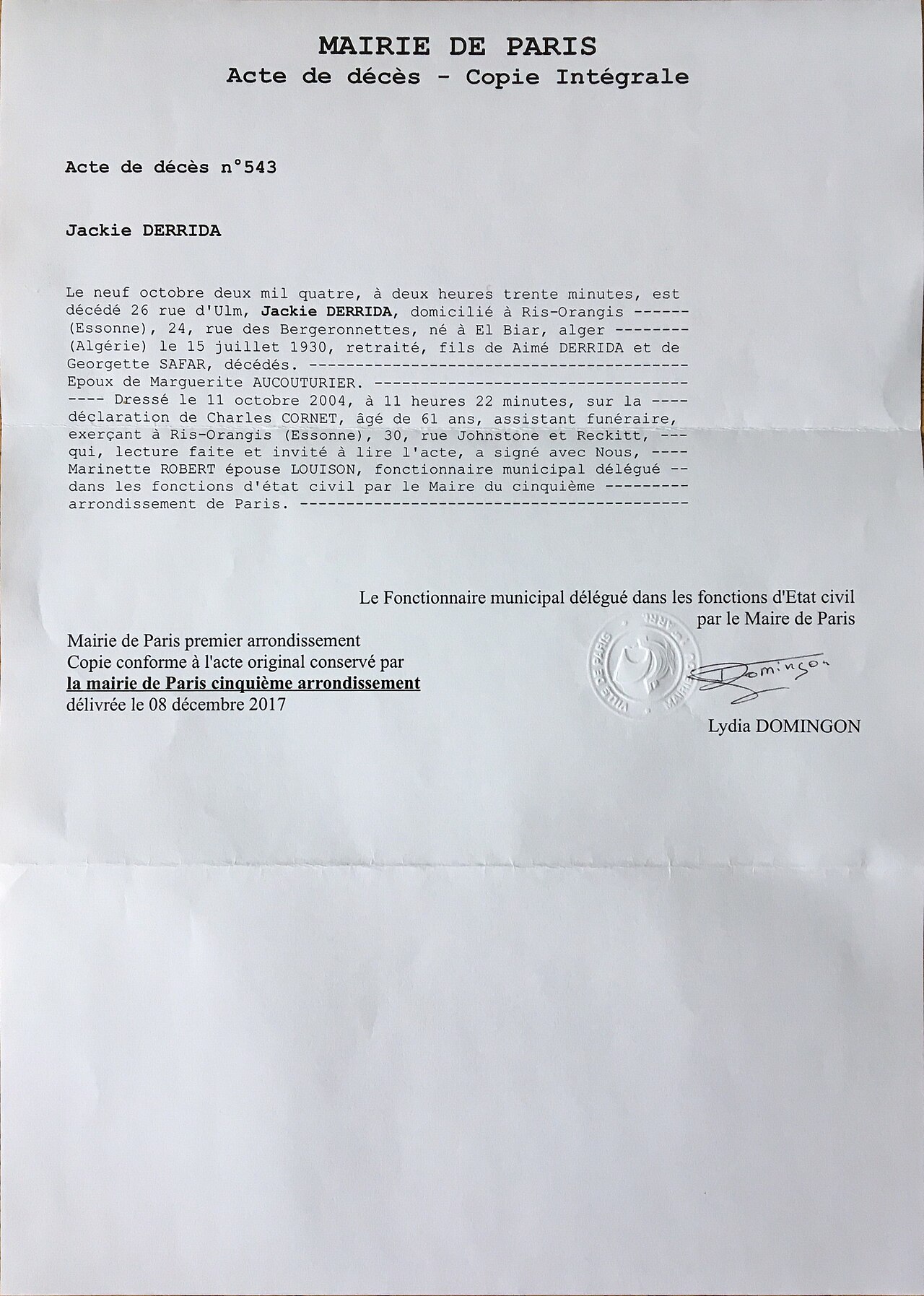
Derrida was born Jackie Élie Derrida on 15 July 1930 in a summer home in El Biar, Algeria, to a Sephardic Jewish family. His father, Haïm Aaron Prosper Charles Derrida, worked all his life for the wine and spirits company Tachet, including as a travelling salesman—a job his son called "exhausting" and "humiliating." On the first day of the 1942 school year, French administrators in Algeria, implementing antisemitism quotas set by the Vichy government, expelled Derrida from his lycée. He secretly skipped school for a year rather than attend the Jewish lycée formed by displaced teachers and students, and took part in numerous football competitions, dreaming of becoming a professional player.

In his teenage years he found in works by Rousseau, Nietzsche, and Gide an instrument of revolt, and his reading also included Camus and Sartre. In 1949 he moved to Paris, attending the Lycée Louis-le-Grand, where his philosophy professor was Étienne Borne. He failed his entrance exam to the École Normale Supérieure on his first try, passed on the second, and was admitted in 1952.
On his first day at ENS he met Louis Althusser, with whom he became friends. After visiting the Husserl Archive in Leuven, Belgium (1953–1954), he completed his master's degree on Edmund Husserl. He passed the agrégation exam in 1956, received a grant for studies at Harvard University, and spent the 1956–57 academic year reading James Joyce's Ulysses at the Widener Library.
Reader's Guide
Derrida's significance lies in his development of deconstruction, which he applied in some of his texts and developed through close readings of Saussure's linguistics and Husserlian and Heideggerian phenomenology. His first three books—Writing and Difference, Speech and Phenomena, and Of Grammatology—were all published in 1967. His work gained international prominence with his contribution "Structure, Sign, and Play in the Discourse of the Human Sciences" to a 1966 colloquium on structuralism at Johns Hopkins University, where he also met Jacques Lacan and Paul de Man. During the Algerian War (1954–1962), Derrida asked to teach soldiers' children in lieu of military service, teaching French and English from 1957 to 1959.
From 1960 to 1964 he taught philosophy at the Sorbonne as an assistant to Suzanne Bachelard, Georges Canguilhem, Paul Ricœur, and Jean Wahl. In 1964, on the recommendation of Louis Althusser and Jean Hyppolite, he received a permanent teaching position at the ENS, which he kept until 1984. He co-founded the Collège international de philosophie in 1983 and was elected its first president.
In 1986 he became Professor of the Humanities at the University of California, Irvine, where he taught until shortly before his death in 2004. His work influenced architecture (deconstructivism), music (hauntology), art, and art criticism. Particularly in his later writings, Derrida addressed ethical and political themes. Some critics consider Speech and Phenomena (1967) his most important work, while others cite Of Grammatology (1967), Writing and Difference (1967), and Margins of Philosophy (1972).
More in Philosophers & Thinkers
Sources
Compiled from Wikipedia and the sources listed below. Text from Wikipedia is available under CC BY-SA 4.0; this entry is adapted from it.
- Wikipedia: Jacques Derrida (CC BY-SA 4.0).
Spotted an error? Know more?
Reader corrections go straight into our review queue. Suggest an edit · How this site is sourced