The Black Death
The deadliest pandemic in recorded history, the Black Death reshaped Europe and the Middle East.
Last updated

Jakub Hałun · CC BY-SA 4.0
Between 1346 and 1353, a plague pandemic known as the Black Death swept through Europe, killing an estimated 30% to 60% of the continent’s population and roughly 33% of the Middle Eastern population. This makes it one of the deadliest pandemics in human history. The culprit was the bacterium Yersinia pestis, which typically spreads through flea bites but can also be transmitted via contact with infected tissue or fluids, and—in its pneumonic form—through respiratory droplets. The Black Death’s effects were far-reaching, reshaping populations, economies, and cultures.

It is often considered the second plague pandemic, though each major outbreak is separated by about 500 to 600 years. This was the second great natural disaster to hit Europe in the late Middle Ages, following the Great Famine of 1315–1317. Further outbreaks continued throughout the Late Middle Ages, and because of the broader crisis of that era, Europe’s population did not recover to its 14th-century levels until the 16th century.
Names
Plague outbreaks recurred around the world until the early 19th century. At the time, European writers described the disease in Latin with terms like magna pestilentia or plaga. In English before the 1700s, it was called the “pestilence,” “great pestilence,” “the plague,” or “the great death.” Later, the phrases “the furste moreyn” (first murrain) or “first pestilence” were used to distinguish this mid-14th-century event from other epidemics. The pandemic was not originally called “black” in any European language.
The expression “black death” had been applied to other deadly diseases before, but it wasn’t used for this pandemic in English until the 1750s; the first known use in English is from 1755, as a translation of a foreign term. The name was popularized by Swedish and Danish chroniclers in the 15th and early 16th centuries, and later spread to other languages as a calque (e.g., morte noire, schwarzer Tod). Before that, most European languages referred to the pandemic as a variant or calque of “great pestilence.” The phrase “black death” itself is ancient.
Homer used it in the Odyssey to describe the monster Scylla’s mouths “full of black Death.” Seneca the Younger may have been the first to apply it to an epidemic, but only to emphasize a disease’s lethality and grim outlook. In the 12th–13th century, French physician Gilles de Corbeil used mors nigra to mean a “pestilential fever.” In 1350, Belgian astronomer Simon de Covino wrote a poem attributing the plague to an astrological conjunction, using the phrase mors nigra—though it’s unclear if he meant the specific 1347 outbreak or just any fatal disease. The historian Elizabeth Penrose (writing as “Mrs Markham”) called the 14th-century outbreak the “black death” in 1823. Cardinal Francis Aidan Gasquet, writing in 1893, suggested it was “some form of the ordinary Eastern or bubonic plague.” In 1908, he noted that the name atra mors for this pandemic first appeared in a 1631 Danish history book by J. I. Pontanus, which stated: “Commonly and from its effects, they called it the black death.” Research from 2017 suggests plague first infected humans in Europe and Asia during the Late Neolithic to Early Bronze Age.

Previous plague epidemics
A 2018 study found Yersinia pestis in an ancient Swedish tomb, possibly linked to a “Neolithic decline” around 3000 BCE when European populations fell sharply. That early strain may have been different from later ones; flea-transmitted bubonic plague is first known from Bronze Age remains near Samara. Symptoms of bubonic plague were first described by Rufus of Ephesus (preserved by Oribasius), indicating it appeared in the Roman Empire before Trajan’s reign—six centuries before reaching Pelusium under Justinian I. In 2013, researchers confirmed that the Plague of Justinian (541–549, with recurrences until 750) was caused by Y. pestis, now called the first plague pandemic. In 610, Chinese physician Chao Yuanfang described a “malignant bubo” with high fever and nodes under the tissue.
Sun Simiao (died 652) also mentioned a “malignant bubo” and plague common in Lingnan (Guangzhou). Ole Jørgen Benedictow believes this indicates an offshoot of the first pandemic reached China by around 600. The Black Death’s origin is debated.
Origin
Genetic analysis shows Yersinia pestis evolved about 7,000 years ago, at the start of the Neolithic, with flea-mediated strains emerging around 3,800 years ago in the late Bronze Age. The immediate territorial origins of the Black Death outbreak remain unclear, with evidence pointing toward Central Asia, China, the Middle East, or Europe. The pandemic was reportedly first introduced to Europe during the 1347 siege of the Genoese trading port of Caffa in Crimea by the Golden Horde army of Jani Beg. From Crimea, it was likely carried by fleas on black rats aboard Genoese ships, spreading through the Mediterranean Basin and reaching North Africa, West Asia, and beyond.
Lore & Background
The Black Death had far-reaching population, economic, and cultural effects. It has been tentatively considered as the second plague pandemic, despite each of these outbreaks being separated by around 500–600 years. The Black Death was the second great natural disaster to strike Europe during the late Middle Ages (the first one being the Great Famine of 1315–1317). There were further outbreaks throughout the Late Middle Ages.

Due to the crisis of the late Middle Ages, the European population did not regain its 14th century level until the 16th century. Outbreaks of the plague recurred around the world until the early 19th century. European writers contemporary with the plague described the disease in Latin as pestis or pestilentia, 'pestilence'; epidemia, 'epidemic'; mortalitas, 'mortality'. In English prior to the 18th century, the event was called the 'pestilence' or 'great pestilence', 'the plague' or the 'great death'.
Subsequent to the pandemic 'the furste moreyn' (first murrain) or 'first pestilence' was applied, to distinguish the mid-14th century phenomenon from other infectious diseases and epidemics of plague. The 1347 pandemic plague was not referred to specifically as 'black', at the time, in any European language. The expression 'black death' had occasionally been applied to other fatal or dangerous diseases. In English, 'Black death' was not used to describe this plague pandemic, however, until the 1750s; the term is first attested in 1755, where it translated Danish: den sorte død, lit. 'the black death'.
This expression – as a proper name for the pandemic – had been popularized by Swedish and Danish chroniclers in the 15th and early 16th centuries, and in the 16th and 17th centuries, it was transferred to other languages as a calque: Icelandic: svarti dauði, German: der schwarze Tod, and French: la mort noire. Previously, most European languages had named the pandemic a variant or calque of the Latin: magna mortalitas, lit. 'Great Death'. The phrase 'black death' — describing Death as black — is very old. Homer used it in the Odyssey to describe the monstrous Scylla, with her mouths 'full of black Death' (Ancient Greek: πλεῖοι μέλανος Θανάτοιο, romanized: pleîoi mélanos Thanátoio).
Scale and Demographic Catastrophe
Estimates place the toll anywhere from thirty to sixty percent of Europeans, while the Middle East lost approximately a third of its inhabitants. The pandemic's consequences rippled far beyond raw mortality, reshaping economies, labor markets, and cultural institutions across the continent.
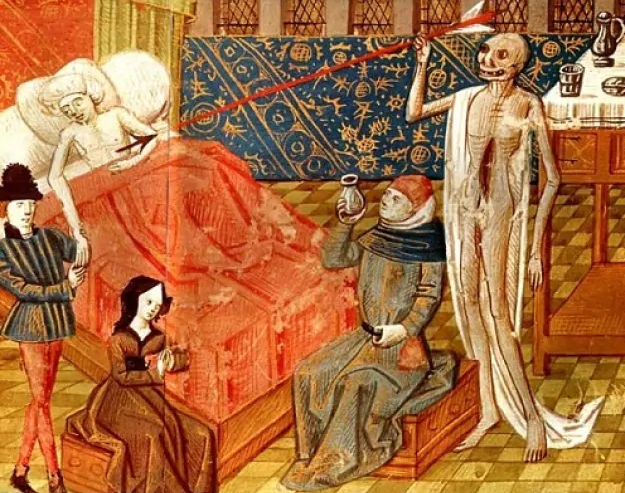
Scholars tentatively classify it as the second plague pandemic, noting that each major outbreak was separated by roughly five to six centuries. The demographic wound proved so deep that European populations did not recover to their pre-plague levels until the sixteenth century. Moreover, the bacterium never truly vanished; recurrent outbreaks of plague continued to appear around the world well into the early nineteenth century, a grim reminder that the pandemic's shadow stretched across centuries.
The Bacterium and Its Vectors
At the heart of the catastrophe was a single bacterium, Yersinia pestis, whose genetic lineage stretches back approximately seven thousand years to the dawn of the Neolithic period. The primary route of transmission was the bite of infected fleas, but the bacterium could also pass through direct contact with the tissues and bodily fluids of the sick. In its most dangerous form, pneumonic plague, the infection spread person to person via respiratory droplets, making containment extraordinarily difficult. Ancient medical texts, including a fragment attributed to Rufus of Ephesus and preserved by Oribasius, describe symptoms consistent with bubonic plague as early as the Roman Empire, suggesting the pathogen had been circulating long before it struck fourteenth-century Europe.
The Evolution of a Name
Swedish and Danish chroniclers had popularized the expression in the fifteenth and early sixteenth centuries, after which it was borrowed as a calque into Icelandic (svarti dauði), German (der schwarze Tod), and French (la mort noire). Before that, most European languages used variants of the Latin magna mortalitas, meaning "Great Death." The imagery of death as "black" is far older than the pandemic itself: Homer applied it to the monster Scylla in the Odyssey, and Seneca the Younger may have been the first to describe an epidemic with the phrase mors atra.
Origins and the Road to Europe
Where the Black Death truly began remains a matter of scholarly debate, with evidence pointing toward Central Asia, China, the Middle East, and Europe itself. From there, fleas living aboard black rats on Genoese merchant ships carried the infection through the Mediterranean Basin. Yet the story extends much further back. pestis, earning it the title of the first plague pandemic. pestis in Late Neolithic and Bronze Age remains, suggest the bacterium had been a human companion for millennia before its most devastating chapter.
Reader's Guide
The origin of the Black Death is disputed. Genetic analysis suggests Yersinia pestis bacteria evolved approximately 7,000 years ago, at the beginning of the Neolithic, with flea-mediated strains emerging around 3,800 years ago during the late Bronze Age. The immediate territorial origins of the Black Death and its outbreak remain unclear, with some evidence pointing towards China, Central Asia, West Asia, and Europe.
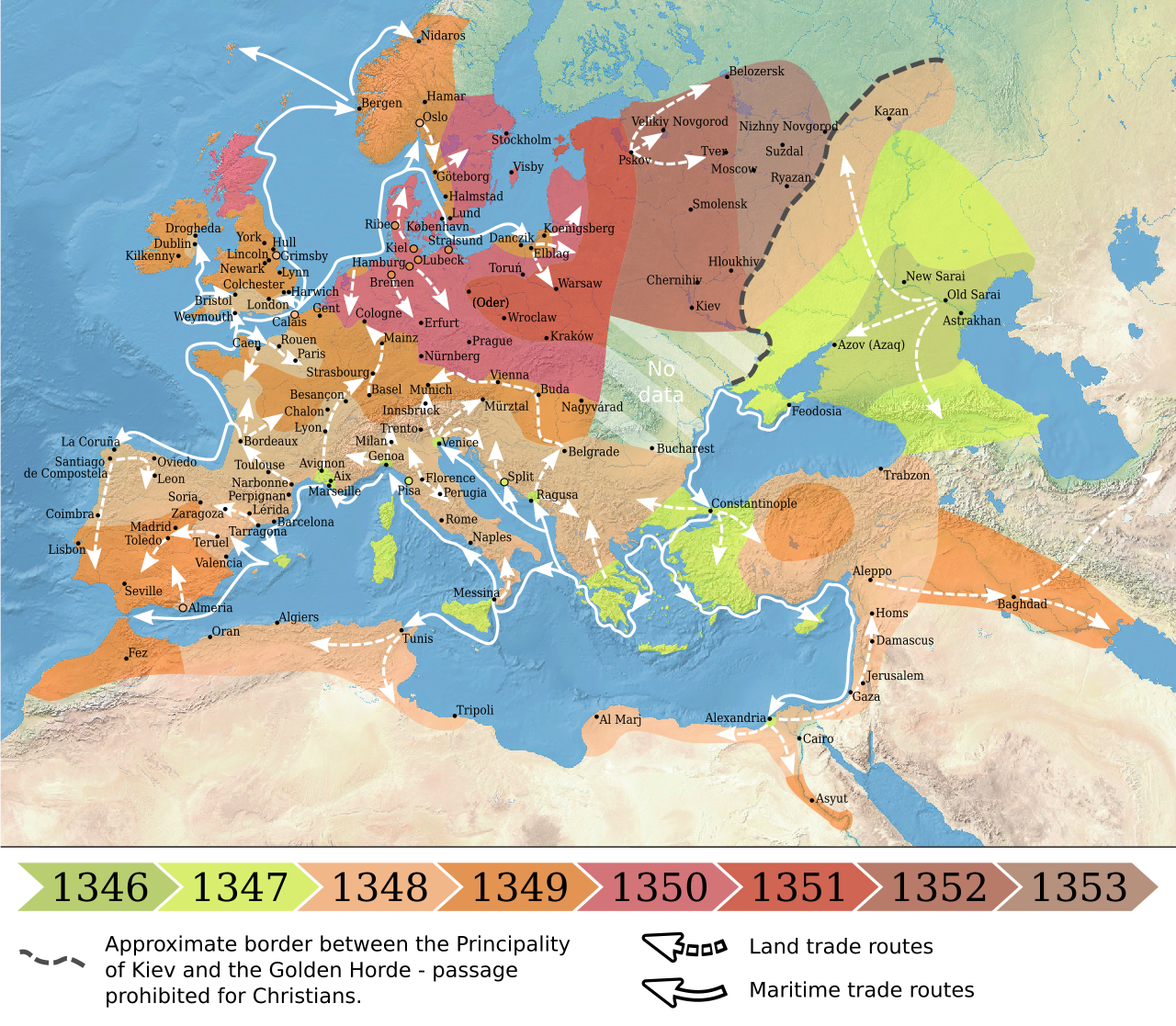
The pandemic was reportedly first introduced to Europe during the siege of the Genoese trading port of Caffa in Crimea by the Golden Horde army of Jani Beg in 1347. From Crimea, it was most likely carried by fleas living on the black rats that travelled on Genoese ships, spreading through the Mediterranean Basin and reaching North Africa, West Asia, and the rest of Europe via Constantinople, Sicily, and the Italian Peninsula. There is evidence that once it came ashore, the Black Death mainly spread from person-to-person as pneumonic plague, thus explaining the quick inland spread of the epidemic, which was faster than would be expected if the primary vector was rat fleas causing bubonic plague.

A 2026 study published in Nature identified the oldest known evidence of plague outbreaks in human remains, finding traces of Yersinia pestis DNA in the teeth of 18 ancient hunter-gatherers from four cemeteries near Lake Baikal in Siberia. Carbon dating revealed two outbreaks, with the earliest cases dating to approximately 5,500 years ago — some 200 years earlier than previously established. Researchers concluded the disease likely spread initially from marmots through contact with raw organs or infected hides, and also transmitted between people through respiratory means. Many victims were young children, with three young girls buried side by side among the dead.
There has been a quest to find 'patient zero', the earliest known victim(s) with evidence of the Black Death. In 2022, in an article called 'The source of the Black Death in fourteenth-century central Eurasia', researchers pointed to the earliest victims of the plague found at two cemeteries in the Chüy Valley near Lake Issyk-Kul in modern Kyrgyzstan. Here graves had tombstones with Syriac inscription, providing the name of the deceased, year of death and often the cause of death, showing a spike due to 'pestilence' in 1338–1339.
Frequently Asked Questions
What is The Black Death?
The Black Death was a catastrophic plague pandemic that swept through Europe and neighboring regions in the mid-14th century, wiping out roughly half of the continent's inhabitants. It stands as one of the deadliest mass-killing events in recorded human history.
How many people died from The Black Death?
Historians estimate the toll reached as many as 50 million lives, representing somewhere between 30 and 60 percent of Europe's 14th-century population. The Middle East also lost approximately a third of its people during the outbreak.
More in Great Collapses
Sources
Compiled from Wikipedia and the sources listed below. Text from Wikipedia is available under CC BY-SA 4.0; this entry is adapted from it.
- Wikipedia: Black Death (CC BY-SA 4.0).
Spotted an error? Know more?
Reader corrections go straight into our review queue. Suggest an edit · How this site is sourced