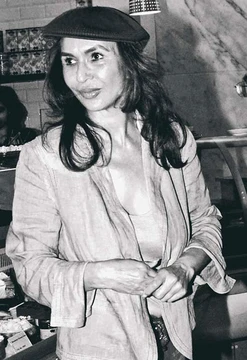
Anita Roddick

Dame Anita Lucia Roddick was a British businesswoman, human rights activist, and environmental campaigner, best known for founding The Body Shop, a cosmetics company that produced and sold natural beauty products and helped shape the concept of ethical consumerism. The company was among the first to prohibit the use of animal testing on some of its products and to promote fair trade with developing countries. Roddick was deeply involved in activism for environmental and social causes, working with organizations such as Greenpeace and the newspaper The Big Issue. In 1990, she established Children on the Edge, a charity that supports disadvantaged children in Eastern Europe, Africa, and Asia. She held the conviction that businesses should provide moral leadership, arguing they could be a more powerful force for change than religion or government. Born Anita Lucia Perella in a bomb shelter in Littlehampton, Sussex, she was one of four children. Her mother was Gilda, wife of restaurateur Donato Perella, though her biological father was Donato’s cousin, Henry Perilli, an ice-cream and soda bar proprietor. She was educated locally at St Joseph’s Convent and Maude Allen secondary modern school, then trained as a teacher at Newton Park College of Education in Bath. She later taught history and English at Maude Allen school. Roddick opened her first Body Shop in Brighton in 1976 to earn an income while her husband was traveling in South America. She aimed to sell quality skincare in refillable containers and sample sizes, marketed with honesty rather than hype. A second shop opened six months later, and her husband joined the business upon his return.
- born
- 23 October 1942, Littlehampton, Sussex
- died
- 10 September 2007, Chichester
- field
- Business, activism, environmental campaigning
- nationality
- British
- known_for
- Founder of The Body Shop; ethical consumerism; animal testing prohibition; fair
Verified Timeline
Lore & Background
Dame Anita Roddick was a British businesswoman, human rights activist, and environmental campaigner, best known as the founder of The Body Shop, a cosmetics company that shaped ethical consumerism. She was born Anita Lucia Perella in a bomb shelter in Littlehampton, Sussex, on 23 October 1942, one of four children. Her registered father was restaurateur Donato Perella, though her biological father was Donato’s cousin, Henry Perilli, an ice-cream and soda bar proprietor. She was educated at St Joseph’s Convent and Maude Allen secondary modern school, then trained as a teacher at Newton Park College of Education in Bath, later teaching history and English at Maude Allen. In 1976, while her husband was in South America, she opened her first Body Shop in Brighton to earn an income for herself and her two daughters, offering quality skincare in refillable containers and sample sizes, marketed with truth rather than hype. By 1991, the company had 700 branches; by 2004, it had 1,980 stores serving over 77 million customers worldwide. Roddick was a prominent activist involved with Greenpeace and The Big Issue, and in 1990 she founded the charity Children on the Edge to help disadvantaged children in Eastern Europe, Africa, and Asia. She also campaigned for the Angola Three, African-American men held in solitary confinement for decades. She believed business should provide moral leadership, a force more powerful than religion or government. In 2006, she sold The Body Shop to L’Oréal for £652 million, describing herself as a ‘Trojan horse’ who could influence the larger company from within.
Reader's Guide
Anita Roddick's significance lies in her role as a pioneer of ethical consumerism, demonstrating that a business could prioritize social and environmental values alongside profit. She believed business should offer moral leadership, a more powerful force than religion or government. Her legacy includes the model of corporate social responsibility and the ongoing influence of her foundation, which donated her entire £51 million estate to charity upon her death.
Did You Know?
- Anita Roddick was born in a bomb shelter in Littlehampton, Sussex.
- By 2004, The Body Shop had 1,980 stores serving over 77 million customers worldwide.
- Upon her death, her foundation donated her entire £51 million estate to charity.
Linguistic Roots and Ancient Heritage
The name Anita carries a dual etymological lineage that stretches back to antiquity. On one hand, it functions as a diminutive of Anahita, a name rooted in ancient Persian tradition, linking the modern bearer to a cultural heritage that predates many of today's dominant naming conventions. On the other hand, it operates as the Spanish rendering of Anna, embedding it within the broader Western onomastic family that has shaped naming practices across centuries. This dual origin means the name simultaneously bridges Eastern and Western linguistic worlds, a quality that likely contributed to its ease of adoption across diverse cultures. As a feminine given name, it has shed any single-culture ownership and become a genuinely international choice. The fact that it survives in both shortened and adapted forms across language families speaks to its phonetic appeal and cultural flexibility, making it one of those names that feels both familiar and timeless regardless of the speaker's native tongue.
Global Footprint Across Continents
Anita has achieved a level of worldwide prevalence that places it among the most recognizable feminine names in regions where Indo-European languages hold sway. Its strongest concentrations appear in Europe, Iran, South Asia, and North America, yet the name's reach extends well beyond those cores. The roster of bearers spans an extraordinary geographic range: Australian artists, Nigerian media personalities, Ghanaian footballers, Ugandan politicians, Canadian ministers, British journalists, Swedish swimmers, Norwegian mushing competitors, Croatian composers, Pakistani actresses, Malaysian legislators, Icelandic actresses, French fencers, Hungarian handballers, Dutch Antarctic researchers, Swiss beauty queens, Italian sopranos, Rwandan politicians, Nepalese athletes, Albanian violinists, Danish boxers, Chilean businesswomen, and Mexican-born writers. This distribution illustrates how a single name can become a quiet thread woven through the social fabric of dozens of nations, carrying no single national identity but belonging comfortably to many.
A Remarkable Spectrum of Vocations
Among the individuals who bear the name Anita, the professional landscape is staggering in its breadth. The roster includes poets, novelists, and children's-book writers alongside epidemiologists, cancer researchers, and biochemists. In the arts, one finds dancers, dramatic sopranos, R&B and soul singers, country and folk performers, Big Band vocalists, and film composers. The political sphere is well represented by members of parliament, mayors, state's attorneys, and ministers of defense from Canada, India, Ghana, Uganda, Malaysia, and numerous European nations. Science and academia contribute economists, computer scientists, historians of mathematics, and oceanographers. Athletics is no less prominent, with swimmers, gymnasts, middle-distance runners, boxers, handballers, Paralympic archers, synchronized swimmers, and fencers all carrying the name. Even more specialized fields appear: a Sinti civil rights writer, an Antarctic researcher, a high-altitude rescue doctor, a coal miner, and a beauty pageant winner. No single profession or social class claims the name.
A Century and a Half of Continuous Use
The birth years recorded among Anita's bearers stretch from 1857 to 1996, while the death dates range from 1928 to 2024, painting a picture of a name in unbroken circulation for well over a century. Early figures include a German lawyer and feminist born in the 1850s, an Argentine actress and singer born in 1896, and a German dancer and writer born in 1899 who passed in 1928. Mid-century names include a Mexican-born writer of children's literature, an American Big Band singer, and a British novelist and art historian. The latter decades bring an Icelandic actress, a French fencer, a Nigerian media entrepreneur, and a synchronized swimmer born in 1996. This temporal span demonstrates that Anita has never fallen out of fashion; rather, it has been passed from generation to generation across every decade of the twentieth and into the twenty-first century, adapting to new cultural contexts while retaining its recognizable phonetic identity. Its endurance is itself a testament to the name's cross-cultural resonance.
More in Philanthropists And Socialites 1-23
Spotted an error? Know more?
This is a living reference — every entry is fact-audited, and reader corrections feed straight into our audit queue. Suggest an edit · See this site's audit record