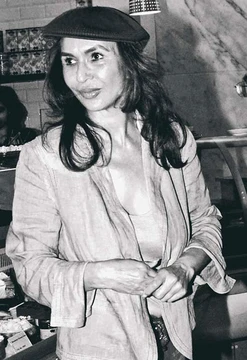
Aly Khan
Italian-born Ismaili prince, diplomat, and socialite.

Prince Aly Salomone Aga Khan was born in Turin, Italy, in 1911, the only surviving son of Sultan Muhammad Shah, the Aga Khan III, and an Italian dancer. His childhood education came from private tutors in India and France, and he later trained as a lawyer in England. As a young man, he gained a reputation as a socialite and man-about-town, with a series of high-profile romantic affairs. In 1935, he was named as the third party in a divorce suit brought by Group Captain Thomas Loel Guinness against his wife, Joan Barbara Guinness. Khan and Guinness married the following year in Paris, after her divorce was finalized; she converted to Islam and took the name Taj-ud-dawlah. The couple had two sons, Karim and Amyn, both reportedly born prematurely. The marriage ended in divorce in 1949, partly due to Khan’s extramarital affairs. Within weeks, he married American film star Rita Hayworth in Cannes, France. Hayworth left her career for the marriage, and they had a daughter, Yasmin. The couple’s involvement in horse racing included ownership of a filly, Double Rose, who placed second in the Prix de l’Arc de Triomphe. Their marriage ended after Hayworth discovered Khan dancing with actress Joan Fontaine. During World War II, Khan served with the French Foreign Legion in Egypt and the Middle East, then joined the Royal Wiltshire Yeomanry, rising to lieutenant colonel. He participated in the Allied landing in southern France as a liaison captain with the U.S. Seventh Army, earning the Legion of Honour, Croix de Guerre, and Bronze Star. In 1957, he was installed as honorary colonel of Pakistan’s 4 Cavalry Regiment. The following year, Pakistan’s President Iskander Mirza appointed him as the country’s Ambassador to the United Nations, a post that surprised many observers. He was elected vice president of the General Assembly in September 1958 and chaired the U.N. Peace Observation Committee until his death in 1960.
- field
- Diplomacy, military service, horse racing
- nationality
- Italian-born, Pakistani ambassador
- known_for
- Pakistan's ambassador to the UN, third husband of Rita Hayworth, father of Aga Khan IV
Lore & Background
Prince Aly Khan was born in Turin, Italy, and spent his early years being instructed by private tutors in both India and France before studying law in England. As a child of twelve, he was acquainted with Orson Welles, who was roughly four years younger; both men would later marry the actress Rita Hayworth. During the Second World War, he served first with the French Foreign Legion’s cavalry in Egypt and the Middle East, then joined the Royal Wiltshire Yeomanry, rising to lieutenant colonel. In 1944 he participated in the Allied landing in southern France as a captain and liaison officer with the U.S. Seventh Army, earning the Legion of Honour, the Croix de Guerre, and the Bronze Star. In 1957 he was installed as the first colonel of the 4 Cavalry Regiment of the Pakistan Army, a role he held until his death. Appointed Pakistan’s ambassador to the United Nations in early 1958, he was elected a vice president of the General Assembly later that year and chaired the Peace Observation Committee. Known as a socialite and a noted racehorse owner and jockey, he was the third husband of Rita Hayworth. His first marriage was to Joan Barbara Guinness, who converted to Islam and took the name Taj-ud-dawlah; they had two sons, Karim al-Husseini and Amyn Muhammad Aga Khan. After their divorce, he married Hayworth, with whom he had a daughter, Yasmin Aga Khan.
Reader's Guide
Aly Khan’s life bridged high society and international diplomacy. Born in Italy to the Aga Khan III and an Italian dancer, he was educated privately in India and France before training as a lawyer in England. During World War II, he served with the French Foreign Legion in Egypt and the Middle East, then joined the Royal Wiltshire Yeomanry, rising to lieutenant colonel. He participated in the Allied landing in southern France as a liaison officer with the U.S. Seventh Army, earning the Legion of Honour, Croix de Guerre, and U.S. Bronze Star. In 1957, he was installed as the first colonel of Pakistan’s newly raised 4 Cavalry Regiment. Appointed Pakistan’s ambassador to the United Nations in 1958, he was elected a vice president of the General Assembly and chaired the Peace Observation Committee. His appointment surprised observers, some comparing him to an American movie star known more for fundraising than politics. A noted socialite, racehorse owner, and jockey, he was the third husband of actress Rita Hayworth, with whom he had a daughter. His first marriage to Joan Barbara Guinness produced sons Karim and Amyn; after divorce, he wed Hayworth. His father’s decision to bypass him for succession as Aga Khan, naming his grandson Karim instead, was a defining moment in Ismaili history. Khan died in 1960 while still serving as ambassador, leaving a legacy as both a diplomat and the father of the 49th Ismaili Imam.
Did You Know?
- Aly Khan was named co-respondent in the divorce suit between Joan Barbara Guinness and Group Captain Thomas Loel Guinness MP.
- His father, Aga Khan III, bypassed him for succession, naming his son Karim as Aga Khan IV.
Early Life in a Storied Household
Her mother was the American screen actress and dancer Rita Hayworth; her father, Aly Khan. She was the younger of the couple's daughters, with a paternal half-brother who would become Karim al-Husayni, Aga Khan IV, and another half-brother, Amyn Aga Khan. On the maternal side, she shared a bond with Rebecca Welles Manning, the daughter Hayworth had with director Orson Welles. Yasmin's earliest years were spent alongside her mother and Rebecca, a quiet domesticity that contrasted with the celebrity orbit around them. During the hearing, the three-year-old wandered around the courtroom and ultimately climbed into the judge's lap—a small, human image of innocence inside a very adult legal battle. Her schooling then took her to Buxton School, a small boarding house in Williamstown, Massachusetts, and later to the International School of Geneva, institutions that shaped her formative years across two continents.
A Lifelong Fight for Alzheimer's Awareness
The loss of her mother to Alzheimer's disease became the defining force behind Yasmin's adult life. Having cared for Rita Hayworth through many years of the illness, she channeled that intimate grief into sustained public advocacy. She serves as vice chairman on the board of directors of the Alzheimer's and Related Disorders Association and holds the presidency of Alzheimer's Disease International. Her commitments extend well beyond a single organization: she serves as a National Council Member of the Salk Institute, acts as a spokesperson for the Boston University School of Medicine Board of Visitors, and sits on numerous boards connected to the Aga Khan Foundation. That image—a mother creating beauty while losing the world—gave the documentary, and Yasmin's broader message, an emotional core that resonated far beyond clinical discussion of the disease.
Love, Marriage, and Profound Loss
Yasmin's personal life carried both the glamour expected of her lineage and a depth of sorrow that few outside her circle witnessed. The pattern of brief marriages and deep personal loss speaks to a life in which public admiration rarely translated into private stability. Yet even amid these upheavals, Yasmin continued to build her philanthropic career, suggesting a resilience that was not performative but deeply personal. The death of her son in his mid-twenties remains one of the most quietly devastating facts in her biography, a private wound she has carried alongside her public advocacy work.
Education, Art, and a Daughter's Inheritance
Before she became a name synonymous with Alzheimer's advocacy, Yasmin was a young woman shaped by a cosmopolitan education and an early fascination with the performing arts. She attended Buxton School, a small boarding institution in Williamstown, Massachusetts, and later the International School of Geneva, experiences that gave her a cross-cultural fluency. During those years, she developed a genuine interest in opera singing, a passion that pointed toward a possible artistic path she never fully pursued. That thread of artistic sensitivity would resurface decades later, not in her own voice but in her mother's. The connection between a daughter's early love of art and a mother's late creative flowering gave the story a poignancy that no medical statistic could replicate.
More in Philanthropists And Socialites 1-23
Spotted an error? Know more?
This is a living reference — every entry is fact-audited, and reader corrections feed straight into our audit queue. Suggest an edit · See this site's audit record