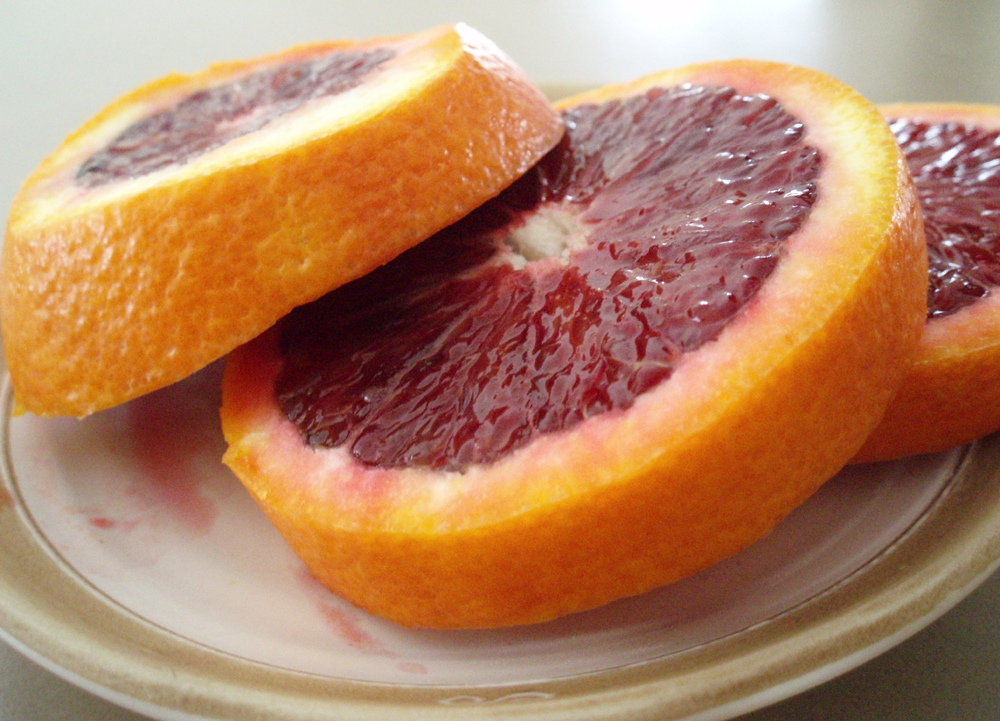
Blood orange
A sweet orange variety with crimson flesh and raspberry-like flavor.
Last updated

Eric Hill from Boston, MA, USA · CC BY-SA 2.0
The orange itself is a hybrid, likely between pomelo and tangerine, and the blood orange is a natural mutation of that hybrid.[1] Anthocyanins, a polyphenol pigment family not commonly found in citrus, cause the dark red color of the flesh.[2] Low nighttime temperatures during fruit development trigger the flesh to turn its characteristic red.[2]
Key facts and history
Italy is a country where blood oranges are commonly grown.[3] Protected geographical status under EU law is held by the arancia rossa di Sicilia (red orange of Sicily).[1] The three most widespread varieties are Tarocco (from Italy), Sanguinello (from Spain), and the deeply pigmented Moro (from Italy).[4] Compared to other oranges, blood oranges have a distinctive flavor that combines typical citrus notes with a clear raspberry-like taste.[5]
What the cited sources add
The 2000 paper by Rapisarda, Fanella, and Maccarone, published in the Journal of Agricultural and Food Chemistry, examines the reliability of analytical methods for determining anthocyanins in blood orange juices.[6] The 2000 paper by Nicolosi, Deng, Gentile, and La Malfa in Theoretical and Applied Genetics investigates citrus phylogeny and the genetic origin of important species as investigated by molecular markers.[7] The book "Citrus Industry" was published by the University of California in June 1978.[8] The book "Horts de tarongers" was published by Institució Alfons el Magnànim in 2016.[9]
References
- Wikipedia, "Blood orange" (CC BY-SA 4.0), which cites: Nicolosi, "Citrus phylogeny and genetic origin of important species as investigated by molecular markers", Theor. Appl. Genet., 2000, p. 1155–1166; "IGP Arancia Rossa di Sicilia: Territory", IGP Arancia Rossa di Sicilia; Besó Ros, "Horts de tarongers. La formació del verger valencià", Institució Alfons el Magnànim, 2016, p. 144 (we also read that source) en.wikipedia.org
- Wikipedia, "Blood orange" (CC BY-SA 4.0), which cites: Paolo, "Reliability of Analytical Methods for Determining Anthocyanins in Blood Orange Juices", J. Agric. Food Chem., 2000, p. 2249–2252; Felgines, "Influence of glucose on cyanidin 3-glucoside absorption in rats", Mol. Nutr. Food Res., 2008, p. 959–64; McGee, Harold, "On food and cooking: the science and lore of the kitchen", Scribner, 2004, p. 376 (we also read that source) en.wikipedia.org
- Wikipedia, "Blood orange" (CC BY-SA 4.0), which cites: McGee, Harold, "On food and cooking: the science and lore of the kitchen", Scribner, 2004, p. 376; "Gourmet Sleuth: Blood Oranges", Gourmet Sleuth (we also read that source) en.wikipedia.org
- Wikipedia, "Blood orange" (CC BY-SA 4.0), which cites: Reuther, "Citrus Industry: Crop Protection. Volume I: History, World Distribution, Botany, and Varieties", University of California, January 1967; Russo, "Blood Oranges: Change You Can Believe In", Kitchen Window, January 28, 2009; "Blood/Pigmented Oranges", Givaudan Citrus Variety Collection at UCR (we also read that source) en.wikipedia.org
- Wikipedia, "Blood orange" (CC BY-SA 4.0), which cites: McGee, Harold, "On food and cooking: the science and lore of the kitchen", Scribner, 2004, p. 376 (we also read that source) en.wikipedia.org
- Paolo Rapisarda, "Reliability of Analytical Methods for Determining Anthocyanins in Blood Orange Juices", Journal of Agricultural and Food Chemistry (2000), doi:10.1021/jf991157h. OpenAlex metadata CC0; paper not read. doi.org
- Elisabetta Nicolosi, "Citrus phylogeny and genetic origin of important species as investigated by molecular markers", Theoretical and Applied Genetics (2000), doi:10.1007/s001220051419. OpenAlex metadata CC0; paper not read. doi.org
- Open Library record, ISBN 0931876249 ("Citrus Industry"). CC0 (metadata); book content not read. openlibrary.org
- Open Library record, ISBN 9788478226863 ("Horts de tarongers"). CC0 (metadata); book content not read. openlibrary.org
Each numbered sentence above was checked against the source it cites before publication. Sentences citing Wikipedia adapt text from the English Wikipedia article Blood orange (contributors), used under CC BY-SA 4.0; this entry is available under the same licence. Other sources were used for facts only; no text or images are copied from them.
More in Peppers & Citrus Fruits
Sources
Compiled from Wikipedia and the sources listed below. Text from Wikipedia is available under CC BY-SA 4.0; this entry is adapted from it.
- Wikipedia: Blood orange (CC BY-SA 4.0).
- Word definitions: the Codexery glossary, each quoted from its Wikipedia article.
Spotted an error? Know more?
Reader corrections go straight into our review queue. Suggest an edit · How this site is sourced