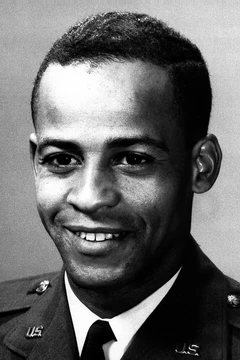
Michael J. Adams
First American space mission fatality.
Last updated
Michael James Adams, an American aviator, engineer, and Air Force astronaut, was among the dozen pilots to fly the X-15 experimental spaceplane. On November 15, 1967, he piloted X-15 Flight 191 in the X-15-3, reaching over 50 miles in altitude and qualifying as an astronaut under U.S. standards. Shortly after, the aircraft disintegrated, killing Adams and destroying the X-15-3. By American convention, he became the first U.S. space mission fatality.
Biography
Adams was born May 5, 1930, in Sacramento, California. He graduated from Sacramento Junior College. He enlisted in the United States Air Force in 1950, and earned his pilot wings and commission in 1952 at Webb Air Force Base, Texas. He served as a fighter-bomber pilot during the Korean War, where he flew 49 combat missions.
Education and flight experience
This was followed by 30 months with the 613th Fighter-Bomber Squadron at England Air Force Base, Louisiana, and six months rotational duty at Chaumont Air Base in France. In 1958, Adams received a Bachelor of Science degree in Aeronautical Engineering from the University of Oklahoma and, after 18 months of astronautics study at Massachusetts Institute of Technology, was selected in 1962 for the U.S. Air Force Test Pilot School at Edwards Air Force Base, California.
Here, he won the A.B. Honts Trophy as the best scholar and pilot in his class. Adams subsequently attended the Aerospace Research Pilot School (ARPS), graduating with honors in December 1963. He was one of four Edwards aerospace research pilots to participate in a five-month series of NASA Moon landing practice tests at the Martin Company in Baltimore, Maryland. In November 1965, he was selected to be an astronaut in the United States Air Force Manned Orbiting Laboratory program.
In July 1966, Major Adams came to the North American X-15 program, a joint USAF/NASA project. He made his first X-15 flight on October 6, 1966. His seventh X-15 flight, Flight 3-65-97, took place on November 15, 1967. He reached a peak altitude of 266000 ft; the nose of the aircraft was off heading by 15 degrees to the right.
Death
While descending, at 230000 ft the aircraft encountered rapidly increasing aerodynamic pressure which impinged on the airframe, causing the X-15 to enter a violent Mach 5 spin. As the X-15 neared 65000 ft, it was diving at Mach 3.93 and experiencing more than 15 g vertically (positive and negative), and 8 g laterally, which inevitably exceeded the design limits of the aircraft. The aircraft broke up 10 minutes and 35 seconds after launch, killing Adams. The United States Air Force posthumously awarded him Astronaut Wings for his last flight.
Frequently Asked Questions
When did Michael J. Adams die?
Michael J. Adams died on 15 November 1967 in Near Johannesburg, California, U.S.
Where did Michael J. Adams study?
Michael J. Adams studied at Sacramento City College and University of Oklahoma, B.S. 1958.
More in People Who Have Flown in Suborbital Spaceflight
Test yourself
Three questions drawn from this entry’s sources. Pick an answer to check it.
Answers checked against the source article
Sources
Compiled from Wikipedia and the sources listed below. Text from Wikipedia is available under CC BY-SA 4.0; this entry is adapted from it.
- Wikipedia: Michael J. Adams (CC BY-SA 4.0).
Spotted an error? Know more?
Reader corrections go straight into our review queue. Suggest an edit · How this site is sourced