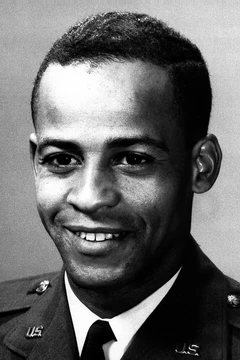
William H. Dana
X-15 pilot and lifting-body test pilot.
Last updated
William Harvey Dana (November 3, 1930 – May 6, 2014) worked as an aeronautical engineer, Air Force pilot, NASA test pilot, and astronaut. He was among the twelve pilots to fly the X-15, a joint Air Force and NASA experimental spaceplane. Dana crossed the 50-mile altitude mark on two X-15 flights, meeting the U.S. definition of space, though he never surpassed the internationally recognized Kármán line at 100 kilometers. He also took part in the X-20 Dyna-Soar program.
Test pilot and astronaut career
From 1960 through 1962 Dana was a pilot astronaut in the U.S. Air Force X-20 Dyna-Soar program. That program was canceled before the vehicle flew, but Dana later tested several other lifting-body space vehicle projects. He made one of the earliest flights in the plywood M2-F1, and flew the HL-10, the M2-F3, and the X-24B. He made the highest-ever flight in a lifting body, to 90,303 feet, in the HL-10.
He also made the final powered flight of a lifting body, in the X-24B (1975). Dana began as an engineer on the North American X-15 program. He progressed to chase pilot, and finally as project pilot on the hypersonic research aircraft. He flew the rocket-powered vehicle 16 times, reaching a top speed of 3,897 mph.
His peak altitude of 307,000 feet (nearly 59 miles high) technically qualified him for the Astronaut Badge, although he was not formally recognized as an astronaut until 2005. He was the pilot on the final (199th) flight of the 10-year program. In the late 1960s and in the 1970s, Dana was a project pilot on the manned lifting body program, which flew several versions of the wingless vehicles and produced data that helped in development of the Space Shuttle.
NASA career
He completed one NASA M2-F1, nine Northrop HL-10, nineteen Northrop M2-F3 and two Martin Marietta X-24B flights, for a total of 31 lifting body missions. Dana was Chief Engineer at NASA's Dryden Flight Research Center, Edwards Air Force Base, California, from 1993 until 1998, when he retired after almost 40 years of distinguished service to NASA. Formerly an aerospace research pilot, Dana flew the F-100 variable stability research aircraft and the Advanced Fighter Technology Integration/F-16 aircraft, as well as many others.
Before his assignment as Chief Engineer, he was Assistant Chief of the Flight Operations Division, a position he assumed after serving since 1986 as Chief Pilot. He was also a project pilot on the F-15 HIDEC (Highly Integrated Digital Electronic Control) research program, and a co-project pilot on the F-18 Hornet High Angle of Attack research program. For his service as a flight research pilot, he received NASA Distinguished Service Medal in 1997. In 2000 he was awarded the Milton O. Thompson Lifetime Achievement Award by the Dryden Flight Research Center.
Honors
For his contributions to the lifting body program, Dana received the NASA Exceptional Service Medal. In 1976 he received the Haley Space Flight Award from the American Institute of Aeronautics and Astronautics (AIAA) for his research work on the M2-F3 lifting body control systems. A member of the Society of Experimental Test Pilots, Dana is the author of several technical papers. In 1993, he was inducted into the Aerospace Walk of Honor.
During the X-15 program, eight pilots flew above 264,000 feet or 50 miles, thereby qualifying as astronauts according to the United States definition of the space border. Of these pilots, five were active-duty Air Force personnel who were awarded military astronaut wings contemporaneously with their achievements.
However, the other three, including Dana, were then-current NASA employees, and did not receive a comparable decoration at the time. In 2004, the Federal Aviation Administration conferred its first-ever commercial astronaut wings on Mike Melvill and Brian Binnie, pilots of the commercial SpaceShipOne, another spaceplane with a flight profile comparable to the X-15's. Following this in 2005, NASA retroactively awarded its civilian astronaut wings to Dana (then living), and to McKay and Walker (posthumously).
Frequently Asked Questions
When and where was William H. Dana born?
William H. Dana was born on 3 November 1930 in Pasadena, California, U.S.
When did William H. Dana die?
William H. Dana died on 6 May 2014 in Phoenix, Arizona, U.S.
Where did William H. Dana study?
William H. Dana studied at USMA, B.S. 1952 and USC, M.S. 1958.
More in People Who Have Flown in Suborbital Spaceflight
Test yourself
Three questions drawn from this entry’s sources. Pick an answer to check it.
Answers checked against the source article
Sources
Compiled from Wikipedia and the sources listed below. Text from Wikipedia is available under CC BY-SA 4.0; this entry is adapted from it.
- Wikipedia: William H. Dana (CC BY-SA 4.0).
Spotted an error? Know more?
Reader corrections go straight into our review queue. Suggest an edit · How this site is sourced