Abdullah Ansari
Sufi saint, Hanbali scholar, and Persian poet from Herat.
Last updated

via Wikipedia: Abdullah Ansari · see source
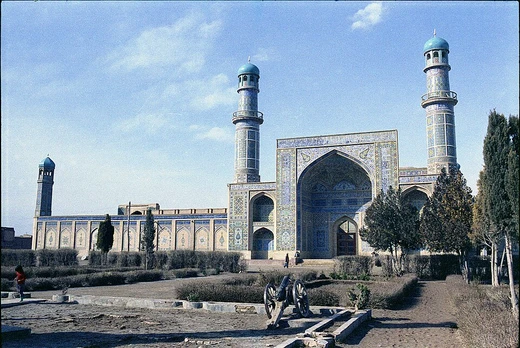
Abu Ismaïl Abdullah al-Harawi al-Ansari, also known as Pir-i Herat (Sage of Herat), was a Sufi saint, commentator on the Qur'an, and scholar of the Hanbali school who lived in Herat, Ghaznavid Empire (modern-day Afghanistan). He was noted for his oratory and poetic talents in Persian, and served as a traditionalist, polemicist, and spiritual master. His tomb in Herat remains a popular pilgrimage site, built during the Timurid dynasty.
Life
Abdullah Ansari was born in 1006 in the Kohandez, the old citadel of Herat. His father, Abu Mansur Muhammad, was a shopkeeper who had spent several years of his youth at Balkh. Ansari was a direct descendant of Abu Ayyub al-Ansari, a companion of the Islamic prophet Muhammad, being the eleventh in line from him.
The lineage is traced in family history records through a series of ancestors, each named Za’im-i-Bani Najjar, ending with Abu Ayyub al-Ansari himself. During the reign of the third Rashid Caliph, Uthman, an ancestor named Abu Mansoor al-Taabi'i took part in the conquest of Khorasan and subsequently settled in Herat. Ansari died in Herat in Dhū al-Ḥijjah 481, corresponding to February-March 1089.
He was a disciple of Abu al-Hassan al-Kharaqani and practiced the Hanbali school of Sunni jurisprudence. He excelled in the knowledge of Hadith, history, and genealogy, and wrote several books on Islamic mysticism and philosophy in Persian and Arabic. Abdullah Ansari had five children: Khwaja Jabir, Khwaja Abdurrahman, Khwaja Hashim Buzurg, Qazi Mohd Yusuf, and Qazi Mohd Naimat.
Sufism
Ansari was one of the first Sufis to write in Persian, which he wrote in a local dialect, indicating that he wanted to spread his teachings to the general populace instead of just to the ulama, who knew Arabic. His most famous work is the Munajat Namah (literally 'Litanies or dialogues with God'), considered a masterpiece of Persian literature.
After his death, many of his sayings recorded in his written works and transmitted by his students were included in the 10-volume Tafsir of Maybudi, Kashf al-Asrar (The Unveiling of Secrets), among the earliest complete Sufi exegeses of the Quran. The Hanbali jurist ibn Qayyim al-Jawziyya wrote a lengthy commentary on a treatise written by Ansari entitled Madarij al-Salikin. In this commentary, he expressed his love and appreciation for Ansari with the statement, 'Certainly I love the Sheikh, but I love the truth more!' Ibn Qayyim al-Jawziyya refers to Ansari with the honorific title 'Sheikh al-Islam' in his work Al-Wabil al-Sayyib min al-Kalim al-Tayyab.
Did You Know?
- He was one of the first Sufis to write in Persian, using a local dialect to reach the general populace rather than just Arabic-literate scholars.
- The Hanbali jurist ibn Qayyim al-Jawziyya wrote a lengthy commentary on Ansari's treatise Madarij al-Salikin, calling him 'Sheikh al-Islam'.
More in People from Herat
Sources
Compiled from Wikipedia and the sources listed below. Text from Wikipedia is available under CC BY-SA 4.0; this entry is adapted from it.
- Wikipedia: Abdullah Ansari (CC BY-SA 4.0).
Spotted an error? Know more?
Reader corrections go straight into our review queue. Suggest an edit · How this site is sourced