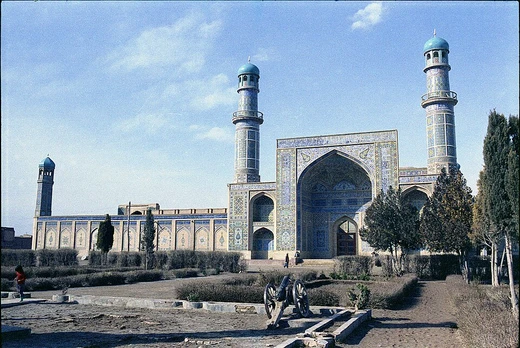
Abu Sa'id Mirza
Timurid ruler who reunified much of the empire in the mid-15th century.
Last updated

via Wikipedia: Abu Sa'id Mirza · see source
Abu Sa'id Mirza, born in 1424 and killed in 1469, ruled the Timurid Empire in the mid-1400s. Starting as a minor prince in a dynasty full of internal conflict, he rose to become the leading figure among his squabbling relatives.
Over roughly twenty years, he managed to reunite much of the empire that had splintered after his great-uncle Shah Rukh's death. His ambition to fully restore the empire to its size under Timur was never realized; he died during a military campaign into what is now western Iran. Notably, he was the paternal grandfather of Babur, who would go on to establish the Mughal Empire in India.
Initial power struggles
Abu Sa'id was given a role at Ulugh Beg's court, later receiving his daughter in marriage through good service. However, upon Ulugh Beg's ascension to the Timurid throne following Shah Rukh's death, Abu Sa'id turned against his benefactor. In 1449, while Ulugh Beg was suppressing the rebellion of his son Abdal-Latif, Abu Sa'id left his post on the northern borders and used a group of Arghun tribesmen to lead an attack on the capital Samarqand. Ulugh Beg's other son Abdal-Aziz retreated to the citadel and warned his father, who marched his army back to the city, forcing Abu Sa'id to retreat.
However, Abdal-Latif used this distraction to his advantage, pursuing and defeating Ulugh Beg, whom he had assassinated soon after. Abu Sa'id led his forces against his cousin, but was also defeated and taken captive. Abu Sa'id escaped his imprisonment in Samarqand in 1450, fleeing to Bukhara.
He found little support there and was imprisoned, only being spared execution when news of Abdal-Latif's death reached the city. The Bukhari nobles hastened to release the prince and swore their allegiance to him, upon which he immediately marched against the new ruler, Ulugh Beg's nephew Abdullah Mirza. After an initial failed assault on Samarqand, Abu Sa'id and his small group of followers seized the frontier town of Yasi.
When Abdullah marched his forces out in retaliation, Abu Sa'id appealed to the Uzbek ruler Abu'l-Khayr Khan for aid. The latter agreed and their combined forces defeated Abdullah in June 1451. Given that his rival was killed during the battle, the victors were able to enter Samarqand unopposed. Abu Sa'id claimed the Timurid throne and in thanks to the Uzbeks, gave Abu'l-Khayr Khan rich presents as well as Ulugh Beg's daughter in marriage.
Reign
When Abu Sa'id annexed Balkh in 1454, another Timurid, Abul-Qasim Babur of Herat, led his forces against him in response, culminating in a siege on Samarqand. However, the two sides eventually agreed on a truce, establishing the Amu Darya river as a border. This treaty remained in effect until Abul-Qasim Babur's death in 1457, when his young son and successor Mahmud was ousted from Herat by Ibrahim Mirza, a great-nephew of Ulugh Beg. Abu Sa'id, who desired to conquer the city as well as the surrounding region of Khorasan, led his forces against Ibrahim, forcing the latter to flee.
However, he was unable to capture the city until 1456. The following year, Abu Sa'id had Shah Rukh's aged widow, the influential dowager-empress Gawhar Shad executed, having accused her of conspiring with Ibrahim, who was her great-grandson. Noting the conflict among the Timurid princes, Jahan Shah, ruler of the Qara Qoyunlu, took advantage of the situation and marched his forces into the region, capturing Herat in 1458. However, as he was facing a revolt by his son Hasan Ali, he was forced to abandon his latest conquests, allowing the re-annexation of Khorasan by Abu Sa'id, who subsequently made Herat his capital.
Friendly relations were established between the two rulers, with multiple embassy missions taking place throughout the 1460s. In 1459, he defeated the combined forces of the three Timurid princes, Sultan Sanjar, Ibrahim Mirza and Ala al-Dawla, in the Battle of Sarakhs. Sanjar was captured and executed after the battle and the latter two died in exile in the following years. With the deaths of so many rivals, Abu Sa'id now had the resources to extend his dominion up to Mazandaran and Sistan.
War with the Aq Qoyunlu
The sultan even succeeded in conquering Badakhshan, a region which Timur himself had gained only nominal suzerainty over. Towards the end of 1467, Abu Sa'id received word of the death of Jahan Shah at the hands of Uzun Hasan, the ruler of the Aq Qoyunlu. Under the pretext of responding to Jahan Shah's son Hasan Ali's appeal for aid, Abu Sa'id launched a campaign against the Aq Qoyunlu in February 1468. The campaign was impulsive, with little initial planning.
He advanced without waiting for all his troops to arrive, failing to ensure adequate reserves. Though he dislodged the Aq Qoyunlu governors of Iraq-i Ajam and Fars, and had his authority recognised in areas such as Gilan, he did not establish order in the hinterland. Some important strongholds were bypassed, such as the city of Ray. Upon the arrival of the Timurid army in Miyana, Abu Sa'id was joined by former amirs of Jahan Shah as well as 50,000 Turkmen troops.
Jahan Shah's sons Yusuf and Hasan Ali, and the latter's son Amirzada Ali, also lent their support. When the army reached the banks of the Araxes, the Shirvanshah Farrukh Yassar too joined the coalition. Despite this strength, the Timurid army soon faced serious supply issues due to the Azerbaijani winter and vulnerable supply routes back to Khorasan, stretching over 1200 miles. A supply column was intercepted by Uzun Hasan, who also blocked off access to ships carrying provisions from Shirvan.
Administration
Abu Sa'id brought stability to his empire, but his rise involved considerable bloodshed, with murders and executions surpassing those of Timur's reign. The scholar Khwandamir reports that court officials were deposed and sometimes killed for misappropriating funds, including vizier Qutb al-Din Simnani. In 1462, army tax-collector Khwaja Mu'izz al-Din and moneychanger Shaikh Ahmad were accused of bribery and extortion; Shaikh Ahmad was skinned alive at Herat's gates, and Khwaja Mu'izz al-Din was boiled in a cauldron at the citadel.
Women could also be caught in court intrigues, as with the execution of Gawhar Shad, which contemporary chroniclers viewed negatively. Abu Sa'id relied on the Arghun tribe, who had elected him their chief; his chief wife was an Arghun lord's daughter. He consolidated power through generous grants of fiefs to tribe members, his sons, and dignitaries.
Legacy
Abu Sa'id is viewed favourably for maintaining a large, cohesive dominion for nearly two decades amid continual warfare. The historian Mīr-Khvānd described him as supreme among Timur's house in enterprise, rank, and discernment, and a patron of scholars. However, he failed to restore the empire to its extent under Timur or Shah Rukh, and within forty years of his death nearly all his territories were lost to invasions. These losses pushed his grandson Babur to begin conquests in India, leading to the Mughal Empire.
Did You Know?
- Abu Sa'id was the second son of Muhammad Mirza, a son of Miran Shah, who was the third son of Timur.
- In 1457, Abu Sa'id executed the dowager-empress Gawhar Shad, accusing her of conspiring with her great-grandson Ibrahim Mirza.
Frequently Asked Questions
When and where was Abu Sa'id Mirza born?
Abu Sa'id Mirza was born in 1424 in Herat, Timurid Empire (present-day Afghanistan).
When did Abu Sa'id Mirza die?
Abu Sa'id Mirza died on 5 February 1469.
More in People from Herat
Sources
Compiled from Wikipedia and the sources listed below. Text from Wikipedia is available under CC BY-SA 4.0; this entry is adapted from it.
- Wikipedia: Abu Sa'id Mirza (CC BY-SA 4.0).
Spotted an error? Know more?
Reader corrections go straight into our review queue. Suggest an edit · How this site is sourced