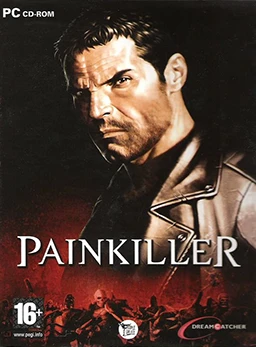
Painkiller: Deathmatch (2005)
Hell's fastest arena, where every bullet is a war cry and every kill is a baptism in fire.
Painkiller: Deathmatch is a 2005 downloadable expansion for the original Painkiller first-person shooter, developed by Flying Dog Games and published by Activision. Rather than adding a new single-player campaign, it focused almost entirely on expanding the multiplayer experience, introducing dedicated deathmatch maps, additional weapons, and refined competitive modes built around the game's signature high-speed, demon-slaying combat.
As a post-launch content package, it served as a bridge between the original 2004 release and the broader Painkiller franchise, giving the community a purpose-built arena for fast-paced multiplayer while reinforcing the series' identity as one of the most kinetic FPS titles of its era.
Quick Facts
- Developer
- Flying Dog Games
- Publisher
- Activision
- Platform
- PC (Windows)
- Release year
- 2005
- Type
- Downloadable expansion; multiplayer DLC
- Engine
- Unreal Engine 2
- Genre
- First-person shooter; Deathmatch
Lore & Background
In the cosmology of Painkiller, the protagonist Malik is the son of a legendary demon hunter who perished battling the forces of Hell. Armed with a revolver, a shotgun, and a chain-saw, Malik descends into the infernal realms to purge the demons that have broken through into the mortal world. The world is a cacophony of molten rock, jagged obsidian spires, rivers of liquid fire, and skies choked with the shrieks of the damned. Combat is brutal, close-quarters, and relentless—Malik does not merely shoot demons; he rips, saws, and hurls them back into the pit they came from.
Painkiller: Deathmatch transplanted that same infernal intensity into a competitive multiplayer framework. The maps were designed as tight, vertical arenas where players could chain-saw, shotgun, and rocket their way through waves of opponents in seconds. The emphasis was on momentum: a player who fell behind could catch up with a single well-timed close-range kill, keeping matches chaotic and unpredictable. The aesthetic remained faithful to the single-player campaign—brimstone, bone, and black flame—so that even in a purely competitive context, the player felt they were fighting inside Hell itself.
The expansion reinforced a core identity the series would carry forward: that a first-person shooter could be both a visceral action spectacle and a competitive sport, without sacrificing the over-the-top, pulp-horror tone that set Painkiller apart from the more restrained shooters of the mid-2000s.
Reader's Guide
Flying Dog Games approached Painkiller: Deathmatch as a focused, community-driven expansion rather than a full sequel. The studio's creative process centered on map design and weapon balance, iterating on arena layouts to encourage close-quarters engagements and vertical movement. The Unreal Engine 2 underpinning allowed the team to push particle effects, dynamic lighting, and the signature slow-motion kill sequences into the multiplayer environment, giving each takedown a cinematic punch that standard deathmatch shooters of the era lacked.
Motion-capture and hand-keyed animation combined to produce the over-the-top kill moves—chain-saw takedowns, shotgun blasts that sent opponents tumbling—that became a hallmark of the series. The engine's networking stack was tuned for low-latency competitive play, a notable technical effort for a mid-2000s DLC.
Critical reception of the original Painkiller was generally positive, with reviewers praising its speed, style, and the sheer fun of its combat. Painkiller: Deathmatch was received as a solid, if modest, addition that gave the multiplayer mode the polish it needed. The franchise's lasting influence is felt in the wave of fast-paced, style-forward shooters that followed, where momentum, close-range spectacle, and a sense of cinematic violence became expected rather than exceptional.
Did You Know?
- Painkiller: Deathmatch was designed as a downloadable expansion, not a full retail release, making it one of the earlier examples of a paid multiplayer-focused DLC for a PC FPS.
- The original Painkiller's protagonist, Malik, is the son of a previous demon hunter, tying the character into a generational lineage of Hell-fighters.
- Flying Dog Games, the studio behind the Painkiller series, later rebranded as Flying Wild Hog and went on to develop the 2013 Painkiller reboot.
- The game's signature chain-saw weapon could be used both as a melee weapon and as a projectile, a design choice that became one of the series' most memorable mechanical quirks.
More in Development & Legacy
Elsewhere in Painkiller
Spotted an error? Know more?
Reader corrections go straight into our review queue. Suggest an edit · How this site is sourced