
Geosynchronous orbit
An Earth orbit synchronized with the planet's rotation.

MikeRun · CC BY-SA 4.0
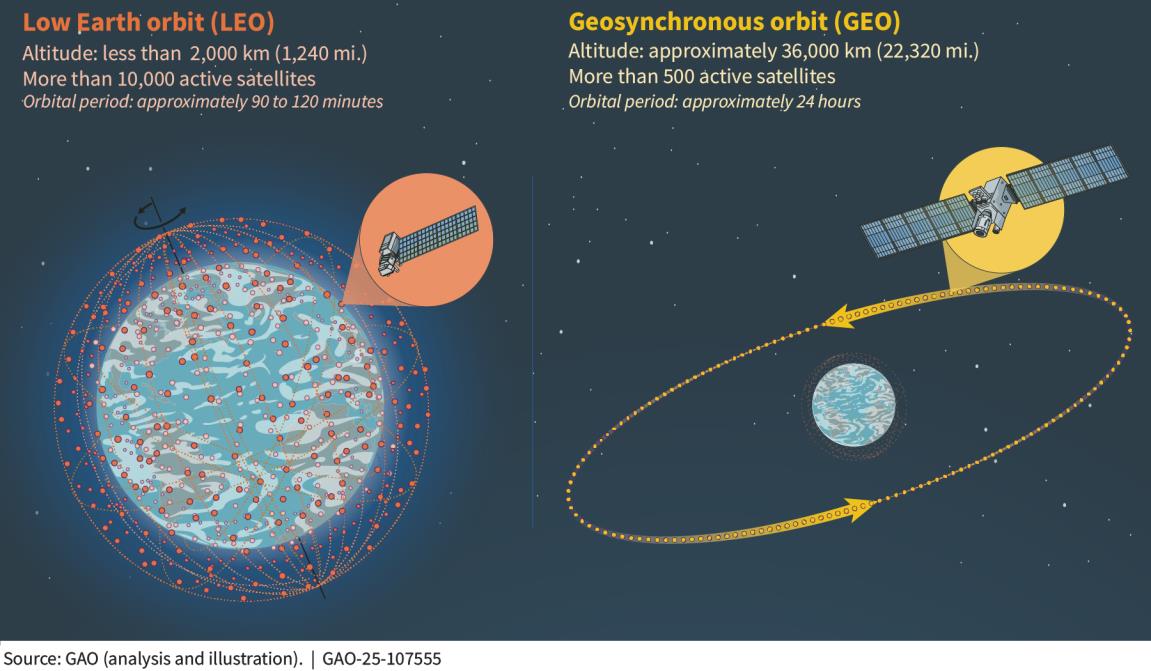
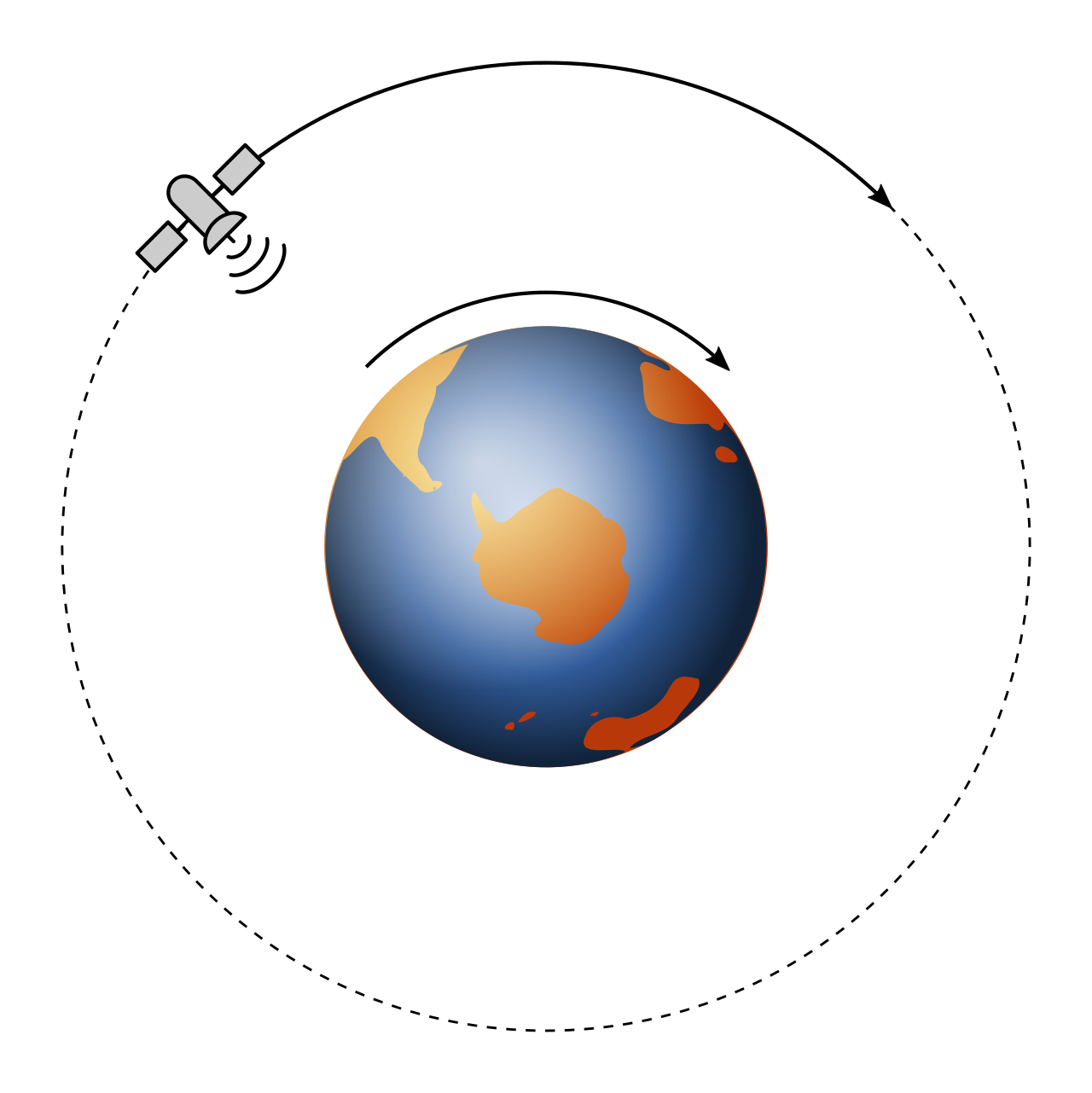
A geosynchronous orbit (GEO) is an Earth-centered orbit where a satellite's orbital period precisely matches Earth's sidereal day of 23 hours, 56 minutes, and 4 seconds. This synchronization means that, from the ground, the satellite returns to the exact same point in the sky every sidereal day. Over the course of a day, the satellite's apparent motion can either be stationary or trace a figure-8 pattern, depending on the orbit's inclination and eccentricity. A circular geosynchronous orbit maintains a constant altitude of 35,786 kilometers. The most important special case is the geostationary orbit (GSO), a circular, equatorial geosynchronous orbit with zero inclination and zero eccentricity. A satellite in geostationary orbit appears fixed in the sky to observers on the surface, making it ideal for communications, as ground antennas can be permanently pointed at one location. The concept was first described in 1929 by Herman Potočnik for space stations, and later popularized by Arthur C. Clarke in a 1945 paper on relay satellites, leading to the orbit sometimes being called the Clarke Orbit. The first functional geosynchronous satellite, Syncom 2, was launched in 1963 after initial skepticism about the feasibility and cost. Today, hundreds of such satellites provide remote sensing, navigation, and communications, though many populated areas now rely on terrestrial fiber-optic and microwave links.
- type
- Orbit
- orbital_period
- 23 hours, 56 minutes, 4 seconds (one sidereal day)
Lore & Background
A geosynchronous orbit is an Earth-centered orbit where the satellite’s orbital period matches Earth’s sidereal day—23 hours, 56 minutes, and 4 seconds. This synchronization means that, from the ground, the satellite returns to the same point in the sky once per day. Over a day, its apparent motion can be stationary or trace a figure-8 path, depending on the orbit’s inclination and eccentricity. A circular geosynchronous orbit maintains a constant altitude. A special, ideal case is the geostationary orbit, which is circular, has zero inclination and eccentricity, and lies in Earth’s equatorial plane. A satellite in geostationary orbit appears fixed in the sky, making it valuable for communications because ground antennas can be aimed permanently at that spot. The concept was first described in 1929 by Herman Potočnik for space stations. It appeared in popular fiction in 1942, in a story by George O. Smith. Arthur C. Clarke popularized the orbit in a 1945 paper, proposing it for broadcast and relay satellites, leading to the terms Clarke Orbit and Clarke Belt. The first functional geosynchronous satellite, Syncom 2, was designed by Harold Rosen at Hughes Aircraft in 1959, inspired by Sputnik 1. Despite early skepticism about rocket power and satellite longevity, Rosen’s team built a lightweight, spin-stabilized cylindrical prototype by 1961. Syncom 2 reached orbit in 1963; though its inclined orbit required moving antennas, it relayed TV and enabled a phone call between President John F. Kennedy and the Nigerian prime minister. Today, hundreds of such satellites provide remote sensing, navigation, and communications.
Reader's Guide
Geosynchronous orbits are foundational to modern global communications, remote sensing, and navigation, with hundreds of satellites currently in such orbits. The geostationary variant allows ground antennas to be pointed permanently at a fixed sky location, eliminating the need for tracking—a critical advantage for communications satellites. However, maintaining a perfectly stable geostationary orbit requires station-keeping to counter perturbations from solar wind, radiation pressure, gravitational variations, and lunar/solar effects. Without thrusters, the orbit becomes inclined, oscillating between 0° and 15° every 55 years. While most populated areas now have terrestrial communications with latency and bandwidth advantages, some rural and remote regions in developed countries still rely on satellite communications. The Tundra orbit and Quasi-Zenith orbit are specialized geosynchronous orbits used for high-latitude coverage and urban canyon signal penetration, respectively.
Theoretical Foundations of Orbital Mechanics
Orbital mechanics, also known as astrodynamics or space dynamics, sits at the intersection of ballistics and celestial mechanics, applying Newton's laws of motion and universal gravitation to predict the paths of rockets, satellites, and other spacecraft. While Newtonian physics handles the vast majority of trajectory calculations, general relativity provides a more exact theoretical framework that becomes necessary in high-gravity environments, such as orbits passing close to the Sun. The discipline encompasses orbital maneuvers, plane changes, and interplanetary transfers, equipping mission planners with the tools to forecast the precise outcomes of every propulsive adjustment. It stands as a core pillar of space-mission design and control, distinct from the broader field of celestial mechanics, which also governs the gravitational dynamics of star systems, planets, moons, and comets.
A Three-Century Lineage of Discovery
Before the twentieth century, orbital mechanics and celestial mechanics were essentially indistinguishable. Johannes Kepler broke new ground in 1609 by accurately modeling planetary orbits, and Isaac Newton expanded the theoretical framework in his 1687 Principia, introducing a method to determine a parabolic orbit from just three observations. Edmund Halley put that method to work, establishing the paths of several comets. Leonhard Euler formalized Newton's successive-approximation technique into an analytic method in 1744, and Johann Lambert later extended it to elliptical and hyperbolic trajectories. Carl Friedrich Gauss achieved a landmark in 1801 by recovering the dwarf planet Ceres using only three positional observations to solve for six orbital elements. The field was formally termed space dynamics around the time of Sputnik, and its history remains almost entirely shared with celestial mechanics.
The Counter-Intuitive Physics of Rendezvous
One of the most surprising aspects of orbital mechanics is how counter-intuitive the physics of rendezvous and docking can be. If a trailing spacecraft in a circular orbit simply fires its engines to close the gap with a leading craft, the added velocity actually raises its orbit, causing it to slow down and drift farther away rather than catch up. A proper docking therefore requires multiple precisely timed engine burns spread across several orbital periods, often taking hours or even days. Similarly, a single brief thrust cannot transfer a satellite between two circular orbits; instead, it creates an elliptical path whose apoapse or periapse lands 180 degrees from the firing point. These constraints mean that what feels like a straightforward speed-up-to-catch-up maneuver is, in practice, a multi-step choreography governed by Kepler's laws.
From Blackboard Mathematics to Spaceflight
The practical techniques of astrodynamics have a long lineage. Samuel Herrick, an astronomer, began developing the discipline in the 1930s, encouraged by rocket scientist Robert Goddard, who foresaw the need for space navigation methods. For decades the mathematics remained largely theoretical, but the coupling of numerical astrodynamics techniques with the powerful computers of the 1960s transformed the field and made crewed lunar missions possible. Today, orbit determination and prediction underpin the operation of every satellite and space probe, since operators must know future positions to extreme precision. The same mathematical heritage that Gauss applied to recovering Ceres now powers GPS receivers and the tracking and cataloguing of newly discovered minor planets, bridging three centuries of celestial mechanics with the demands of modern spaceflight.
Gallery
Frequently Asked Questions
What exactly is a geosynchronous orbit?
It is an Earth-centered orbit whose period equals one sidereal day—23 hours, 56 minutes, and 4 seconds—so the object returns to the same sky position every rotation. Depending on its tilt and shape, the object may look frozen in place or sweep out a figure-8 track.
What is the difference between geosynchronous and geostationary orbit?
Geostationary is a narrow special case of geosynchronous where the orbit is perfectly circular and lies in the equatorial plane, locking the satellite to a single longitude. A general geosynchronous orbit can carry inclination or eccentricity, causing the object to drift in a figure-8 rather than sitting still.
More in Orbits And Celestial Mechanics 1-24
Spotted an error? Know more?
This is a living reference — every entry is fact-audited, and reader corrections feed straight into our audit queue. Suggest an edit · See this site's audit record