
RGB color model
Additive color model foundational to electronic displays and imaging.

Danny William Wilson · CC BY-SA 4.0
The RGB color model works by adding together red, green, and blue light. Its name comes from the first letters of these three additive primary colors. This model is mainly used to sense, represent, and display images in electronics like televisions and computers, though it also appeared in older photography and colored lighting. Even before electronics, the theory behind RGB was well established, grounded in how humans perceive color.
Because different devices—such as monitors, cameras, or screens—use different materials (like phosphors or dyes) that respond to red, green, and blue levels in their own way, RGB is device-dependent. The same RGB value can look different on one device versus another, or even on the same device over time. Without color management, an RGB value does not guarantee the same color across devices.
Typical input devices that use RGB include color TV and video cameras, image scanners, and digital cameras. Output devices include various TV technologies (CRT, LCD, plasma, OLED, quantum dots), computer and phone displays, video projectors, multicolor LED screens, and large displays like Jumbotrons. Color printers, however, are not RGB devices; they use the subtractive CMYK color model.
To create a color with RGB, three beams of light—one red, one green, one blue—are superimposed, either emitted from a black screen or reflected from a white screen. Each beam is a component of the final color, and its intensity can range from fully off to fully on. The model is additive because when light beams overlap, their emission spectra add up wavelength by wavelength to form a new spectrum. This is the opposite of subtractive models like CMY, used for paints and inks, where combining colors multiplies their reflection spectra.
If the resulting spectrum from adding three colors is flat, the human eye perceives white when the light hits the retina directly. In subtractive models, the perceived spectrum comes from dyed surfaces. A dye filters out all colors except its own; two blended dyes filter out everything except their common color component—for example, green is the common component between yellow and cyan, red between magenta and yellow, and blue-violet between magenta and cyan. Magenta, cyan, and yellow share no common component, so their mix gives a spectrum of zero intensity: black.
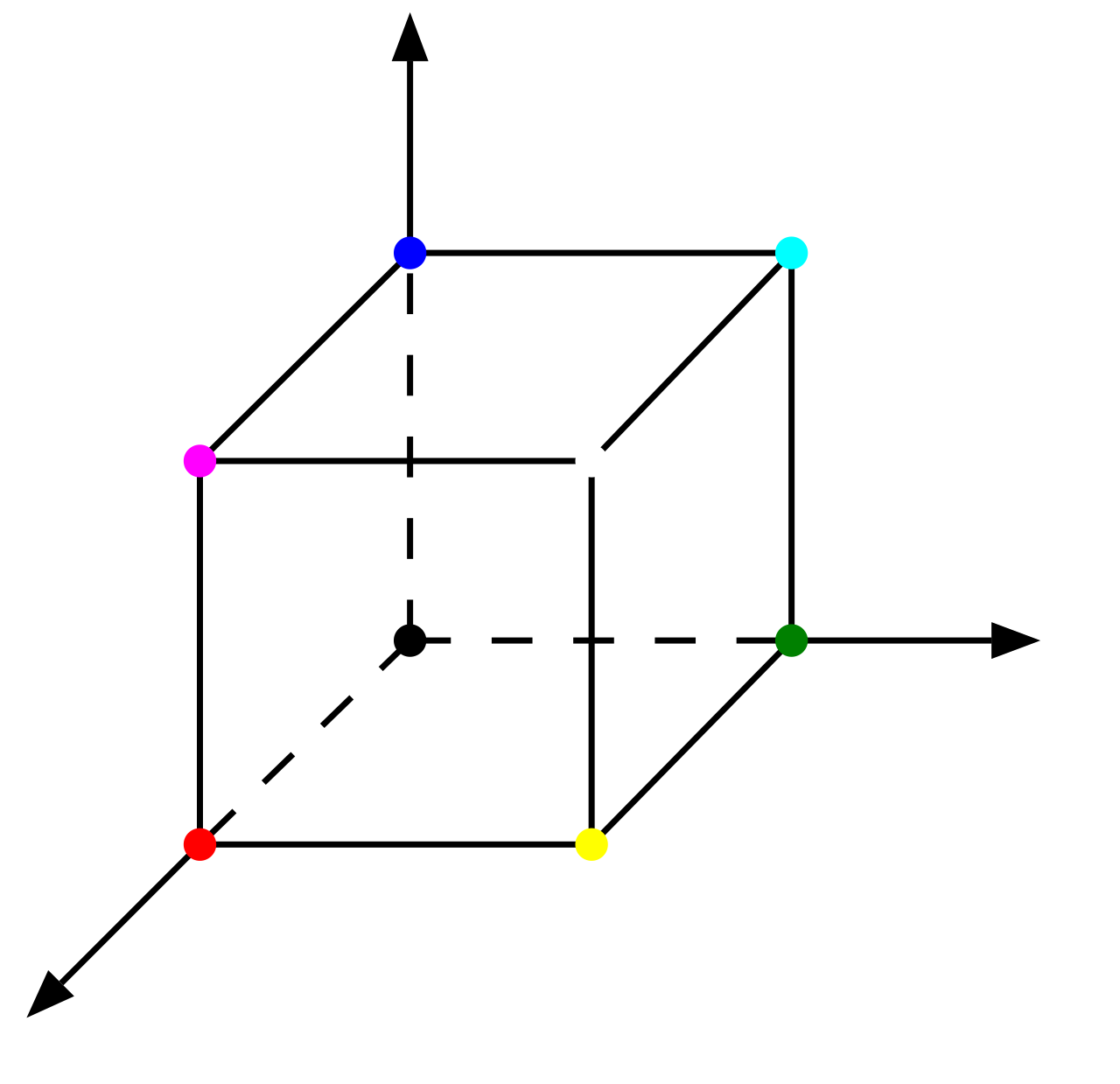
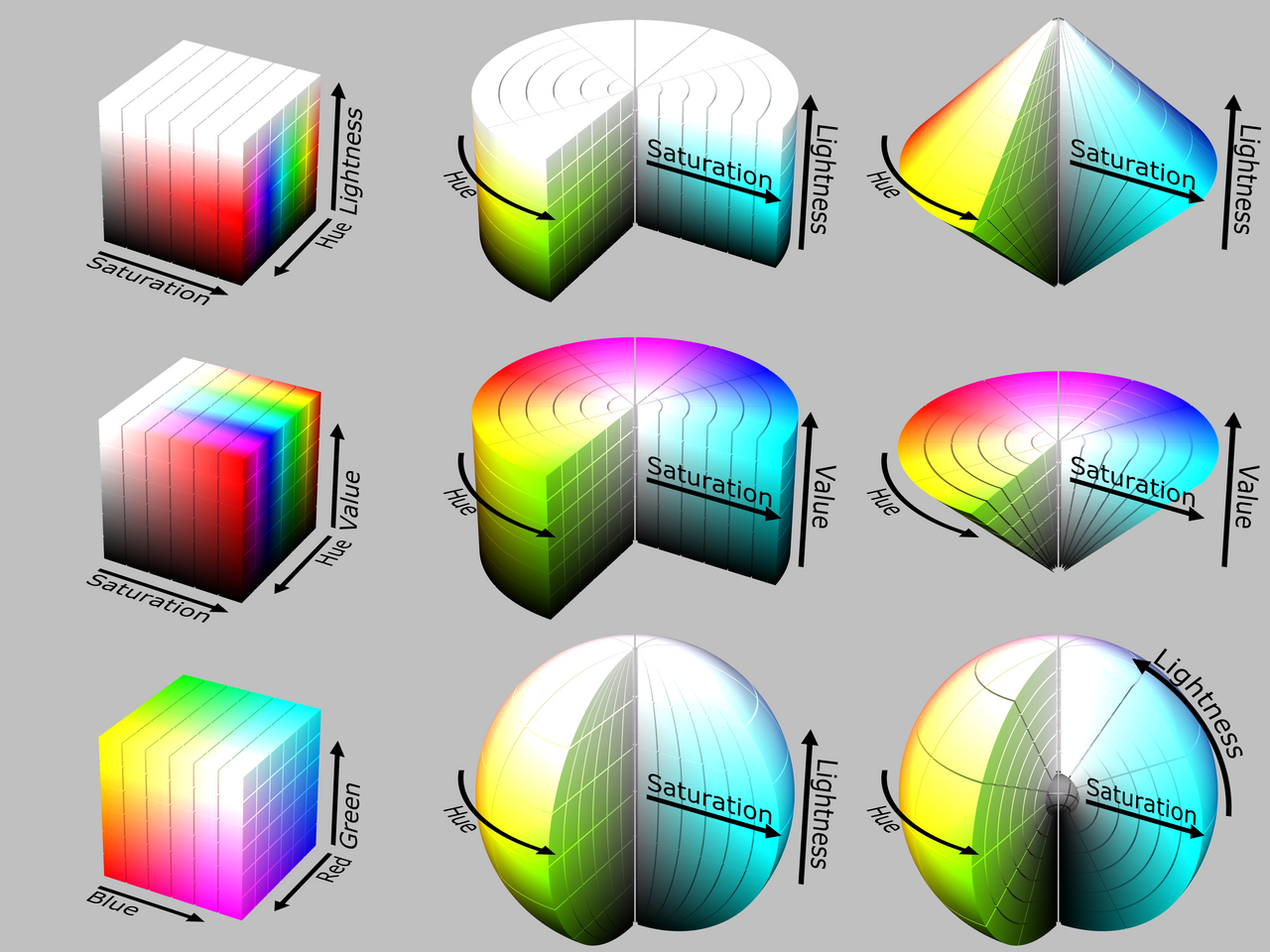
Zero intensity for all components produces the darkest color (black, or no light), while full intensity for all produces white. The quality of that white depends on the primary light sources; if balanced correctly, it matches the system’s white point. When all component intensities are equal, the result is a shade of gray—darker or lighter depending on the intensity. When intensities differ, the result is a colored hue, more or less saturated based on the difference between the strongest and weakest primary intensities.
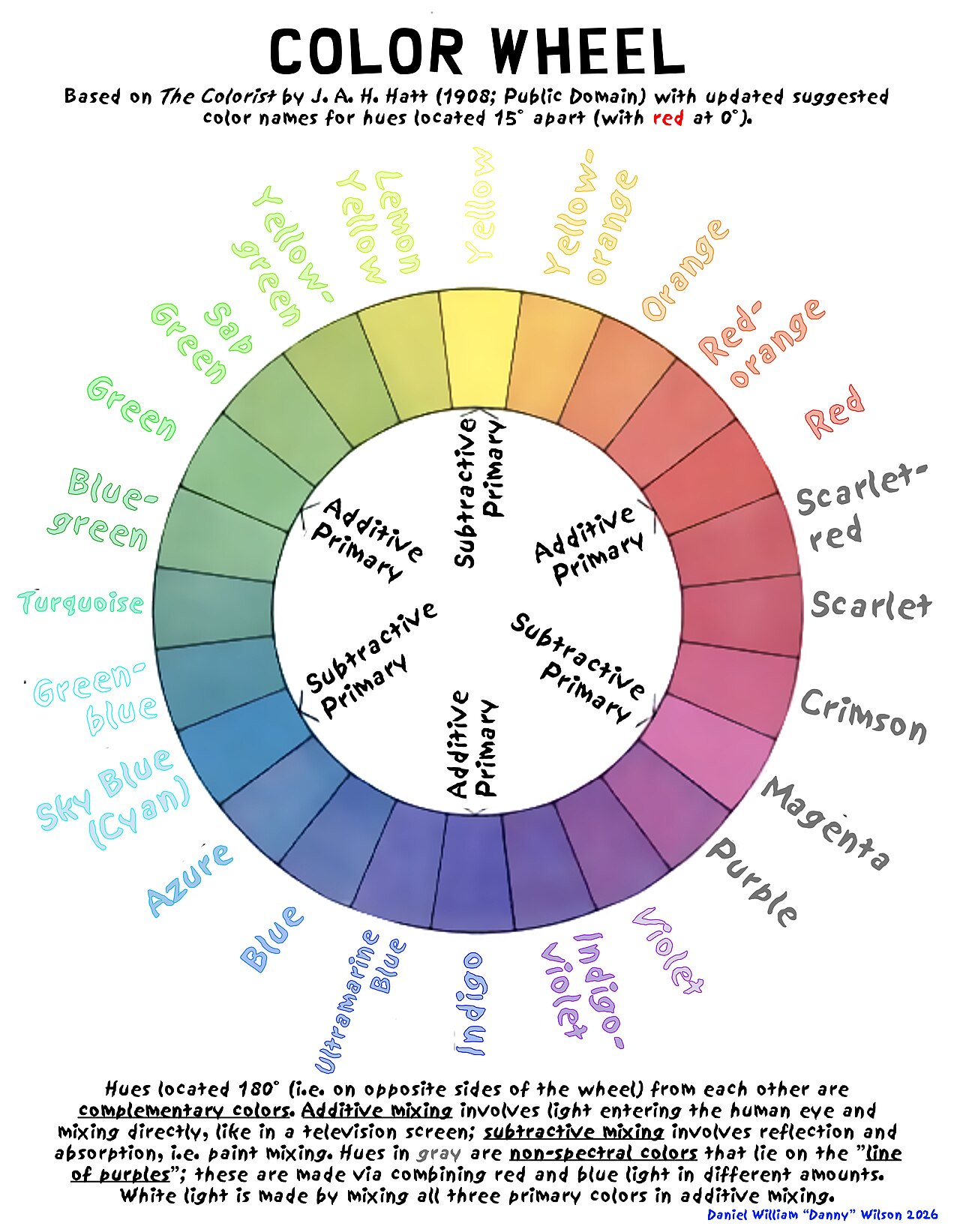
If one component has the strongest intensity, the color is a hue near that primary (reddish, greenish, or bluish). If two components share the same strongest intensity, the color is a hue of a secondary color (cyan, magenta, or yellow). A secondary color comes from adding two equal-intensity primaries: cyan is green plus blue, magenta is blue plus red, and yellow is red plus green. Each secondary color is the complement of one primary: cyan complements red, magenta complements green, and yellow complements blue. Mixing all primaries equally gives white.
The RGB model itself does not define what red, green, and blue mean colorimetrically, so mixing results are relative to the primaries used. When exact chromaticities for the red, green, and blue primaries are set, the model becomes an absolute color space, like sRGB or Adobe RGB.
The choice of red, green, and blue as primaries relates to human eye physiology. Good primaries maximize the difference in responses from the three types of cone cells in the retina, creating a large color triangle. These cones respond most to yellow (long wavelength), green (medium), and violet (short) light, with peak sensitivities near 570 nm, 540 nm, and 440 nm. The brain uses differences in signals from these three cone types to distinguish a wide range of colors, while being most sensitive overall to yellowish-green light and to hue differences in the green-to-orange range. For example, orange light (roughly 577–597 nm) activates both medium and long-wavelength cones, but the long-wavelength ones respond more. The brain detects this difference, which is how we perceive orange.
- field
- Color science, electronic imaging
- known_for
- Additive color model using red, green, and blue primaries
- based_on
- Young–Helmholtz theory of trichromatic color vision (19th century)
Lore & Background
The RGB color model is based on the Young–Helmholtz theory of trichromatic color vision, developed by Thomas Young and Hermann von Helmholtz in the early to mid-nineteenth century, and on James Clerk Maxwell's color triangle elaborated around 1860. The theory found that red, green, and violet (instead of blue) make up all sensations of color. The RGB model is additive: three light beams (red, green, blue) are superimposed, and their emission spectra add wavelength for wavelength. When all three are at full intensity and balanced, the result is white; zero intensity gives black. Equal intensities produce shades of gray. The model is device-dependent, meaning the same RGB value can appear differently on different devices without color management.
Reader's Guide
The RGB color model is the cornerstone of modern electronic imaging, underpinning the operation of televisions, computer monitors, digital cameras, scanners, and video projectors. Its additive nature—where light beams are superimposed—contrasts with subtractive models like CMYK used in printing. The choice of red, green, and blue primaries is rooted in human physiology: the cone cells of the retina respond most to long (yellowish), medium (green), and short (violet) wavelengths, and the RGB primaries maximize differences in cone responses to create a large color triangle. However, not all colors can be reproduced; only those within the triangle defined by the primaries' chromaticities. The model itself does not define absolute colors; when exact chromaticities are specified, it becomes an absolute color space such as sRGB or Adobe RGB. The model's device dependence means that consistent color reproduction across devices requires color management.
Did You Know?
- The RGB color model is based on the Young–Helmholtz theory of trichromatic color vision, which originally identified red, green, and violet as the primary colors.
The Additive Mixing Principle
The RGB model operates on a fundamentally additive logic: when red, green, and blue light beams are superimposed—whether emitted from a dark screen or reflected off a white one—their emission spectra combine wavelength by wavelength to produce a new, resulting spectrum. This stands in direct opposition to subtractive color mixing, where pigments and dyes filter light rather than emit it. In the additive framework, zero intensity across all three components yields black (the absence of light), while full intensity on each produces white. Equal intensities generate shades of gray, and unequal intensities create saturated hues. When two primaries share the strongest intensity, the result is a secondary color: cyan from green and blue, magenta from blue and red, yellow from red and green. Each secondary color serves as the complement of the remaining primary. The model itself, however, does not prescribe absolute chromaticities for its primaries; only when specific chromaticities are fixed does it become an absolute color space like sRGB or Adobe RGB.
The Biology Behind the Choice of Primaries
The selection of red, green, and blue as additive primaries is rooted in the physiology of human vision. Effective primaries are those that maximize the differential response among these three cone types, thereby creating a large color triangle in chromaticity space. The brain interprets this asymmetric activation as the perception of orange. This differential signaling mechanism is what allows humans to distinguish a wide gamut of hues, with particular acuity in the green-to-orange region. Importantly, even with three well-chosen primaries, additive mixing can only reproduce colors that fall within the triangle defined by their chromaticities; colors outside that boundary remain unreachable.
Device Dependency and the Need for Color Management
A critical limitation of the RGB model is its inherent device dependency. Because the physical color elements—phosphors, dyes, or other emitters—differ from one manufacturer to another, and can even drift within a single device over time, a given set of RGB values will not necessarily produce the same perceived color on every screen or sensor. This means that without some form of color management, an RGB triplet is only a relative specification, tied to the particular hardware interpreting it. The model itself does not define what red, green, or blue mean in absolute colorimetric terms; the mixing results are always relative to whatever primaries the device employs. Only when the exact chromaticities of the three primaries are explicitly fixed does the model transition into an absolute color space, such as sRGB or Adobe RGB, providing a consistent reference that transcends individual hardware. This distinction between relative and absolute specification is central to understanding why color reproduction across different displays, cameras, and printers demands careful calibration.
Practical Applications and the RGB–Subtractive Divide
The RGB model serves as the foundational framework for sensing, representing, and displaying images across electronic systems. Typical input devices include color television cameras, video cameras, image scanners, and digital cameras, all of which capture light and decompose it into red, green, and blue components. On the output side, the model underpins an enormous range of display technologies: CRT televisions, LCD panels, plasma screens, OLED displays, quantum-dot systems, computer and mobile phone screens, video projectors, multicolor LED arrays, and large-format installations like the Jumbotron. Notably, color printers do not operate on RGB principles; they are subtractive devices that typically employ the CMYK model, where inks absorb rather than emit light. Before the electronic era, the theoretical groundwork for additive color mixing was already well established, grounded in the science of human color perception. The model has also found applications in conventional photography and colored lighting, extending its reach well beyond the digital displays most people associate with it today.
Gallery
More in Optics And Color 1-15
Spotted an error? Know more?
This is a living reference — every entry is fact-audited, and reader corrections feed straight into our audit queue. Suggest an edit · See this site's audit record