
Gloss (optics)
Optical property describing specular light reflection from surfaces.

Dura-Gloss / Lorr Laboratories · Public domain
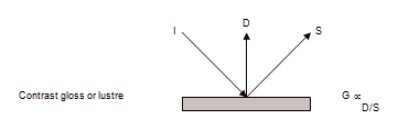
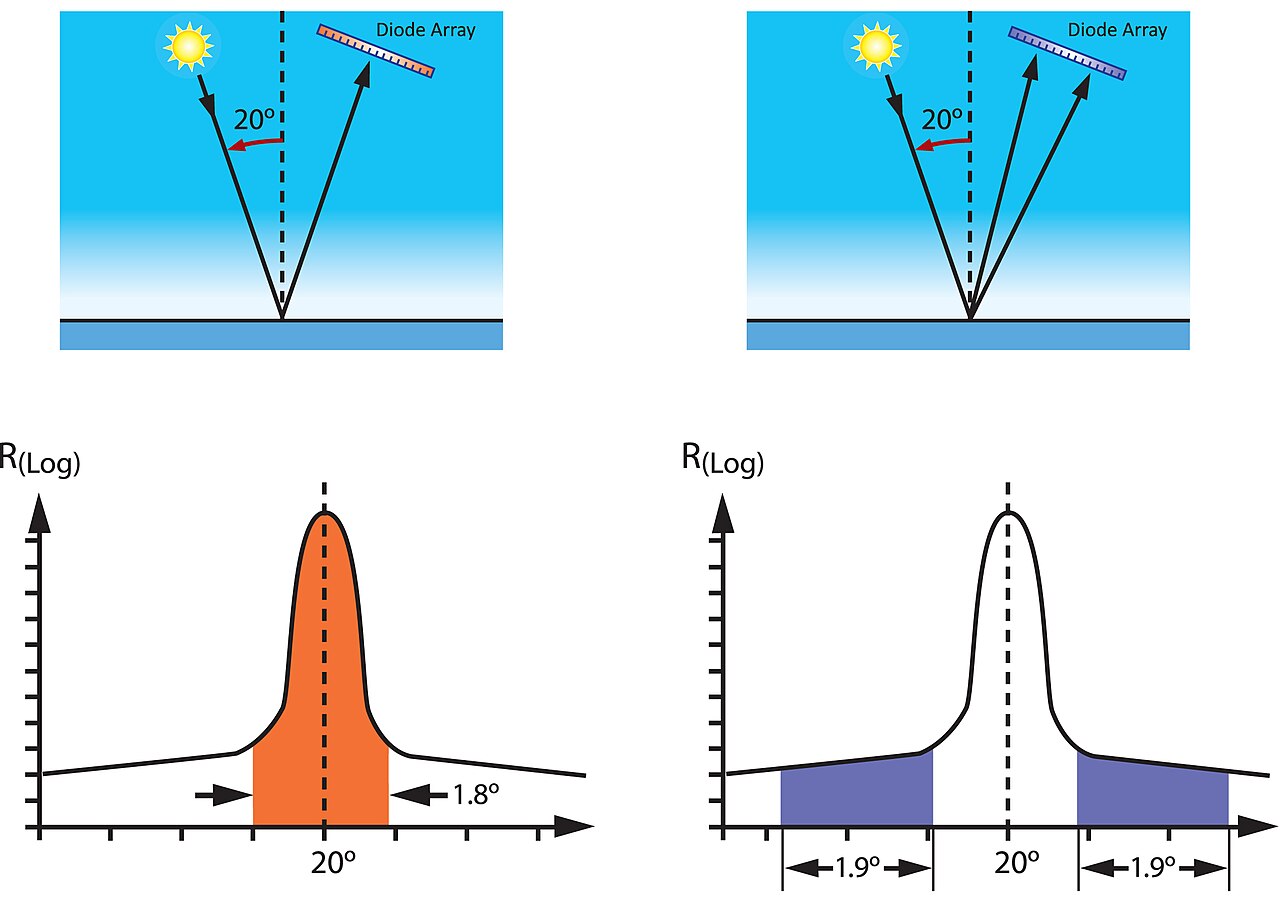
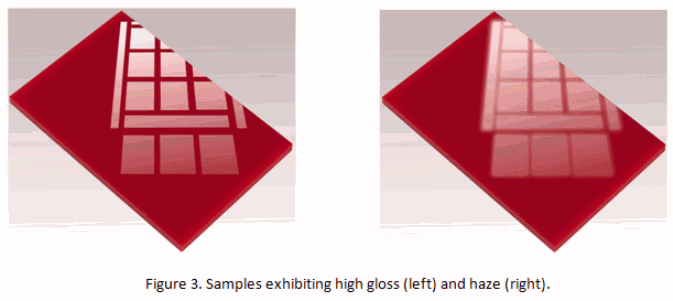
Gloss is an optical property that describes how effectively a surface reflects light in a specular, or mirror-like, direction. It is a key parameter for characterizing an object's visual appearance and falls under the concept of cesia, a three-variable ordering system that also includes other aspects of regular and diffuse light reflection and transmission. The level of gloss depends on the material's refractive index, the angle of incoming light, and the surface texture. Apparent gloss is determined by comparing the amount of specular reflection—where light bounces off at an equal and opposite angle to the incident light—against diffuse reflection, which is light scattered in various directions.
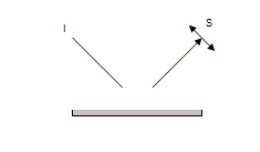
When light hits an object, it can be absorbed (mainly affecting color), transmitted (depending on transparency and opacity), scattered from or within the surface (producing diffuse reflection, haze, and transmission), or specularly reflected (gloss). Surface texture directly controls specular reflection: smooth surfaces, such as those that are highly polished or coated with finely dispersed pigments, appear shiny because much light reflects specularly, while rough surfaces scatter light in all directions, appearing dull with blurred and distorted reflections. The substrate material also matters. Non-metallic materials like plastics reflect more light at steeper illumination angles because some light is absorbed or diffusely scattered based on the material's color. Metals, however, reflect strongly at any angle without this effect. The Fresnel formula calculates specular reflectance for unpolarized light, relating the intensity of the reflected beam to the incident beam based on the angle of incidence and the surface's refractive index.
- field
- Optics
- known_for
- Specular reflection and surface appearance
- key_factors
- Refractive index, angle of incident light, surface texture
- related_concept
- Cesia
Lore & Background
Gloss depends on the amount of specular reflection compared to diffuse reflection. When light illuminates an object, it can be absorbed, transmitted, scattered, or specularly reflected. Variations in surface texture directly influence the level of specular reflection: smooth surfaces appear shiny due to large amounts of specular reflection, while rough surfaces scatter light and appear dull. Substrate material type also influences gloss; non-metallic materials produce higher reflected light at greater illumination angles, while metals produce higher amounts of reflection at any angle. The Fresnel formula gives the specular reflectance for unpolarized light, relating the intensity of the reflected beam to the angle of incidence and the refractive index of the surface. Surface roughness influences specular reflectance levels; in the visible frequencies, surface finish in the micrometre range is most relevant. The path difference between rays reflected from surface bumps leads to a phase difference, determining whether the surface appears smooth (constructive interference) or rough (destructive interference).
Reader's Guide
Gloss is a key parameter in describing visual appearance, particularly in industries such as coatings, plastics, and metals. Understanding gloss involves the interplay of refractive index, illumination angle, and surface texture. The Fresnel equation provides a mathematical model for specular reflectance, while surface roughness analysis explains how microscopic height variations affect perceived shininess. The concept of cesia organizes gloss alongside other visual appearance categories. This knowledge is essential for quality control in manufacturing, where gloss measurements ensure consistent product appearance. The distinction between specular and diffuse reflection underpins both theoretical optics and practical applications, from automotive paints to display screens.
Did You Know?
- Gloss is one of the parameters used to describe visual appearance, organized under the concept of cesia.
- The Fresnel formula gives specular reflectance for unpolarized light based on angle of incidence and refractive index.
- Surface roughness influences specular reflectance; in visible frequencies, surface finish in the micrometre range is most relevant.
- Non-metallic materials produce higher reflected light at greater illumination angles, while metals produce higher reflection at any angle.
The Core Discipline
Optics stands as a dedicated branch within the broader field of physics, focused squarely on understanding how light behaves and what properties define it. At its heart, this discipline examines the way light moves through space, the characteristics that distinguish one form of illumination from another, and the intricate ways in which light interacts with matter around us. When a beam of light strikes a surface, bends through a medium, or is absorbed by a material, optics provides the framework for describing and predicting those events. Beyond pure theory, the field also encompasses the design and construction of instruments that either harness light for practical purposes or detect its presence. This dual focus—on fundamental behavior and on applied engineering—makes optics a discipline that bridges abstract physics with tangible technology. Whether one is studying how a lens focuses a beam or how a sensor captures a faint signal, the underlying principles belong to this single, cohesive branch of physical science.
Spectral Reach
The scope of what optics traditionally addresses spans three major regions of the electromagnetic spectrum: visible light, ultraviolet radiation, and infrared radiation. These three bands represent the portion of electromagnetic energy most directly connected to human sensory experience and to the everyday technologies we rely on for imaging, communication, and measurement. Visible light occupies the narrow window our eyes can perceive, while ultraviolet and infrared extend beyond that window on either side, carrying energy at different frequencies. The fact that optics usually describes these three regions suggests that the discipline has a primary focus here, even though the underlying physics extends further. This tripartite coverage means that phenomena like absorption, reflection, and refraction are studied across a meaningful range of wavelengths, giving the field a breadth that connects laboratory spectroscopy with practical applications in materials science and instrumentation.
The Electromagnetic Thread
A crucial insight that unifies optics with the wider world of physics is the recognition that light is fundamentally an electromagnetic wave. This single fact has profound implications for the scope of the discipline. Because the behavior of visible, ultraviolet, and infrared light is governed by the same wave principles that apply to other electromagnetic radiation, the properties observed in optics do not stop at the boundaries of the optical spectrum. X-rays, microwaves, and radio waves all exhibit similar properties to those studied in optics, simply because they share the same underlying electromagnetic nature. This means that techniques and concepts developed in optical research—such as wave propagation, interference, and polarization—find natural parallels in the study of radio communications, medical imaging with X-rays, and microwave engineering. The electromagnetic thread thus weaves optics into a much larger tapestry of physical phenomena, reminding us that the optical is really just one chapter in the broader story of electromagnetic radiation.
Instruments, Components, and Materials
Optics is not merely a theoretical pursuit; it is deeply tied to the physical construction of devices that use or detect light. The discipline explicitly encompasses the engineering and design of instruments, which implies a close relationship between fundamental optical principles and the tangible hardware that brings those principles to life. This practical dimension is reflected in the recognized categories of optical components and optical materials, which serve as the building blocks for any optical system. A component might be a lens, a mirror, or a filter—each shaped and manufactured to manipulate light in a specific way. A material, by contrast, is the substance from which those components are fashioned, chosen for its particular interaction with light across the visible, ultraviolet, and infrared ranges. Together, components and materials form the material foundation upon which all optical instruments rest, linking the abstract behavior of electromagnetic waves to the concrete objects we build, test, and deploy in laboratories and industry alike.
Gallery


More in Optics And Color 1-15
Spotted an error? Know more?
This is a living reference — every entry is fact-audited, and reader corrections feed straight into our audit queue. Suggest an edit · See this site's audit record