
Reflection (physics)
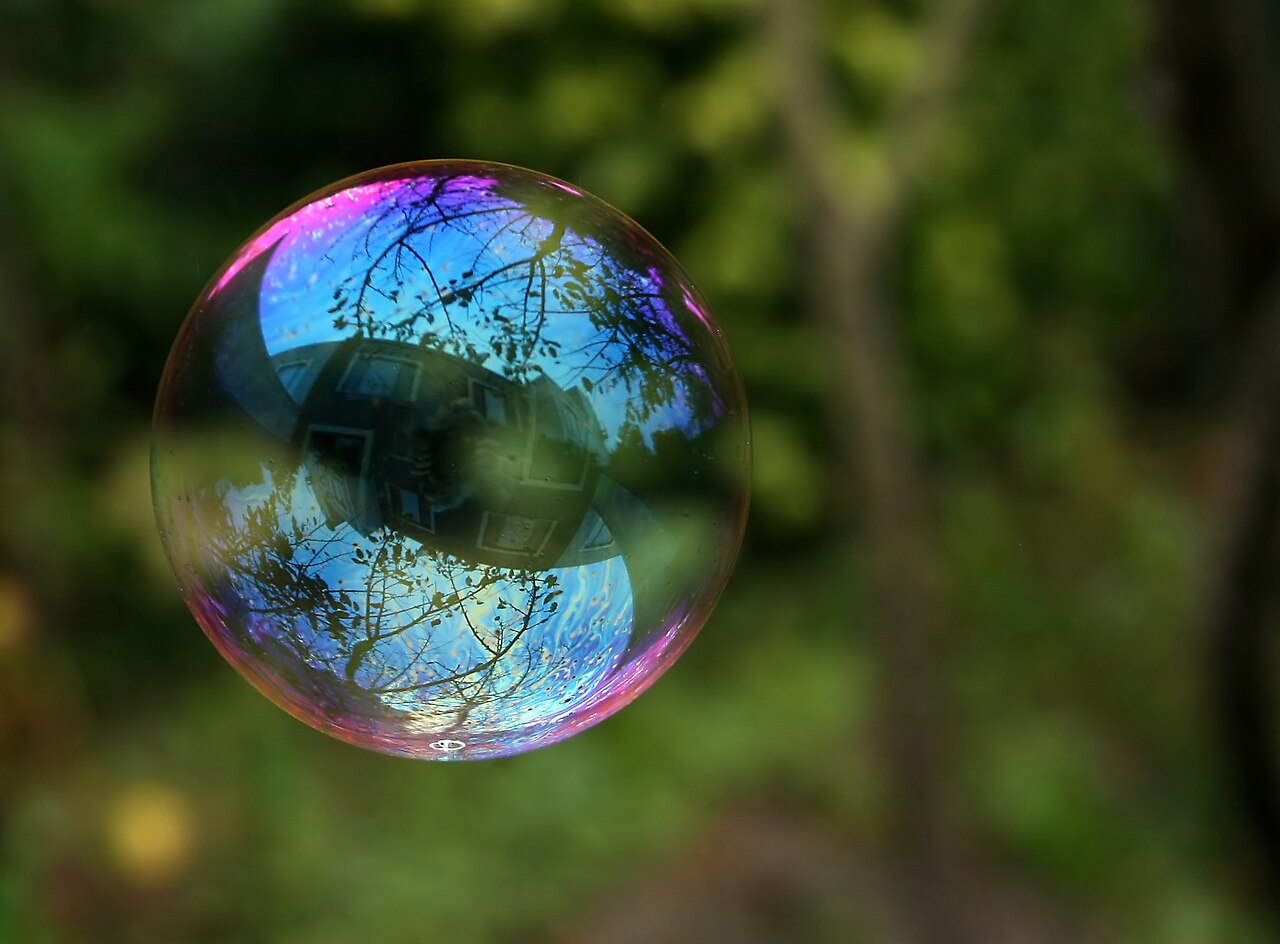
Wavefront returns into the original medium upon striking an interface.

Basile Morin · CC BY-SA 4.0
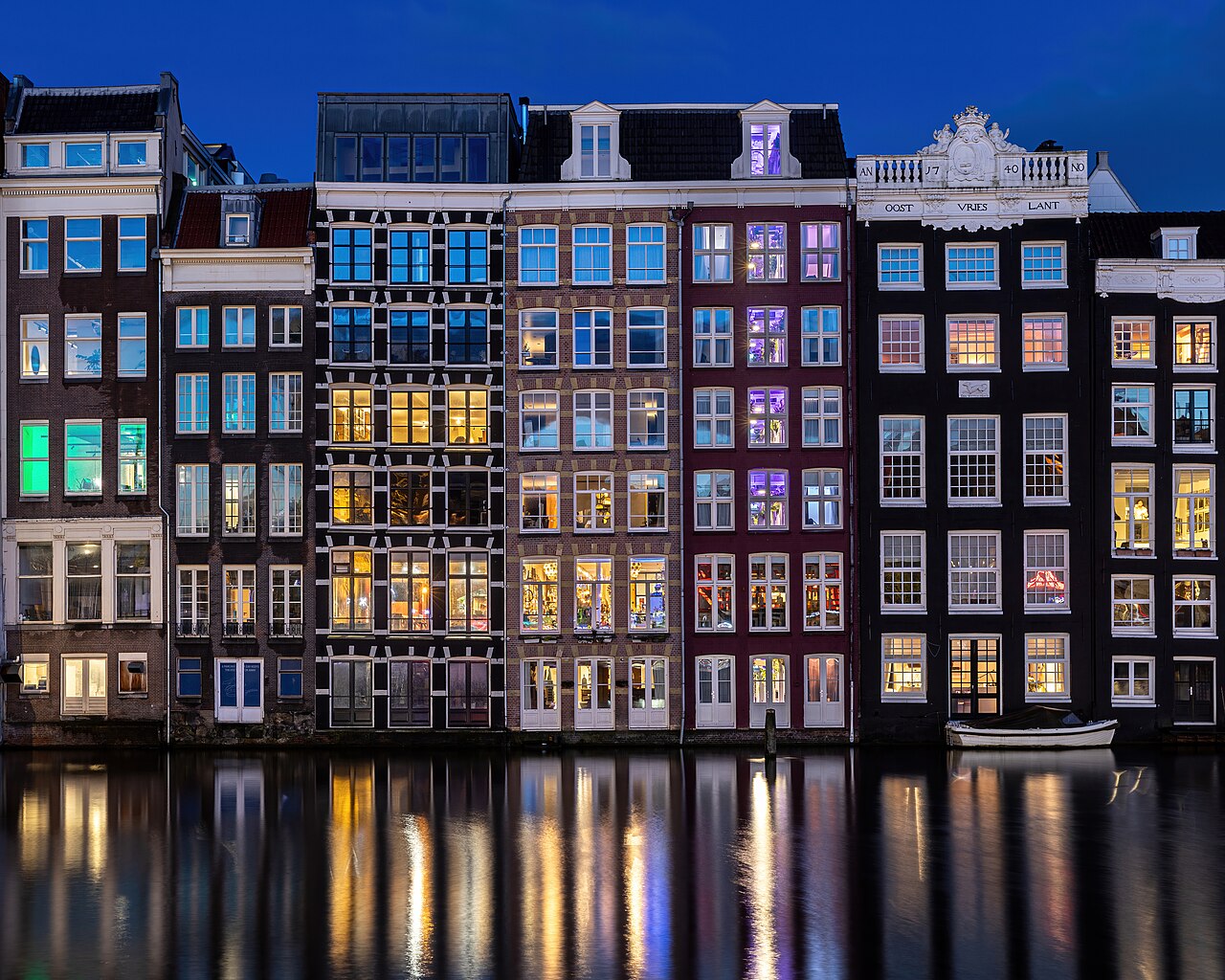
Reflection happens when a wavefront traveling through one medium hits a boundary with another medium and bounces back into the original medium. This phenomenon shows up in everyday life with light, sound, and water waves. For specular reflection—like what you get from a mirror—the angle the incoming wave makes with the surface equals the angle the outgoing wave makes, a rule known as the law of reflection. Beyond visible light, reflection occurs across the electromagnetic spectrum: radio waves at VHF and higher frequencies rely on it for transmission and radar, and even hard X-rays and gamma rays can be reflected at shallow angles using specialized grazing mirrors. In acoustics, reflection creates echoes and is the basis for sonar; in geology, it helps study seismic waves; and surface waves on water also reflect.
When it comes to light, reflection can be specular (mirror-like, preserving an image) or diffuse (scattering energy but losing the image), depending on the interface's texture. A typical mirror is a glass sheet with a metallic coating; metals reflect strongly because they suppress wave propagation beyond a thin skin depth. Transparent materials like water or glass also reflect light, though less efficiently. The law of reflection for light is the same: the incident ray, the reflected ray, and the normal (an imaginary line perpendicular to the surface at the point of contact) all lie in the same plane, with the incident and reflected rays on opposite sides of the normal, and the angle of incidence equals the angle of reflection. More generally, whenever light moves from one medium to another with a different refractive index, some light reflects and some refracts. The Fresnel equations, derived from Maxwell's equations, predict exactly how much reflects and how much refracts—similar to how impedance mismatch in an electric circuit causes signal reflection. If light travels from a denser to a rarer medium and the incident angle exceeds a critical value, total internal reflection occurs. This principle is used in X-ray telescopes, which use a converging tunnel to reflect X-rays at shallow angles toward a detector, since conventional mirrors would let them pass through. When light reflects off a material with a higher refractive index, it undergoes a 180° phase shift; off a lower index, it stays in phase—a key idea in thin-film optics. Specular reflection from a flat surface produces a mirror image that appears left-right reversed because we compare it to what we'd see if rotated into the image's position. Curved surfaces, like spherical or parabolic mirrors, can magnify or demagnify images, giving them optical power.
The laws of reflection can be summarized as: the incident ray, reflected ray, and normal all lie in the same plane; the incident and reflected angles are equal; and the two rays are on opposite sides of the normal. These laws follow from the Fresnel equations.
The mechanism behind reflection, in classical electrodynamics, treats light as an electromagnetic wave described by Maxwell's equations. When light hits a material, it makes atoms oscillate (or electrons in metals), each radiating a small secondary wave in all directions, like a tiny dipole antenna. These waves combine to produce specular reflection and refraction, as explained by the Huygens–Fresnel principle. In dielectrics like glass, the light's electric field moves electrons, which then generate new fields; the refracted light is the sum of the electrons' forward radiation and the incident light, while the reflected light comes from their backward radiation. In metals, free electrons oscillate with the incident light, and the phase difference between their radiation and the incident field determines the reflection.
- field
- Physics
- known_for
- Law of reflection, specular and diffuse reflection, total internal reflection, retroreflection
- types
- Specular, diffuse, retroreflection, multiple reflections
- applications
- Mirrors, sonar, radar, X-ray telescopes, traffic signs, thin-film optics
Lore & Background
Reflection occurs when a wavefront encounters an interface between two different media and returns into the medium from which it originated. The law of reflection, which applies to specular reflection, states that the angle of incidence equals the angle of reflection, with the incident ray, reflected ray, and normal all lying in the same plane. These laws can be derived from the Fresnel equations, which solve Maxwell's equations for light striking a boundary and predict how much light is reflected versus refracted.
Reader's Guide
Reflection is fundamental to numerous technologies and natural phenomena. In acoustics, it produces echoes and enables sonar; in geology, it is crucial for studying seismic waves. Specular reflection from flat surfaces forms mirror images, while curved mirrors can magnify or demagnify images and have optical power. Total internal reflection, occurring when light in a denser medium strikes an interface at an angle greater than the critical angle, is used in X-ray telescopes to focus waves that cannot be reflected by conventional means. Diffuse reflection, caused by microscopic irregularities, allows most objects to be visible by scattering light in all directions. Retroreflection, where light is returned toward its source, is employed in traffic signs and automobile license plates, and occurs naturally in some animals' eyes and in dew on grass. Multiple reflections between two facing mirrors produce an infinite series of images.
Did You Know?
- Reflection of VHF and higher frequencies is important for radio transmission and for radar.
- A simple retroreflector can be made by placing three ordinary mirrors mutually perpendicular to one another.
- Total internal reflection is used in X-ray telescopes by creating a converging tunnel that reflects waves at low angles toward a focus.
Defining the Caustic Envelope
A caustic is the geometric boundary formed where reflected or refracted light rays converge after interacting with a curved surface. Rather than being a single line, it represents the envelope to which every individual ray in the bundle is tangent, creating a curve or surface of concentrated illumination. This boundary acts as a dividing line between regions of high and low light density. In many practical situations, the caustic manifests visually as a bright patch or a sharply defined luminous edge, often exhibiting cusp singularities—points where the curve folds back on itself. The term itself carries a historical weight: it derives from the Greek word for "burnt" (καυστός), passed through Latin as causticus meaning "burning," a nod to the fact that concentrated sunlight along such a curve can reach temperatures sufficient to cause combustion.
Everyday Encounters with Caustic Light
Caustics are far from abstract; they appear in ordinary settings with remarkable regularity. A classic example involves shining light through a drinking glass: while the glass casts a shadow, it simultaneously projects a curved region of intensified brightness. Under ideal conditions—perfectly parallel incident rays, as though originating from a point at infinite distance—the resulting pattern takes the form of a nephroid, a two-cusped curve. On a larger scale, sunlight passing through the undulating surface of a body of water generates rippling caustic patterns that dance across the bottom. Perhaps the most celebrated natural caustic is the rainbow, where light scattered by spherical raindrops is refracted into arcs of varying radius, with different wavelengths separating to produce the familiar spectral bow. Each of these phenomena illustrates the same underlying principle: curved interfaces redirect light into concentrated envelopes, making the invisible geometry of ray paths visible to the eye.
Rendering Caustics in Computer Graphics
Modern rendering pipelines in computer graphics routinely simulate caustic effects, and some systems even extend this to volumetric caustics where light appears to pool within a medium. The core technique involves raytracing the possible paths a light beam might follow, accounting for both refraction and reflection at each surface encounter. One prominent implementation is photon mapping, in which virtual photons are launched from a light source and allowed to bounce through the scene according to physical rules; wherever a sufficient density of photons strikes a surface, that region is rendered brighter than its surroundings, producing the caustic. An alternative approach, called backward ray tracing, starts at the receiving surface and works in reverse to determine whether a direct path to the light source exists. However, the driving priority in most graphics systems—particularly real-time game engines—tends to be visual appeal rather than strict physical fidelity, with generic pre-calculated textures often substituting for genuine optical computation.
Caustic Engineering and Real-World Fabrication
Caustic engineering tackles the inverse of the rendering problem: given a desired target image, one must determine the precise surface geometry whose reflected or refracted light reproduces that image. In the discrete formulation, the target surface is partitioned into numerous small micro-surfaces, each assumed smooth enough to produce a Gaussian-distributed caustic patch. The position and orientation of every micro-surface are then solved using a combination of Poisson integration and simulated annealing. For the continuous version, one promising strategy borrows from optimal transport theory to establish a mapping between incoming rays and the target pattern, after which the surface is iteratively refined using Snell's law of refraction. Once the computational design is finalized, it moves to the manufacturing stage, typically via subtractive machining. Materials range from acrylic, polycarbonate, and glass for refractive applications to steel, titanium, and gold for reflective ones. Finished caustic elements find their way into luminaires, jewelry, architectural features, and decorative glass production.
Gallery



More in Optics And Color 1-15
Spotted an error? Know more?
This is a living reference — every entry is fact-audited, and reader corrections feed straight into our audit queue. Suggest an edit · See this site's audit record