
Primary color
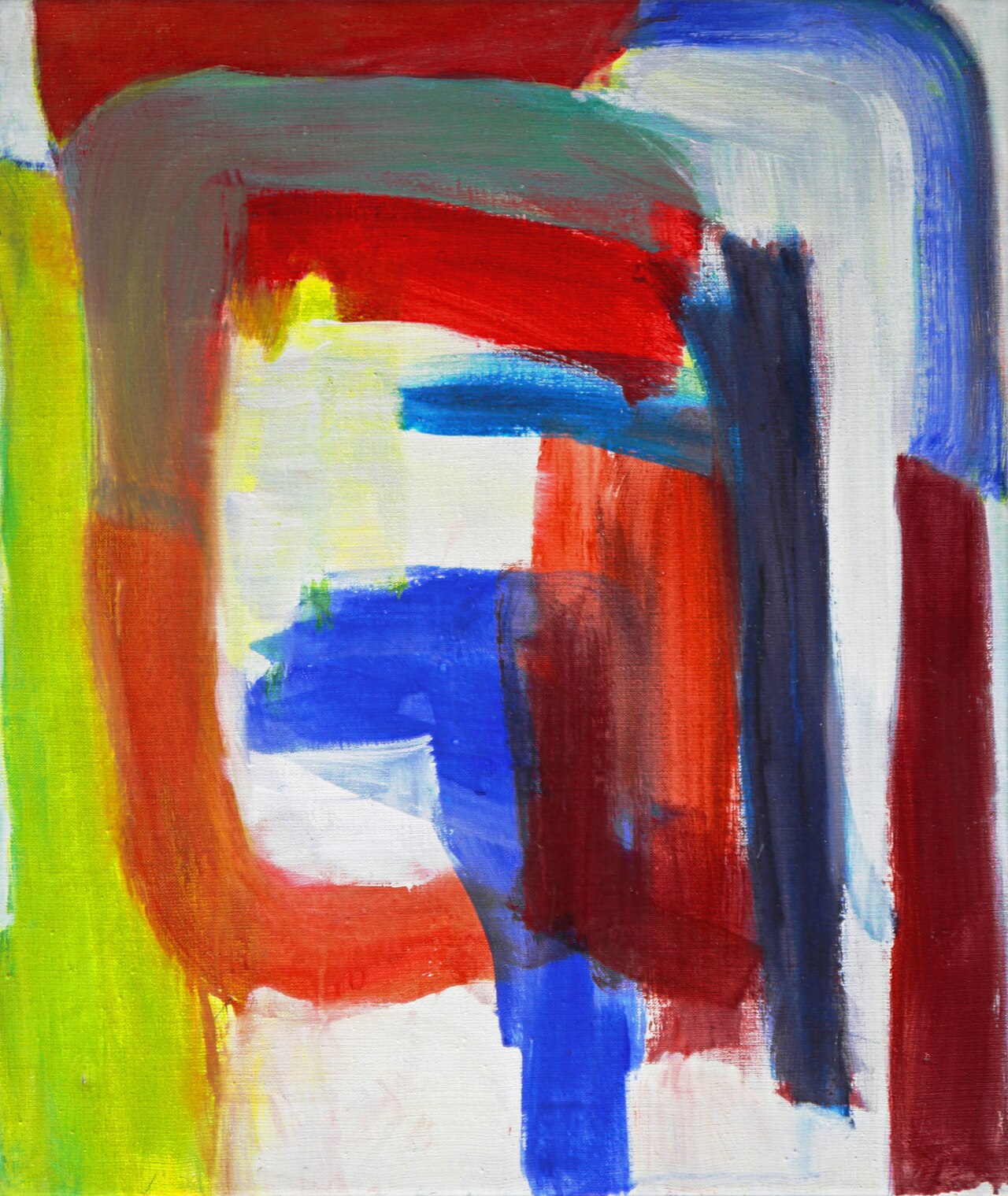
Primary colors are the basis for mixing a gamut of colors.

Fons Heijnsbroek · CC BY 2.0
Primary colors are the basic colorants or lights that, when mixed in different amounts, create a wide range of other colors. This technique is fundamental to how we see many colors in things like screens, printed materials, and paintings. The way a specific mix of primaries will look can be figured out using a mixing model—either additive or subtractive—which relies on the physics of light interacting with surfaces and the eye's retina to produce the intended color.
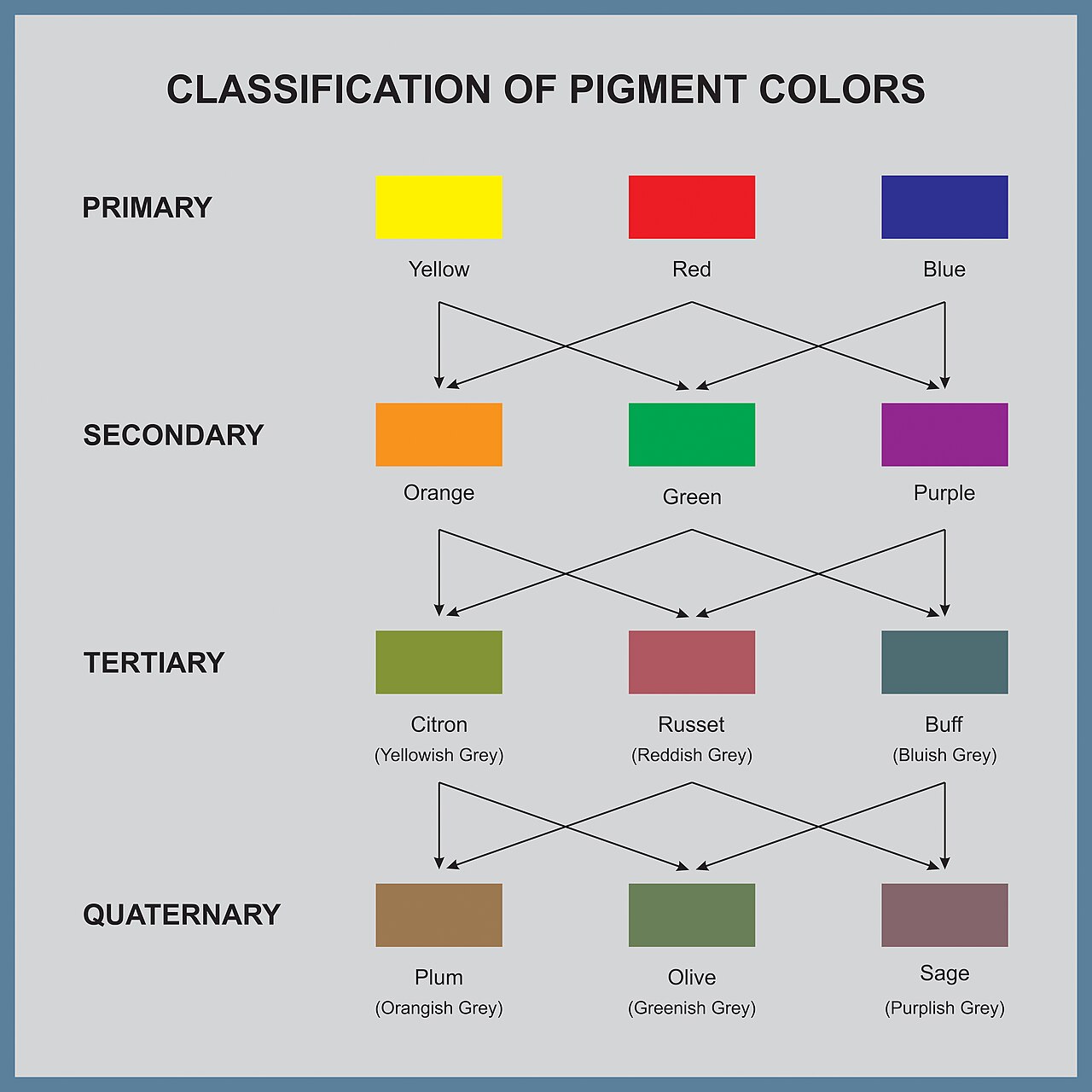
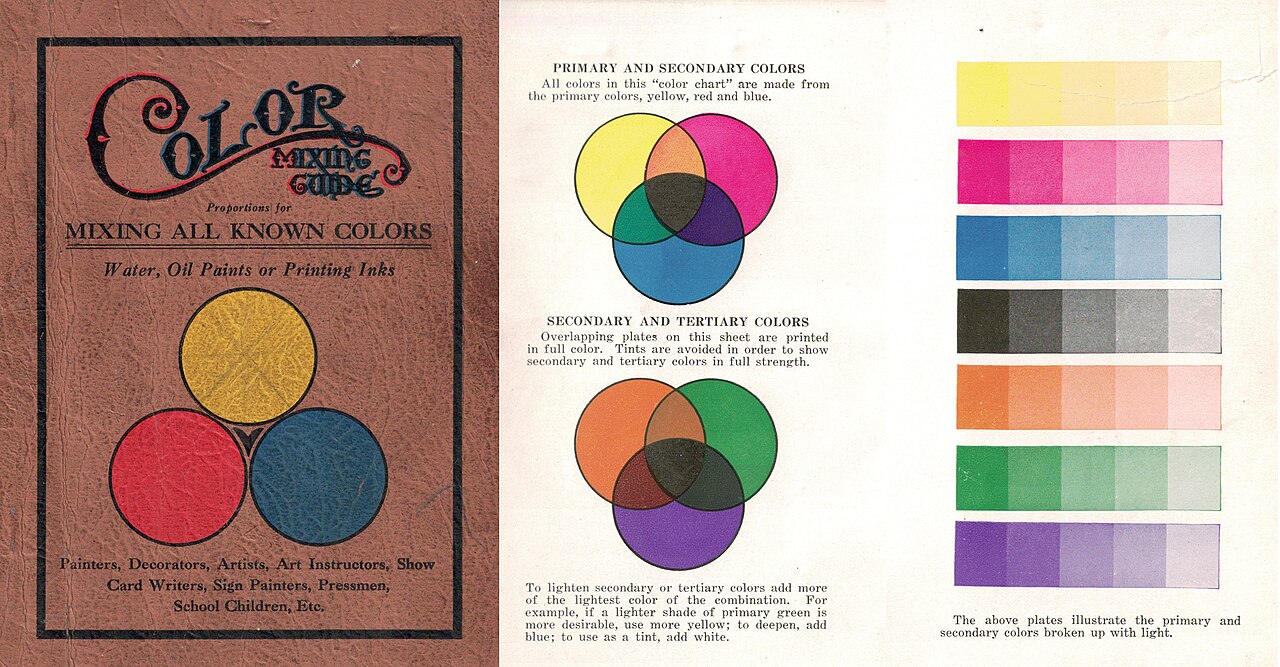
The two most common mixing models are the additive set (red, green, blue) and the subtractive set (cyan, magenta, yellow). Red, yellow, and blue are also frequently taught as primaries, especially for subtractive mixing, though this choice is often criticized for lacking a solid scientific basis.
Primary colors can also be conceptual rather than physical. They may serve as mathematical building blocks in a color space, or as basic categories in fields like psychology and philosophy. Color space primaries are defined through psychophysical experiments that are key to understanding color vision. Some color spaces use primaries that are complete—meaning they can describe all visible colors using positive intensity values—but these primaries are imaginary, with no physical or perceptual reality. Phenomenological primaries, like psychological ones, have guided practical color work even though they aren't quantitative.
No single set of primaries is considered the one true set. The choice of primary pigments or lights for any application depends on personal preference and practical concerns like cost, stability, and availability.
The idea of primary colors has a long and complicated history, with different choices emerging over time across fields like philosophy, art history, color order systems, and the science of light and perception. Art education often uses red, yellow, and blue as primaries, but no real set of colorants or lights can mix every possible color. In other fields, the standard primaries are red, green, and blue, which better match the sensitivity of the cone cells in the human eye.
**Color model primaries**
A color model is an abstract system for describing how colors behave, especially in mixing. Most models rely on multiple primaries. Because most humans are trichromatic, any model aiming to reproduce a meaningful part of human color vision needs at least three primaries. More than three can be used to expand the color gamut, but the entire human perceptual range can be covered with just three primaries—even if they are imaginary, as in the CIE XYZ color space.
Some people (and most mammals) are dichromats, meaning they have only two types of color receptors. They need only two primaries to see their full range of colors, and their participation in color-matching experiments was crucial for determining the cone fundamentals behind all modern color spaces. Most vertebrates are tetrachromatic and require four primaries for their full gamut, but only one scientific report describes a functional human tetrachromat, for whom trichromatic models are insufficient.
**Additive models**
When multiple light sources stimulate the same area of the retina, the resulting perception is additive—it can be predicted by summing the spectral power distributions of the individual lights, assuming a color-matching context. For instance, a purple spotlight on a dark background can be matched by combining dimmer blue and red spotlights. If the purple light's intensity doubles, it can be matched by doubling both the red and blue lights. This principle is captured in Grassmann's laws. Additive mixing is sometimes called "additive color matching" to stress that additivity only works under specific conditions, like a foveal field of view and proper luminance.
Additive mixing of coincident spotlights was used in experiments that created the CIE 1931 color space. The original monochromatic primaries—435.8 nm (violet), 546.1 nm (green), and 700 nm (red)—were chosen for their convenience in those experiments.
In electronic displays, small red, green, and blue elements with adjustable brightness mix additively when viewed from a distance, creating vivid color images. This is a type of partitive mixing. Red, green, and blue are popular for this because they produce a large color triangle, or gamut. The exact hues chosen for additive primaries are a trade-off between available technology and other practical factors.
- field
- Color science, art, and technology
- known_for
- Fundamental concept in color mixing models (additive, subtractive) and color spaces
- types
- Additive (red, green, blue); subtractive (cyan, magenta, yellow); traditional (red, yellow, blue)
- applications
- Electronic displays, color printing, paintings, colorimetry
Lore & Background
The most common color mixing models are the additive primary colors (red, green, blue) and the subtractive primary colors (cyan, magenta, yellow). Red, yellow, and blue are also commonly taught as primary colors, usually in the context of subtractive color mixing, despite some criticism due to its lack of scientific basis. Primary colors can also be conceptual, either as additive mathematical elements of a color space or as irreducible phenomenological categories in domains such as psychology and philosophy.
Reader's Guide
The concept of primary colors has a long, complex history, with choices changing over time across philosophy, art history, color order systems, and scientific work involving the physics of light and perception of color. Sets of color space primaries are generally arbitrary, with no one canonical set; primary pigments or light sources are selected for a given application on the basis of subjective preferences and practical factors such as cost, stability, and availability. While it is sometimes suggested that three primaries can mix all colors, no set of real colorants or lights can mix all possible colors. In electronic displays, small red, green, and blue elements mix additively from an appropriate viewing distance to synthesize compelling colored images. In printing, cyan, magenta, and yellow are good chromatic subtractive primaries, often augmented with black ink for efficiency. The exact colors chosen for primaries are a compromise between available technology and the need for large chromaticity gamut.
Did You Know?
- Dichromats require only two primaries to reproduce their entire gamut.
- There is only one scholarly report of a functional human tetrachromat, for which trichromatic color models are insufficient.
The Physics Behind Color Mixing
When multiple light sources illuminate the same retinal region simultaneously, the resulting perception follows a principle of summation. Each source contributes its spectral power distribution—the intensity across wavelengths—and the visual system effectively adds these contributions together. This additive behavior is formalized in what are known as Grassmann's laws, which govern how coincident lights combine to produce a perceived match. A practical illustration: a single purple spotlight in a dark room can be replicated by overlapping dimmer red and blue beams, and doubling the purple's brightness requires doubling both component beams. Crucially, this additivity holds only under specific viewing conditions, such as foveal focus and appropriate luminance levels. In contrast, subtractive mixing operates through the absorption of wavelengths by pigments or dyes, a process central to color printing and paint mixing. Both frameworks rely on the physics of how light interacts with physical media before ultimately reaching the photoreceptors in the retina, and each demands an appropriate mathematical model to predict the resulting color perception accurately.
Human Vision and the Need for Primaries
Because the vast majority of humans possess three types of cone photoreceptors, any color model aiming to reproduce a meaningful slice of human perceptual experience must employ at least three primaries. This trichromatic foundation underpins virtually every modern color space. However, the story is more nuanced for those with color vision differences. Dichromats—individuals with only two functional cone types—require just two primaries to span their entire gamut, and their participation in color matching experiments proved essential in determining the cone fundamentals that anchor all contemporary color spaces. At the other extreme, most vertebrates are tetrachromatic, needing four primaries, yet only a single scholarly report documents a functional human tetrachromat for whom standard trichromatic models fall short. Interestingly, the CIE XYZ color space achieves complete reproduction of all visible colors using three primaries, but these primaries are necessarily imaginary—no physical light source or pigment could actually produce them. This reveals a fundamental tension: mathematical completeness and physical realizability do not always coexist in color science.
From Theory to Screens and Print
The translation of primary color theory into practical technology has been shaped by decades of engineering compromise. In electronic displays, tiny red, green, and blue elements with independently controllable brightness mix additively from a suitable viewing distance to synthesize the full range of colored images we see daily. This specific form of additive mixing is termed partitive mixing, and red, green, and blue are favored because they define a large chromaticity triangle—essentially a wide gamut. Yet the exact hues chosen are never purely scientific; they represent a balance between available technology, manufacturing cost, power consumption, and the desire for vivid color reproduction. Over subsequent decades, market demand for brighter, more saturated colors pushed manufacturers to deviate significantly from those original specifications. No single set of primaries is canonical; selection always depends on the application's specific constraints.
A Conceptual and Contested History
The idea of primary colors stretches far beyond physics into philosophy, psychology, and art education, giving it a long and complex intellectual history. In art classrooms worldwide, red, yellow, and blue remain the standard primaries taught to students, yet this triad lacks a firm scientific basis and has drawn criticism for that reason. No set of real colorants or lights can actually mix all possible colors, undermining the common claim that these three can produce the full spectrum. Beyond practical mixing, primary colors can exist as purely conceptual entities: additive mathematical elements within a color space, or irreducible phenomenological categories in psychology and philosophy. Color space primaries are precisely defined through psychophysical colorimetry experiments that form the foundation of our understanding of color vision, while phenomenological primaries have served as the conceptual backbone for practical color applications without being quantitative descriptions in their own right. The choice of which primaries to use has shifted over time across different domains—philosophy, art history, color order systems, and the physics of light and perception—reflecting that the concept is as much a human interpretive framework as it is a physical reality.
Gallery
More in Optics And Color 1-15
Spotted an error? Know more?
This is a living reference — every entry is fact-audited, and reader corrections feed straight into our audit queue. Suggest an edit · See this site's audit record