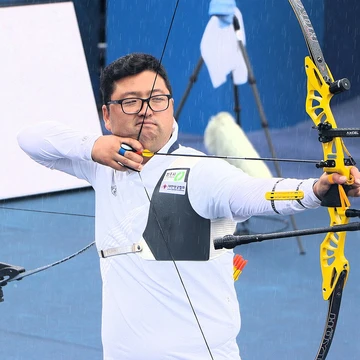
Park Sung-hyun (archer)
South Korean archer with three Olympic gold medals.

Park Sung-hyun (born 1 January 1983) is a South Korean archer who took part in two Olympic Games and came away with three gold medals. She first competed internationally in 2001, claiming the women's recurve title at the World Archery Championships. At the 2004 Summer Olympics, she won gold in both the women's individual and women's team events. Four years later at the 2008 Summer Olympics, she added another gold in the women's team competition and a silver medal as runner-up in the individual event.
Throughout her career, Park excelled across major international tournaments. She became the first South Korean archer to win gold at the Olympics, World Championships, Asian Games, and Asian Championships. She was also the first recurve archer to score at least 1,400 points in a 144-arrow round, and from 2004 to 2015 held the world record for the women's 72-arrow round. In 2016, the World Archery Federation named her the greatest Olympic archer of the 21st century and the third greatest archer of all time.
Park was born on 1 January 1983 in Incheon. In December 2008, she married fellow archer and Olympic gold medalist Park Kyung-mo; the couple had kept their engagement private until after the 2008 Olympics to avoid distracting the national team. As of those Games, she lived in Gunsan in western South Korea. She has three daughters.
At the 2004 Athens Olympics, Park set a new women's world record in the preliminary 72-arrow ranking round with 682 points out of 720, surpassing the previous mark of 679 set by Italy's Natalia Valeeva three months earlier. Alongside teammates Lee Sung-jin and Yun Mi-jin, she also set a world record in the women's team event over 216 arrows, with a combined score of 2,030 out of 2,160. Because both rounds took place before the opening ceremony, neither counted as an Olympic record.
Park and Lee both reached the women's individual final, where Park defeated her teammate 110–108 over twelve arrows to take the gold—South Korea's sixth in that event. Two days later, Park, Lee, and Yun beat China by a single point in the women's team final to secure their nation's fifth consecutive gold in the discipline. As the designated final shooter, Park scored the ten points on the last arrow needed to win the match.
Heading into the 2008 Beijing Olympics, Park was favored to defend her titles.
Quick Facts
- Header Color
- lightsteelblue
- Birth Date
- 1983-01-01
- Birth Place
- Incheon, Gyeonggi Province, South Korea
- Height
- 172cm
- Sport
- Archery
- Event
- Recurve archery
- Show Medals
- yes
Facts from the source article.
Lore & Background
Park Sung-hyun was born in Incheon and later lived in Gunsan. She married fellow Olympic gold medalist Park Kyung-mo in December 2008, having disclosed their intention to wed after the 2008 Olympics to avoid disrupting the national team. She has three daughters. At the 2004 Olympics she set a world record in the 72-arrow ranking round with 682 points, and with teammates Lee Sung-jin and Yun Mi-jin set a world record in the team ranking round. Both scores were not classified as Olympic records because the ranking round took place before the opening ceremony. In the individual final she defeated Lee Sung-jin 110–108, and in the team final she scored the winning ten points on the last arrow against China. At the 2008 Olympics she equaled the Olympic record in the ranking round with 673 points and set an Olympic record in the team ranking round with Yun Ok-hee and Joo Hyun-jung. The team won a sixth consecutive Olympic title. In the individual final she lost to Zhang Juanjuan by one point, ending South Korea's 24-year winning streak in the event. Park expressed disappointment but said the loss motivated her and might reduce pressure on future Korean archers.
Reader's Guide
Park Sung-hyun is notable as the first South Korean archer to win gold at the Olympics, World Championships, Asian Games, and Asian Championships. She was the first recurve archer to score at least 1,400 points in a 144-arrow round, posting 1,405 points in October 2004, a record that stood for nearly fifteen years. Her 72-arrow world record of 682 points from 2004 remained unbroken until 2015. In 2016 the World Archery Federation named her the greatest Olympic archer of the 21st century and the third greatest archer of all time. Her career includes four World Championship appearances with a medal in each, including individual gold in 2001 and silver in 2003, and three consecutive women's team golds from 2005 to 2007. At the Asian Games she won gold in the team event in 2002 and both individual and team gold in 2006. Her Olympic record of 115 points in a 12-arrow match at the 2008 Games was matched the same day by Zhang Juanjuan.
Defending the Crown
Park Sung-hyun arrived in Beijing in 2008 carrying the weight of a title she had claimed four years earlier in Athens. As the reigning Olympic champion in women's individual archery, she entered the competition as one of the most recognized names in the sport, attempting to add a second consecutive gold to her résumé. She was not the only decorated competitor on the field; British archer Alison Williamson, who had claimed the bronze medal in 2004, was also present, lending the event a familiar cast of athletes from the previous cycle. The stage for her defense was the Olympic Green Archery Field, a purpose-built venue where 64 archers representing 37 nations would battle across a compressed three-day schedule in August. For Park, the stakes were personal and national: South Korea had long been synonymous with excellence in this event, and her presence in Beijing symbolized a continuity of dominance that stretched back decades.
The Historic Upset
In what would become one of the most talked-about results in Olympic archery history, Park Sung-hyun fell to Chinese archer Zhang Juanjuan by a single point in the 2008 Beijing tournament. The razor-thin margin made the defeat all the more painful, yet its significance extended far beyond one athlete's loss. Zhang's victory shattered a streak of South Korean supremacy in the women's individual event that had persisted since the 1984 Summer Olympics in Los Angeles. For more than two decades, Korean archers had dominated this particular competition, and Park's attempt to extend that legacy ended in the most dramatic fashion possible—a one-point gap in a 12-arrow match. The result signaled a genuine shift in the global archery landscape, demonstrating that the sport's competitive balance had finally shifted beyond a single nation's grip.
Tournament Architecture & Scale
The 2008 women's individual archery event was a tightly structured affair involving 64 competitors drawn from 37 different countries. Qualification was a layered process: 61 of the 64 slots were allocated through the 44th Outdoor Archery World Championship held in Leipzig, Germany, five continental qualification tournaments, and a Final World Qualification Tournament, while the remaining three places were filled via Tripartite Commission invitations. The competition itself followed a two-phase design. A 72-arrow ranking round served purely as a seeding mechanism, ensuring every archer advanced to the elimination bracket. From there, a single-elimination format governed all subsequent rounds. Notably, the 2008 tournament marked a format change: every elimination match used a 12-arrow structure, replacing the earlier system in which the first three rounds had employed 18-arrow bouts.
Venue, Conditions & Schedule
All shooting at the 2008 women's individual event took place at the Olympic Green Archery Field in Beijing, a venue purpose-built for the Games. Archers faced a standard 70-metre range, with targets measuring 1.22 metres in diameter—dimensions that demanded extraordinary precision at every draw. The competition was compressed into a tight three-day window in August. The 72-arrow ranking round was held on 9 August, establishing the seeding for the elimination brackets. The first and second elimination rounds followed on 12 August, while the quarterfinals, semifinals, and medal matches were all concentrated on 14 August. This rapid progression meant that archers who survived the early rounds would face multiple high-pressure matches within a single day, leaving little time to regroup between bouts. The entire event unfolded under China Standard Time, with all times in the official schedule reflecting the UTC+8 timezone.
More in Olympic Archers, Part 2 1-24
Spotted an error? Know more?
Reader corrections go straight into our review queue. Suggest an edit · How this site is sourced