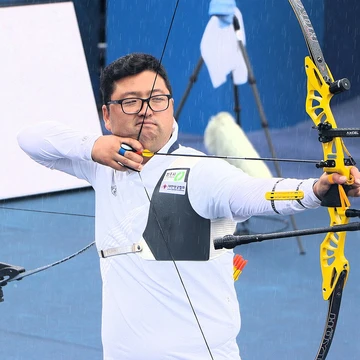
Magnus Petersson
Swedish archer, Olympic silver medalist, two-time world indoor champion.

Magnus Petersson is a Swedish archer born on 17 June 1975 in Gothenburg. He is an experienced Olympian who won a silver medal in 1996 and became the first male archer to win the World Indoor Championships twice, in 1995 and 1999.
- Born
- 17 June 1975
- Birthplace
- Gothenburg
- Country
- Sweden
- Olympic medal
- silver (1996)
- World indoor championships wins
- 1995, 1999
Lore & Background
Magnus Petersson first gained international recognition by winning the World Indoor Championships in 1995, a feat he repeated in 1999, making him the first male archer to win the tournament twice. At the 1996 Summer Olympics, he earned a silver medal. In the 2000 Summer Olympics, he advanced to the semifinals but was defeated by Vic Wunderle; he then lost the bronze medal match to Wietse van Alten. The Swedish team, of which he was a member, placed 6th. At the 2004 Summer Olympics, he won his first match in men's individual archery, advancing to the round of 32, but was defeated in the second round, finishing 23rd overall. He was also a member of the 9th-place Swedish men's archery team. At the 2008 Summer Olympics in Beijing, he finished the ranking round with 646 points, earning the 49th seed. In the first round, he faced Crispin Duenas; both scored 108 points, and the match was decided by an extra round in which Petersson scored 19 points to Duenas's 18. In the next round, Maksim Kunda defeated Petersson 112–110.
Reader's Guide
Magnus Petersson's career spans multiple Olympic Games, from 1996 to 2008, with his most notable achievement being a silver medal in 1996. His two World Indoor Championships titles, in 1995 and 1999, established him as a pioneer in indoor archery, as he became the first male archer to win that tournament twice. His Olympic performances include a semifinal appearance in 2000, where he lost to Vic Wunderle and then the bronze medal match to Wietse van Alten, and a 23rd-place finish in 2004. In 2008, he advanced past the first round by defeating Crispin Duenas in a tiebreaker before losing to Maksim Kunda. Petersson also contributed to Swedish team results, placing 6th in 2000 and 9th in 2004. His consistency across three decades of competition and his indoor championship records mark him as a significant figure in Swedish archery.
Did You Know?
- Magnus Petersson won a silver medal at the 1996 Summer Olympics.
- At the 2000 Olympics, he lost the bronze medal match to Wietse van Alten.
- In the 2008 Olympics, he defeated Crispin Duenas in a tiebreaker round (19–18).
Athens 2004: A Top-Three Ranking
Magnus Petersson represented Sweden in the men's individual archery event at the 2004 Summer Olympics in Athens. His campaign opened with the ranking round, held on 12 August at the Dekelia Air Force Base, where each competitor loosed 72 arrows. Petersson finished third in that round, trailing South Korea's Im Dong-hyun—who posted a then-world-record 687—and Italy's Marco Galiazzo. The top five also included Park Kyung-mo and Jang Yong-ho of Korea, while Dmytro Hrachov of Ukraine matched Jang's score for sixth. Petersson's third-place seeding marked him as a serious contender heading into the elimination rounds. The bracket's geometry, however, locked the three Korean archers into a configuration where they could claim at most gold and bronze between them, meaning the remaining podium spots depended on archers like Petersson and Galiazzo navigating a field of 64.
The Round of 32 Upset
Petersson's Olympic run ended in the Round of 32 on 18 August, when Great Britain's Laurence Godfrey, seeded 31st, edged out the Swedish archer in what the record characterizes as a narrow, hard-fought victory. The match followed the standard format of six ends of three arrows, with the higher total advancing and the loser receiving a final placement between 17th and 32nd based on his score. Godfrey's result was one of several upsets in that round, which also saw top-ten archers Dmytro Hrachov of Ukraine and Hasse Pavia Lind of the Netherlands fall to lower-ranked opponents. For Petersson, the loss was a sharp contrast to the confidence his third-place ranking round score had projected. It illustrated how quickly the single-elimination structure could eliminate even the highest-seeded competitors, reducing a top-three seed to a mid-field finish in a single afternoon of shooting.
A Bracket Dominated by Korea
The 2004 men's individual archery bracket was shaped heavily by South Korea's depth. Im Dong-hyun, Park Kyung-mo, and Jang Yong-ho held the 1st, 4th, and 5th seeds, and the bracket's structure meant that if all three advanced undefeated they would meet one another in the quarterfinals and semifinals, capping their collective medal haul at gold and bronze. In the event, both Park and Jang were eliminated in the quarterfinals by Hiroshi Yamamoto of Japan and Tim Cuddihy of Great Britain, respectively, in one-point matches that removed them from medal contention. The gold ultimately went to Marco Galiazzo of Italy, who defeated Yamamoto in the final at the Panathinaiko Stadium on 19 August, claiming Italy's first-ever Olympic gold in archery. Petersson's third-place seed placed him in a bracket where the Korean wall was the primary obstacle for any non-Korean medal hope.
The Format and the Competitive Field
The men's individual archery competition at the 2004 Games followed a single-elimination structure spanning three knockout rounds before the medal matches. The Round of 64 on 16 August cut the field from 64 to 32 archers, with each competitor firing six ends of three arrows for a maximum of 180 points. The Round of 32 on 18 August halved the field again, and the Round of 16, held on 19 August, produced the eight quarterfinalists. Quarterfinals, semifinals, and both the bronze and gold medal matches all took place on 19 August at the Panathinaiko Stadium. The field Petersson entered included the three 2000 Olympic medalists—Simon Fairweather, Vic Wunderle, and Wietse van Alten—none of whom placed higher than 14th in the ranking round. Only Wunderle reached the quarterfinals, where he was eliminated by Galiazzo in a tense final-end battle. The depth of competition meant that even a top-three seed faced the constant threat of a single poor match ending his campaign.
More in Olympic Archers, Part 2 1-24
Spotted an error? Know more?
Reader corrections go straight into our review queue. Suggest an edit · How this site is sourced