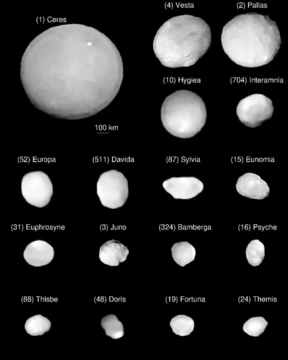
8026 Johnmckay
Binary Hungaria asteroid, very slow rotator, named for X-15 pilot.

8026 Johnmckay, first designated 1991 JA1, is a binary asteroid belonging to the Hungaria group and a notably slow rotator. Located in the inner asteroid belt, it measures roughly 2 kilometers across. American astronomer Eleanor Helin discovered it on 8 May 1991 at Palomar Observatory in California. The asteroid was later named after NASA test pilot John B. McKay.
As a bright E-type asteroid, it is part of the Hungaria family, the densest cluster of asteroids closest to the Sun. Johnmckay orbits the Sun at a distance of 1.8 to 2.1 AU, completing one orbit every 976 days (about 2 years and 8 months). Its orbit has an eccentricity of 0.08 and an inclination of 20° relative to the ecliptic. The first observation of the asteroid occurred at the same observatory in 1989, extending its observation arc nearly two years before its official discovery.
Diameter estimates vary. Data from NASA's NEOWISE mission indicate a diameter of 1.7 kilometers and an exceptionally high surface albedo of 0.81. In contrast, the Collaborative Asteroid Lightcurve Link assumes a standard Hungaria albedo of 0.30 and calculates a diameter of 2.5 kilometers based on an absolute magnitude of 14.9.
Two rotational lightcurves were obtained by U.S. astronomer Brian D. Warner at the Palmer Divide Station in Colorado. The first, from August 2010, showed a long rotation period of 372 ± 5 hours with a brightness variation of 1.0 magnitude. The second, from June 2015, gave a similar period of 355 ± 5 hours with an amplitude of 0.66 magnitude. These results place Johnmckay among the top 100+ slowest rotators known.
In 2010, a small moon was discovered orbiting the asteroid. Its orbital period was measured at 2.300 ± 0.001 hours, while observations at the Palmer Divide Station gave periods of 2.2981 hours and 14.93 hours, respectively.
The minor planet was named in memory of John B. McKay (1922–1975), a NASA test pilot and one of the first assigned to fly the North American X-15. He also flew the X-1E and D-558-II. McKay died in 1975 from injuries sustained in an X-15 crash. In 2005, he was posthumously awarded the astronaut badge for reaching a peak altitude of 89,900 meters (295,000 feet). The naming citation was published by the Minor Planet Center on 7 February 2012 (M.P.C. 78269).
Quick Facts
- Minorplanet
- yes
- Background
- #D6D6D6
- Discovered
- 8 May 1991
- Discoverer
- E. F. Helin
- Discovery Site
- Palomar Obs.
- Mpc Name
- (8026) Johnmckay
- Named After
- John B. McKay (test pilot)
- Mp Category
- main-belt(inner) / Hungaria
- Epoch
- 4 September 2017 (JD 2458000.5)
- Uncertainty
- 0
- Observation Arc
- 27.33 yr (9,981 days)
- Aphelion
- 2.0697 AU
Facts from the source article.
Lore & Background
8026 Johnmckay is a bright E-type asteroid and a member of the Hungaria family, which forms the innermost dense concentration of asteroids in the Solar System. It orbits the Sun in the inner main-belt at a distance of 1.8–2.1 AU once every 2 years and 8 months (976 days), with an eccentricity of 0.08 and an inclination of 20° relative to the ecliptic. The first observation was made at the discovering observatory in 1989, extending the asteroid's observation arc by almost 2 years prior to its discovery.
Two rotational lightcurves were obtained by U.S. astronomer Brian D. Warner at the Palmer Divide Station (PDO) in Colorado. The first, in August 2010, gave a long rotation period of 372 ± 5 hours with a brightness variation of 1.0 magnitude; the second, from June 2015, gave a similar period of 355 ± 5 hours with an amplitude of 0.66 magnitude. This makes Johnmckay one of the Top 100+ slowest rotators known. In 2010 a small asteroid moon was discovered around this asteroid, with an orbital period of 2.300 ± 0.001 hours, while observations at the PDO gave it a period of 2.2981 and 14.93 hours, respectively.
The minor planet was named in memory of NASA test pilot John B. McKay (1922–1975), one of the first pilots assigned to fly the North American X-15. He was also assigned to the X-1E and to the D-558-II. He died in 1975 from injuries sustained during an X-15 crash. In 2005, he received posthumously the astronaut badge for a reached peak-altitude of 89,900 metres (295,000 feet). The approved naming citation was published by the Minor Planet Center on 7 February 2012.
Reader's Guide
8026 Johnmckay holds significance as a binary Hungaria asteroid and one of the slowest rotators known, with a rotation period exceeding 350 hours. Its discovery by Eleanor Helin at Palomar Observatory in 1991 and subsequent photometric observations by Brian D. Warner at the Palmer Divide Station revealed its extremely long rotation period, placing it among the Top 100+ slowest rotators. The detection of a small moon in 2010 further distinguishes it as a binary system, with the moon's orbital period measured at about 2.3 hours. The asteroid's naming honors John B. McKay, a NASA test pilot who flew the X-15, X-1E, and D-558-II, and who died from injuries sustained in an X-15 crash. The naming citation was published in 2012, posthumously recognizing McKay's contributions to aerospace. The asteroid's exceptionally high albedo of 0.81 (from NEOWISE) and its classification as an E-type Hungaria asteroid add to its scientific interest, though diameter estimates vary between 1.7 km (NEOWISE) and 2.5 km (based on a standard albedo assumption).
Did You Know?
- 8026 Johnmckay is a binary asteroid with a small moon discovered in 2010.
- Its rotation period of about 372 hours makes it one of the Top 100+ slowest rotators known.
- The asteroid was named for NASA test pilot John B. McKay, who flew the X-15 and died from crash injuries.
- It has an exceptionally high albedo of 0.81 according to the NEOWISE survey.
More in Notable Asteroids, Part 3 1-24
Spotted an error? Know more?
Reader corrections go straight into our review queue. Suggest an edit · How this site is sourced