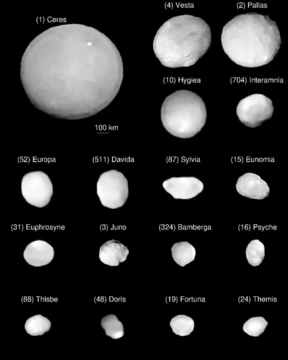
5143 Heracles
A rare O-type binary asteroid near Earth.

Kwamikagami · CC BY-SA 4.0
5143 Heracles (1991 VL) is a near-Earth asteroid belonging to the Apollo group, known for its highly stretched orbit and rare spectral type. It is also a synchronous binary system, meaning it has a moon that orbits in lockstep with its rotation. The asteroid is linked to the Beta Taurids daytime meteor shower.
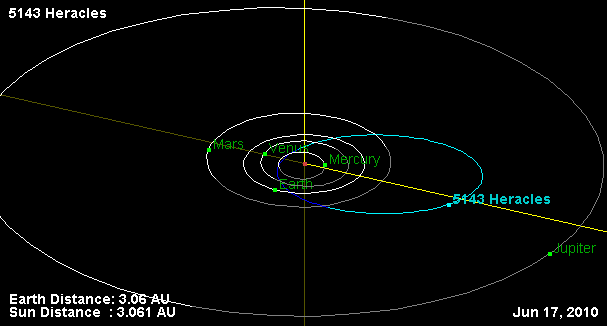
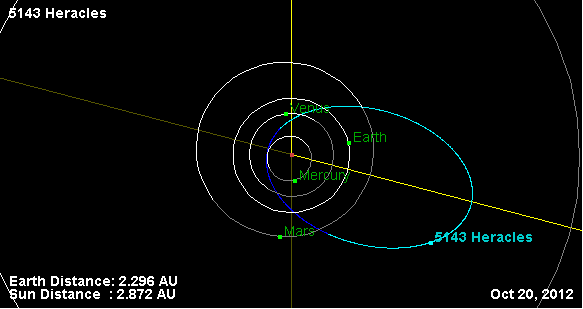
Discovered on 7 November 1991 by American astronomer Carolyn Shoemaker at Palomar Observatory in California, the asteroid was named after the Greek divine hero Heracles. Its orbit brings it as close as 0.4 AU to the Sun and as far as 3.2 AU, completing one circuit every 907 days (about 2.5 years). With an eccentricity of 0.77 and an inclination of 9° relative to the ecliptic, Heracles crosses the orbits of both Mercury and Mars. Its minimum distance from Earth is 0.0584 AU (roughly 8.7 million kilometers, or 22.8 lunar distances). A precovery image from the Digitized Sky Survey at Palomar in 1953 extended the known observation arc by 38 years before its official discovery.
In terms of composition, Heracles is classified as a rare O-type in the SMASS taxonomy, with a spectrum similar to stony L6 and LL6 chondritic meteorites. However, it has also been described as a carbonaceous C-type, as well as stony Sk and Q-type. Photometric lightcurves gathered between 2006 and 2016 show a rotation period between 2.7051 and 2.7065 hours, with brightness variations of 0.05 to 0.20 magnitude. Diameter estimates from the Spitzer Space Telescope, Japan's Akari satellite, and NASA's WISE/NEOWISE surveys range from 3.26 to 4.843 kilometers, with albedos between 0.20 and 0.24. The Collaborative Asteroid Lightcurve Link adopts a revised WISE value giving an albedo of 0.1481 and a diameter of 4.83 kilometers (absolute magnitude 14.27).
Heracles is a binary asteroid. Its moon was discovered in December 2011 by a team using radar observations from the Arecibo Observatory, following months of photometric lightcurve studies. The system is assumed to be synchronous, with the moon orbiting the primary in retrograde motion roughly every 16 hours, though a longer orbital period of 40–57 hours cannot be ruled out. The primary is estimated at 3.6 ± 1.2 kilometers in diameter, and its moon at 0.6 ± 0.3 kilometers. Follow-up observations in 2016 confirmed an orbital period of 17 hours for the satellite.
Quick Facts
- Minorplanet
- yes
- Background
- #FFC2E0
- Discovered
- 7 November 1991
- Discoverer
- C. Shoemaker
- Discovery Site
- Palomar Obs.
- Mpc Name
- (5143) Heracles
- Pronounced
- ' · h · ɛ · r · ə · k · l · iː · z
- Adjective
- Heraclean h · ɛ · r · ə · ˈ · k · l · iː · ə · n
- Named After
- Ἡρακλῆς Hēraklēs (Greek mythology)
- Mp Category
- ApolloNEO
- Epoch
- 4 September 2017 (JD 2458000.5)
- Uncertainty
- 0
Facts from the source article.
Lore & Background
Heracles orbits the Sun in the inner main-belt at a distance of 0.4–3.2 AU once every 2 years and 6 months (907 days). Its orbit has an eccentricity of 0.77 and an inclination of 9° with respect to the ecliptic. The first precovery was taken at Palomar during the Digitized Sky Survey in 1953, extending the body's observation arc by 38 years prior to its official discovery observation. Due to its high eccentricity, Heracles is also a Mercury-grazer and a Mars-crosser.
In the SMASS taxonomy, Heracles is a rare O-type asteroid, which have spectra similar to those of stony chondritic meteorites of the L6 and LL6 type. However, it has also been characterized as a carbonaceous C-type, as well as a stony Sk and Q-type asteroid. A large number of rotational lightcurves of Heracles were obtained from photometric observations between 2006 and 2016, giving a rotation period between 2.7051 and 2.7065 hours with a brightness variation of 0.05 to 0.20 magnitude.
On 12 July 2012, it was announced that Heracles is an assumed synchronous binary asteroid with a minor-planet moon orbiting its primary in a retrograde motion approximately every 16 hours. The companion was discovered in December 2011 by a team of astronomers using radar observations from Arecibo Observatory in Puerto Rico. A longer orbital period of 40–57 hours cannot be excluded, which would then no longer be a synchronous system. Estimated diameters for Heracles and its moon are 3.6±1.2 and 0.6±0.3 kilometer, respectively. Follow-up observations in 2016 confirmed an orbital period of 17 hours for the asteroid moon.
Reader's Guide
5143 Heracles holds significance as a rare O-type asteroid, a classification that links it spectrally to stony chondritic meteorites, though its type remains disputed with alternative C, Sk, and Q classifications. Its binary nature, discovered via radar at Arecibo Observatory in December 2011 and announced in July 2012, makes it one of the known synchronous binary systems among near-Earth objects. The moon's orbital period was initially estimated at about 16 hours, with a longer period of 40–57 hours not excluded, but follow-up observations in 2016 confirmed a 17-hour orbit. The asteroid's high eccentricity (0.77) brings it close to Mercury and Mars, and its Earth minimum orbit intersection distance of 0.0584 AU (8.74 million km) classifies it as a potentially hazardous object. Its association with the Beta Taurids daytime meteor shower adds to its interest for meteor astronomy. The naming after the Greek hero Heracles, son of Zeus and Alcmena, connects it to other named minor planets 5731 Zeus and 82 Alkmene. The discovery by Carolyn Shoemaker at Palomar Observatory in 1991, with precovery images from 1953, underscores the value of archival data in asteroid studies.
Did You Know?
- Heracles is a rare O-type asteroid in the SMASS taxonomy, though it has also been classified as C, Sk, and Q-type.
- The asteroid is associated with the Beta Taurids daytime meteor shower.
- Heracles has an Earth minimum orbit intersection distance of 0.0584 AU, equivalent to 22.8 lunar distances.
A Member of the Taurid Asteroid Family
5143 Heracles is one of several asteroids catalogued as physically linked to the Beta Taurid meteor stream, a class of daytime showers that reach their peak activity after sunrise rather than under the night sky. Alongside 2201 Oljato, 6063 Jason, (8201) 1994 AH2, and 1991 BA, Heracles belongs to a small family of bodies whose orbital paths intersect the same debris trail that Earth encounters each June. The stream itself is active from June 5 through July 18, with its radiant centered near right ascension 5 hours 18 minutes and declination +21.2 degrees. Because the peak falls around June 28–29, the radiant sits only 10 to 15 degrees west of the Sun, making visual observation extraordinarily difficult. For this reason, the Beta Taurids are primarily tracked through radar and radio-echo techniques, which can detect the faint ionization trails left by meteoroids even in full daylight. The maximum hourly rate recorded on radar is roughly 25 meteors per hour, a modest figure that underscores how understudied this stream remains compared to its nighttime counterparts.
One Stream, Two Annual Showers
The Beta Taurids and the more widely recognized Taurids are not two separate meteor streams but rather two expressions of a single debris trail left by a parent body. Earth's orbit crosses this trail twice each year: once in late October, when the radiant is well placed in the night sky, and again in late June, when the radiant is lost in the glare of the Sun. The October event, occurring under dark skies, is far more visible and has become the better-known of the two. The June intersection, which produces the Beta Taurids, peaks during daylight hours and is accessible mainly to radar astronomers. This dual-intersection geometry means that the same population of meteoroids—of which 5143 Heracles is a surviving fragment—generates two distinct annual showers separated by roughly six months. The Zeta Perseids, another active daytime June shower, are also related to the broader Taurid complex, while the Arietids, though radiating from a similar region of the sky, belong to an entirely different stream.
The 2019 Close Approach and the Search for Hidden Rocks
In 2019, the Taurid swarm was predicted to make its closest post-perihelion pass to Earth since 1975, threading approximately 0.06 astronomical units—roughly 9 million kilometers—below the ecliptic plane between June 23 and July 17. Anticipating that the passage might sweep up or reveal larger fragments, astronomers conducted targeted searches for asteroids around 100 meters in diameter during two windows: July 5–11 and July 21–August 10. No such objects were identified. The event drew particular attention because of a long-standing circumstantial link to the Tunguska event of 1908: the daytime explosion on June 30 of that year appeared to originate from roughly the same region of the sky as the Beta Taurid radiant, suggesting a possible connection to the same debris family that includes 5143 Heracles. The next comparable June close approach of the Taurid swarm is not expected until 2036, leaving a seventeen-year gap in which the stream's larger members remain largely unobserved.
Observing a Shower You Cannot See
The fundamental challenge of the Beta Taurids—and by extension of understanding asteroids like 5143 Heracles that feed the stream—lies in the geometry of the June sky. At peak activity around June 28–29, the radiant sits a mere 10 to 15 degrees west of the Sun, placing the shower's origin deep within the solar glare where the human eye is useless. Non-radio observers face what can only be described as a near-impossible prospect: the meteors are burning in broad daylight, their trails invisible against the bright sky. Radar and radio-echo methods become the primary tools, detecting the brief ionization signatures that meteoroids carve into the upper atmosphere. Even with these instruments, the maximum hourly rate hovers around 25, a figure modest by meteor-shower standards. The result is that the Beta Taurids remain one of the least visually experienced showers in the annual calendar, and the parent asteroids that seed the stream, including Heracles, are known more through orbital calculations and association lists than through direct telescopic study.
Gallery

Frequently Asked Questions
What is 5143 Heracles?
It is a near-Earth asteroid in the Apollo group, roughly 4.8 kilometers across, that carries a rare O-type spectral signature. It was named in honor of the Greek divine hero Heracles.
Who discovered 5143 Heracles and when?
American astronomer Carolyn Shoemaker identified it on 7 November 1991 from Palomar Observatory in California. It initially carried the provisional label 1991 VL before receiving its permanent designation.
What makes 5143 Heracles's orbit unusual?
Its path is extremely elongated, dipping to just 0.4 AU from the Sun on one end and stretching out to 3.2 AU on the other. A single lap around the Sun takes about 907 days, or roughly two and a half years.
Does 5143 Heracles have a moon?
Yes; it is a synchronous binary system in which a companion body orbits the primary in perfect lockstep with its rotation. This makes it a noteworthy example of a binary asteroid in near-Earth space.
What meteor shower is 5143 Heracles linked to?
It is the parent body of the Beta Taurids daytime meteor shower. Because the debris stream intersects Earth's orbit during daylight hours, the meteors appear only as brief daytime flashes rather than a traditional night-sky display.
More in Notable Asteroids, Part 3 1-24
Spotted an error? Know more?
Reader corrections go straight into our review queue. Suggest an edit · How this site is sourced