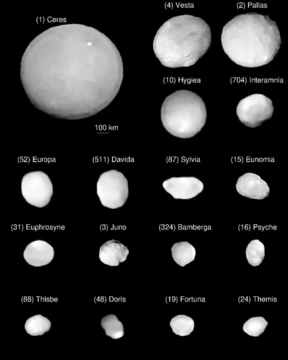
5261 Eureka
First discovered Mars trojan, stable at L5 point.

Frank Schulenburg · CC BY-SA 4.0
5261 Eureka was the first asteroid ever found sharing Mars’ orbit, discovered on June 20, 1990, by David H. Levy and Henry Holt at Palomar Observatory. It follows Mars at the L5 Lagrangian point, staying within 0.3 AU of the planet during each orbit, though a slow drift shifts its distance from about 1.5–1.8 AU around 1850 to 1.3–1.6 AU around 2400. Its closest approaches to Earth, Venus, and Jupiter are 0.5, 0.8, and 3.5 AU, respectively.
Long-term computer simulations confirm the orbit is stable. Researchers Kimmo A. Innanen and Seppo Mikkola noted that, despite intuition, there is clear evidence that motion around the L4 and L5 points of all terrestrial planets remains stable for millions of years.
Since Eureka’s discovery, three other asteroids have been recognized as Martian trojans: (121514) 1999 UJ7 at the L4 point, and (101429) 1998 VF31 and (311999) 2007 NS2, both at the L5 point. At least five other asteroids in near-1:1 resonance with Mars have been found but do not behave as trojans: 2001 FR127, 2001 FG24, (36017) 1999 ND43, 1998 QH56, and (152704) 1998 SD4. Most of the smaller members of the L5 group are thought to be fragments of Eureka itself, broken off after it was spun up by the YORP effect—consistent with its rotation period of 2.69 hours.
Eureka’s infrared spectrum is typical of an A-type asteroid, while its visual spectrum matches an evolved form of achondrite called an angrite. A-class asteroids appear reddish and have a moderate albedo. Because the asteroid sits deep inside a stable Lagrangian zone of Mars, it is likely primordial—meaning it has probably occupied this orbit for much of the Solar System’s history.
A natural satellite of 5261 Eureka was discovered on November 28, 2011. This unnamed moon is roughly 0.46 km in diameter and orbits about 2.1 km from the asteroid. Its existence was announced in September 2014.
Quick Facts
- Minorplanet
- yes
- Background
- #FA8072
- Discoverer
- David H. Levy and Henry Holt
- Discovered
- 20 June 1990
- Named After
- Eureka
- Pronounced
- j · ʊ · ˈ · r · iː · k · ə yuurr · EE · kə
- Mp Category
- Martian L5 · 125
- Epoch
- 13 January 2016 (JD 2457400.5)
- Aphelion
- 1.6222 AU
- Perihelion
- 1.4249 AU
- Semimajor
- 1.5236 AU
- Eccentricity
- 0.064766
Facts from the source article.
Lore & Background
5261 Eureka was discovered on 20 June 1990 by David H. Levy and Henry Holt at Palomar Observatory. It is the first Mars trojan identified, located at the L5 Lagrangian point trailing Mars. Its distance from Mars varies by only 0.3 AU per revolution, with a secular trend shifting the range from 1.5–1.8 AU around 1850 to 1.3–1.6 AU around 2400. Minimum distances from Earth, Venus, and Jupiter are 0.5, 0.8, and 3.5 AU, respectively. Long-term numerical integration shows the orbit is stable; Innanen and Mikkola note empirical evidence for stability of motion around L4 and L5 points of terrestrial planets over several million years. The infrared spectrum is typical for an A-type asteroid, while the visual spectrum is consistent with an evolved form of achondrite called an angrite. A-class asteroids are tinted red with moderate albedo. The asteroid is deep within a stable Lagrangian zone, considered indicative of a primordial origin, meaning it has likely been in this orbit for much of Solar System history. On 28 November 2011, a natural satellite about 0.46 km in diameter was found orbiting 2.1 km from Eureka; its existence was announced in September 2014.
Reader's Guide
Since its discovery, 5261 Eureka has been recognized as the first Mars trojan, leading the Minor Planet Center to identify three other Martian trojans: (121514) 1999 UJ7 at L4, (101429) 1998 VF31 at L5, and (311999) 2007 NS2 at L5. At least five other asteroids in near-1:1 resonances with Mars have been discovered but do not exhibit trojan behavior. Due to close orbital similarities, most smaller members of the L5 group are hypothesized to be fragments of 5261 Eureka detached after it was spun up by the YORP effect, consistent with its rotational period of 2.69 hours. The asteroid's stable orbit and primordial origin suggest it has been in this Lagrangian zone for much of Solar System history. Its spectral properties—A-type in infrared, angrite-like in visual—provide clues to its composition. The discovery of a satellite in 2011, announced in 2014, adds to its significance as a binary system among Mars trojans.
Did You Know?
- 5261 Eureka was the first Mars trojan ever discovered.
- It has a natural satellite about 0.46 km in diameter, found on 28 November 2011.
- Its rotational period is 2.69 hours, consistent with YORP-driven fragmentation.
- The asteroid's visual spectrum matches an evolved achondrite called an angrite.
Gallery

Frequently Asked Questions
What is 5261 Eureka and who discovered it?
5261 Eureka is a small asteroid that shares Mars' orbital path, making it the first confirmed Mars Trojan. David H. Levy and Henry Holt spotted it on June 20, 1990, from Palomar Observatory.
What makes 5261 Eureka unique among known asteroids?
It was the very first asteroid ever identified as riding along with Mars, trailing the planet at the L5 Lagrangian point. Before its discovery, no asteroid had been confirmed to co-orbit Mars in this way.
How does 5261 Eureka stay near Mars, and does its distance change?
It occupies the L5 point behind Mars, remaining within roughly 0.3 AU of the red planet each orbit. A slow gravitational drift gradually shifts its mean distance from about 1.5–1.8 AU in the 1850s to 1.3–1.6 AU by around 2400.
Is 5261 Eureka's orbit stable over the long term?
Yes—long-term computer simulations, including work by Innanen and Mikkola, confirm the orbit is stable even though that might not seem intuitive at first. The asteroid is expected to keep trailing Mars without being ejected.
How close does 5261 Eureka get to Earth?
Its minimum approach to Earth is about 0.5 AU, roughly ten times the average Moon distance. It also reaches 0.8 AU from Venus and 3.5 AU from Jupiter at closest pass.
More in Notable Asteroids, Part 3 1-24
Spotted an error? Know more?
Reader corrections go straight into our review queue. Suggest an edit · How this site is sourced