Leo Minor
A faint northern constellation between Ursa Major and Leo.
Last updated

via Wikipedia: Leo Minor · see source
Leo Minor is a small and faint constellation in the northern celestial hemisphere, its name Latin for 'the smaller lion' in contrast to Leo, the larger lion. It lies between the larger and more recognizable Ursa Major to the north and Leo to the south. Classical astronomers did not regard it as a separate constellation; Johannes Hevelius designated it in 1687. The constellation contains 37 stars brighter than apparent magnitude 6.5, with three exceeding magnitude 4.5.
History
Classical astronomers Aratus and Ptolemy noted the region of what is now Leo Minor as undefined and lacking distinctive patterns; Ptolemy classified its stars as amorphōtoi, not belonging to a constellation outline, within Leo. Johannes Hevelius first depicted Leo Minor in 1687 when he outlined ten new constellations in his star atlas Firmamentum Sobiescianum, including 18 of its objects in the accompanying Catalogus Stellarum Fixarum. Hevelius chose the name Leo Minor or Leo Junior to align with its neighbours the Lion and the Great Bear.
In 1845, Francis Baily revised Hevelius's catalogue and assigned a Greek letter known as Bayer designation to stars brighter than magnitude 4.5. Richard A. Proctor gave the constellation the name Leaena 'the Lioness' in 1870, seeking to shorten constellation names for celestial charts. Christian Ludwig Ideler suggested that the stars of Leo Minor had been termed Al Thibā' wa-Aulāduhā 'Gazelle with her Young' on a 13th-century Arabic celestial globe.
Friedrich Wilhelm Lach offered a different view, noting they had been seen as Al Haud 'the Pond' into which the Gazelle jumps. In Chinese astronomy, stars Beta, 30, 37 and 46 Leonis Minoris made up Neiping, a 'Court of Judge or Mediator', or Shi 'Court Eunuch', or were combined with stars of Leo to form a large celestial dragon or State Chariot. A line of four stars known as Shaowei represented four Imperial advisors and may have been located in Leo Minor, Leo or adjacent regions.
Characteristics
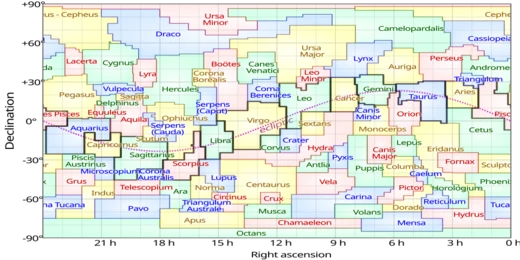
Leo Minor is a dark area of the sky with a triangle of brighter stars just visible to the naked eye in good conditions. It is bordered by Ursa Major to the north, Lynx to the west, Leo to the south, and touches the corner of Cancer to the southwest. The constellation's three-letter abbreviation, adopted by the International Astronomical Union in 1922, is 'LMi'. Its official boundaries, set by Eugène Delporte in 1930, are defined by a polygon of 16 sides, covering 232.0 square degrees and ranking 64th out of 88 constellations in size.
Features
Only three stars in Leo Minor are brighter than magnitude 4.5, and 37 stars have a magnitude brighter than 6.5. The constellation lacks a star designated Alpha because Baily erred and allocated a Greek letter to only one star, Beta. It is unclear whether he intended to give 46 Leonis Minoris a Bayer designation, as he recognized Beta and 46 Leonis Minoris as of appropriate brightness in his catalogue; he died before revising his proofs. At magnitude 3.8, the brightest star is 46 Leonis Minoris, also called Praecipua, an orange giant of spectral class K0III located 95 light-years from Earth.
It has around 32 times the luminosity and 8.5 times the size of the Sun. Johann Elert Bode catalogued it as o Leonis Minoris, misinterpreted as Omicron Leonis Minoris. The proper name Praecipua appears to have been originally applied to 37 Leonis Minoris in the 1814 Palermo Catalogue of Giuseppe Piazzi, who mistakenly assessed that star as brighter; the name was later connected by Allen with 46 Leonis Minoris. The original Praecipua, 37 Leonis Minoris, has apparent magnitude 4.69 and is a distant yellow supergiant of spectral type G2.5IIa, around 578 light-years distant.
Beta Leonis Minoris is a binary star system; the primary is a giant star of spectral class G9III and magnitude 4.4, with about double the mass, 7.8 times the radius and 36 times the luminosity of the Sun. The secondary is a yellow-white main sequence star of spectral type F8, separated by 0.1 to 0.6 arcsecond; the two orbit every 38.62 years and lie 154 light-years away. Around 98 light-years away and about 10 times as luminous as the Sun, 21 Leonis Minoris is a rapidly rotating white main-sequence star of spectral type A7V and average magnitude 4.5, spinning in less than 12 hours and likely flattened. It is a Delta Scuti variable, a short-period pulsating star used as a standard candle and for asteroseismology.
More in Northern Constellations
Sources
Compiled from Wikipedia and the sources listed below. Text from Wikipedia is available under CC BY-SA 4.0; this entry is adapted from it.
- Wikipedia: Leo Minor (CC BY-SA 4.0).
Spotted an error? Know more?
Reader corrections go straight into our review queue. Suggest an edit · How this site is sourced