Aratus
Greek didactic poet known for his astronomical poem Phenomena.
Last updated
His works were very popular in both the Greek and Roman world, with many commentaries and Latin translations.[1] The poem Phaenomena was composed by Aratus because Antigonus asked him to.[2]
Quick Facts
- Born
- c. 315/310 BC
- Died
- 240 BC
- Field
- Didactic poetry
- astronomy
- weather lore
- Nationality
- Greek (from Soli, Cilicia)
- Known for
- Hexameter poem Phenomena and Diosemeia
Facts from the source article.
Life and work
Several anonymous Greek accounts of Aratus's life exist, along with mentions in the Suda and Eudocia.[3] According to several ancient accounts, Aratus was from Soli in Cilicia, but one source claims he came from Tarsus instead.[3] While at that court, Aratus created his best-known work, Phenomena.[4] Medicine, grammar, and philosophy were the main fields Aratus pursued.[4]
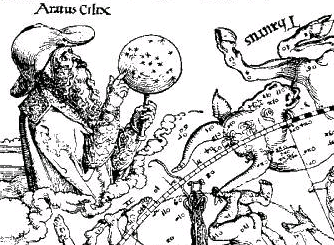
The Suda attributes many works to Aratus, among them Phainomena, Hymns to Pan, Astrologia, and an Edition of the Odyssey.[5][6] Weather predictions based on astronomical signs and their impact on animals make up the Diosemeia.[7] The Diosemeia seems to follow Hesiod's style, and Virgil later copied parts of it in his Georgics.[7]
What the cited sources add
The Suda also notes that Aratus's brother Myris was a student of Zeno.[6] Diogenes Laertius offers an anecdote where Aratus and Timon discuss Homeric texts.[6] Another Diogenes Laertius passage brings Aratus into contact with Menedemus, Lycophron, and Antagoras of Rhodes.[6] Two epigrams attributed to Aratus survive in the Greek Anthology.[6]
The attalus website records an abortive plot by a different Aratus against Aristomachus.[2] That same source notes that Aratus broke a truce with the Macedonians by attacking the Peiraeus.[2]
References
- Wikipedia, "Aratus" (CC BY-SA 4.0), which cites: comp. Ovid, Am. i. 15. 16 (original not read by us) en.wikipedia.org
- attalus website retrieved 15/09/2011. facts only, no text reused. attalus.org
- Wikipedia, "Aratus" (CC BY-SA 4.0), which cites: attalus website retrieved 15/09/2011 (we also read that source) en.wikipedia.org
- Wikipedia, "Aratus" (CC BY-SA 4.0), which cites: Chisholm 1911; A. W. Mair and G. R. Mair, trans., Callimachus and Lycophron; Aratus, Loeb Classical Library (New York: G. P. Putnam’s Sons, 1921), p. 363 (original not read by us) en.wikipedia.org
- Wikipedia, "Aratus" (CC BY-SA 4.0), which cites: Suda, alpha, 3745 (we also read that source) en.wikipedia.org
- Suda, alpha, 3745. facts only, no text reused. cs.uky.edu
- Wikipedia, "Aratus" (CC BY-SA 4.0), which cites: Chisholm 1911 (original not read by us) en.wikipedia.org
Each numbered sentence above was checked against the source it cites before publication. Sentences citing Wikipedia adapt text from the English Wikipedia article Aratus (contributors), used under CC BY-SA 4.0; this entry is available under the same licence. Other sources were used for facts only; no text or images are copied from them.
More in Poets Of The Ancient World
Sources
Compiled from Wikipedia and the sources listed below. Text from Wikipedia is available under CC BY-SA 4.0; this entry is adapted from it.
- Wikipedia: Aratus (CC BY-SA 4.0).
Spotted an error? Know more?
Reader corrections go straight into our review queue. Suggest an edit · How this site is sourced