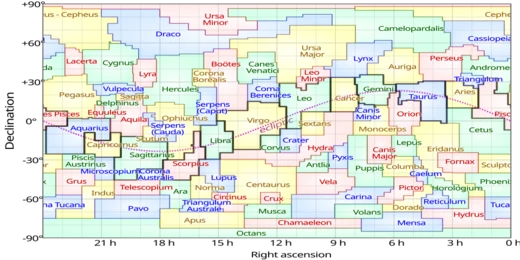
Vulpecula
A faint northern constellation home to the first pulsar.
Last updated
Vulpecula is a faint constellation in the Northern Sky, its Latin name meaning 'little fox'. It lies within the Summer Triangle, an asterism formed by Deneb, Vega, and Altair. The constellation was identified in the 17th century.
Features
No stars in Vulpecula are brighter than 4th magnitude. This star is an optical binary with a separation of 413.7 arcseconds, splittable with binoculars, and carries the traditional name Anser, referring to the goose the little fox holds in its jaws. The second-brightest star is 23 Vulpeculae. In 1967, the first pulsar, PSR B1919+21, was discovered in Vulpecula by Jocelyn Bell, supervised by Antony Hewish, while they searched for scintillation of radio signals from quasars.
They observed pulses repeating every 1.3373 seconds; terrestrial origin was ruled out because the object reappeared after a sidereal day rather than a solar day, and the signal was identified as coming from a rapidly rotating neutron star. Fifteen years later, the first millisecond pulsar, PSR B1937+21, was also discovered in Vulpecula, only a few degrees away. The constellation hosts HD 189733 b, one of the closest extrasolar planets studied by the Spitzer Space Telescope; in 2007, a team led by Giovanna Tinetti published evidence for significant water vapor in its atmosphere, though its temperatures exceed 1,000 °C. Also located here is soft gamma repeater SGR 1935+2154, which emitted a fast radio burst in 2020, the first observed in the Milky Way.
The Dumbbell Nebula (M27) is a large, bright planetary nebula discovered by Charles Messier in 1764 as the first object of its kind. It appears as a dimly glowing disk about 8 arcminutes in diameter with binoculars in a dark sky, is roughly 9,800 years old, and a telescope reveals its double-lobed hourglass shape. Brocchi's Cluster (Collinder 399), also called the Coathanger, is an asterism formerly thought to be an open cluster.
More in Northern Constellations
Sources
Compiled from Wikipedia and the sources listed below. Text from Wikipedia is available under CC BY-SA 4.0; this entry is adapted from it.
- Wikipedia: Vulpecula (CC BY-SA 4.0).
- Word definitions: the , each quoted from its Wikipedia article.
Spotted an error? Know more?
Reader corrections go straight into our review queue. Suggest an edit · How this site is sourced