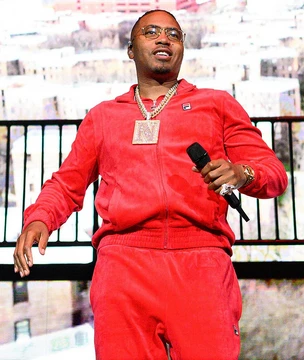
Method Man
The slowest burn in the room, and the one that takes the whole building down.

Where Nas speaks in the measured, street-poetic cadence of Queensbridge, Method Man arrives like a slow-burning fuse: unhurried, dangerous, and dripping with a cool that feels almost aristocratic in its indifference. As a Featured Artist & Collaborator in Nas's world, Method Man represents the cross-pollination that made the mid-to-late '90s New York scene feel like a single, breathing organism. Their shared era, shared city, and overlapping circles of producers, engineers, and label executives meant that the boundary between 'Nas track' and 'Wu-Tang track' was often thinner than the liner notes suggested.
Quick Facts
- Birth Name
- Clifford Smith Jr.
- Birth Date
- 1971-03-02
- Birth Place
- Hempstead, New York, United States
- Origin
- Staten Island, New York City, United States
- Occupations
- Rapper / songwriter / record producer / actor
- Years Active
- 1992–present
- Alias
- Johnny Blaze · Tical · Methical · Ticallion Stallion · Iron Lung · Meth · Mr. M.e.f. · Hott Nikkels · Shakwon the Panty Raider · Shotgun
- Genre
- East Coast hip-hop
- Discography
- Method Man discography
- Label
- Def Jam / Island Def Jam / Tommy Boy / RBC / Wu-Tang Productions
- Current Member Of
- Wu-Tang Clan / Method Man & Redman
Facts from the source article.
Lore & Background
In the mythology of 1990s New York hip-hop, Method Man occupies a singular niche: the rapper who made it look effortless to be dangerous. While Wu-Tang Clan's early records were dense, layered, and almost aggressively textural, Method Man's verses cut through that density like a blade through wet burlap. His delivery—low, unhurried, almost bored—became a signature that no one in the Nas orbit could replicate without it sounding like a cover. The two men's worlds intersected most visibly in the mid-to-late '90s, when New York hip-hop was at its most interconnected. Producers like RZA, DJ Premier, and the engineers at 4th & B'way studios moved fluidly between Nas's sessions and Wu-Tang's. The result was a sonic ecosystem where a Nas hook could sit comfortably next to a Method Man bridge, and the audience in the studio would nod as if nothing unusual had happened. That casual cross-pollination—where the Queensbridge poet and the Staten Island philosopher shared a vocal chain and a cigarette break—is one of the defining textures of the era. As a performer, Method Man brought something Nas's own catalog rarely contained in such concentrated form: a sense of theatrical menace that wasn't performative. His acting roles, from the bumbling charm of Jumanji to the genuinely unsettling Sandman in Spider-Man 3, reinforced the idea that his rap persona was the *least* exaggerated version of who he was.
Reader's Guide
The Nas–Method Man dynamic is less a head-to-head battle and more two different dialects of the same language. Nas builds sentences; Method Man drops single words and lets the room fill in the grammar. When they share a track, the effect is almost cinematic: Nas is the close-up, the tight lens on a face in the rain, and Method Man is the wide shot, the whole street stretching out under a sodium-vapor glow.
The era they defined together—mid-to-late '90s New York—produced records where the boundary between a Nas verse and a Wu-Tang interlude was almost invisible. You could hear RZA's production fingerprints on Nas sessions and DJ Premier's swing on Wu-Tang cuts. Method Man, sitting in the middle of that crosscurrent, brought a coolness that made Nas's urgency feel even more urgent by contrast. It's the difference between a fist hitting a wall and a slow, inevitable tide eroding the same wall.
And then there's the era's emotional anchor, the track that still makes you cringe in the best way: 'If I Ruled the World (Imagine That).' You know the one. The strings. The Maxwell hook. The way Nas's voice cracks just slightly on the final line and you swear he didn't plan it. Method Man wasn't on that record, but he was in the room, in the city, in the same sonic family. Hearing it now, years later, you can almost feel the ghost of his low murmur in the mix, the way a Wu-Tang verse would have sat right under those strings like a second heartbeat. That's the magic of the pairing: even in absence, the presence is felt. You close your eyes and you can *hear* the space where his bar would have been, and somehow that empty space is the loudest part of the track.
It's the kind of collaboration that doesn't need a shared verse to be real. It just needs the same city, the same year, and the same stubborn belief that a record should make you feel something in your sternum before it makes you feel anything in your head.
More in Band Members & Collaborators
Elsewhere in Nas
Spotted an error? Know more?
Reader corrections go straight into our review queue. Suggest an edit · How this site is sourced