
Circle of fifths
A cycle of perfect fifths organizing pitch classes and key signatures.

Original: Watchduck You can name the author as "T. Piesk", "Tilman Piesk" or "Wa · Public domain
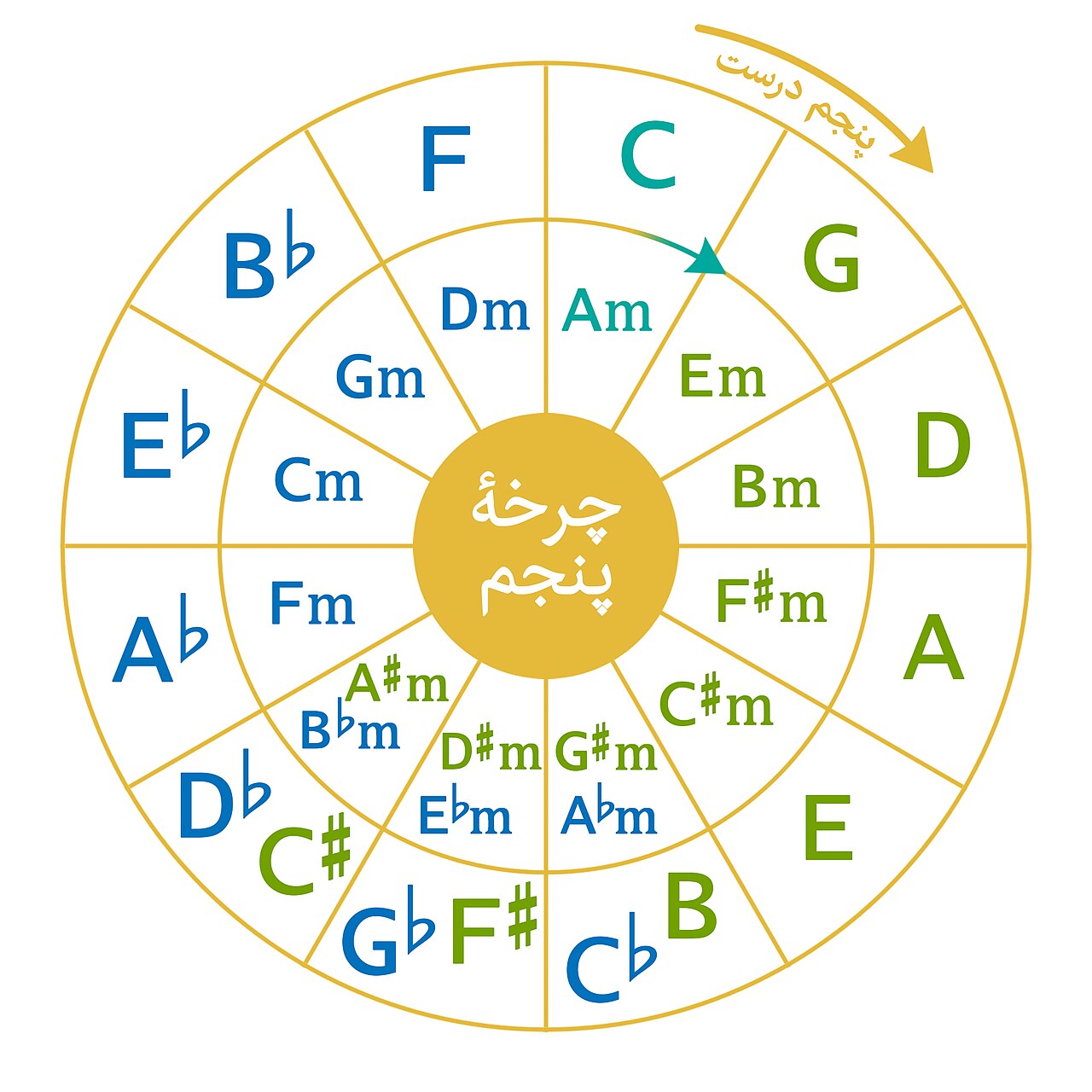
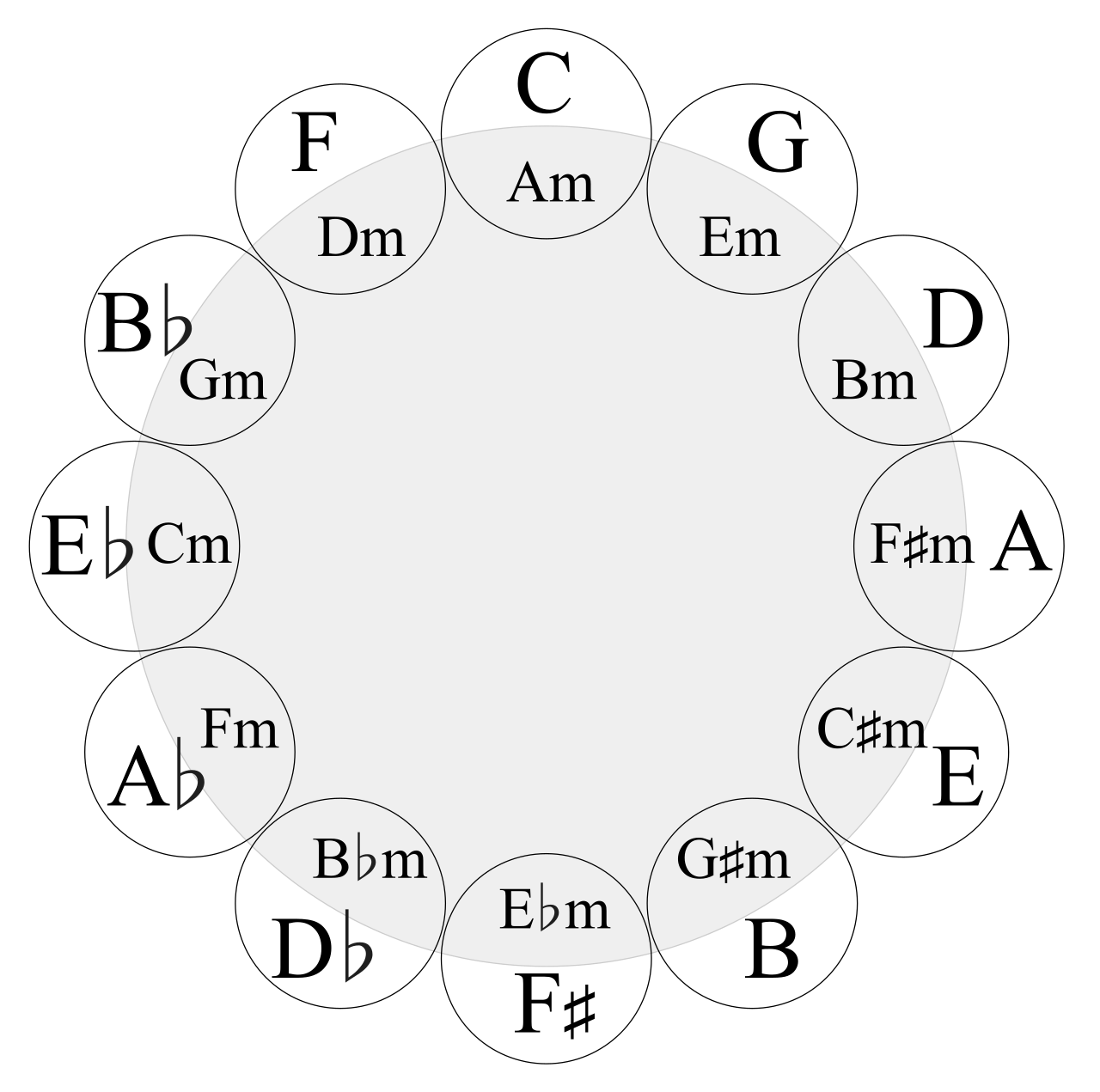
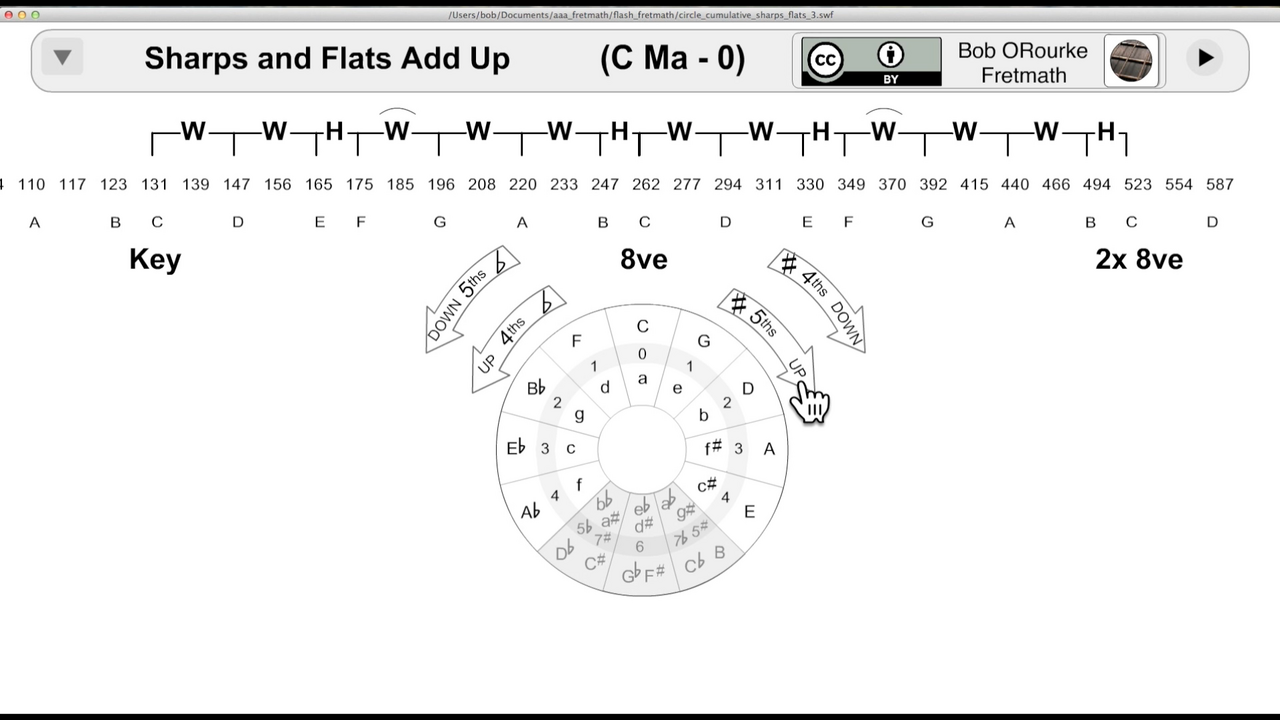
The circle of fifths, also called the cycle of fifths, arranges the twelve pitch classes of the chromatic scale into a sequence where each step is a perfect fifth higher. Because moving in the opposite direction—by perfect fourths—creates the same cycle, it is sometimes referred to as the circle of fourths. Starting from C, the order goes: C, G, D, A, E, B or C♭, F♯ or G♭, C♯ or D♭, A♭, E♭, B♭, F, and back to C. This arrangement places key signatures that are most closely related next to each other.
If you ascend by twelve perfect fifths tuned exactly to a 3:2 frequency ratio, you do not land back on the starting pitch class. Instead, you overshoot it by a small interval called the Pythagorean comma. This creates tuning problems when shifting keys or modulating, which led to the development of various tuning systems. By adjusting, or tempering, the 3:2 ratio, these systems make the sequence of fifths return to the starting pitch. Examples include historical well temperaments and the modern standard for Western music, 12-tone equal temperament.
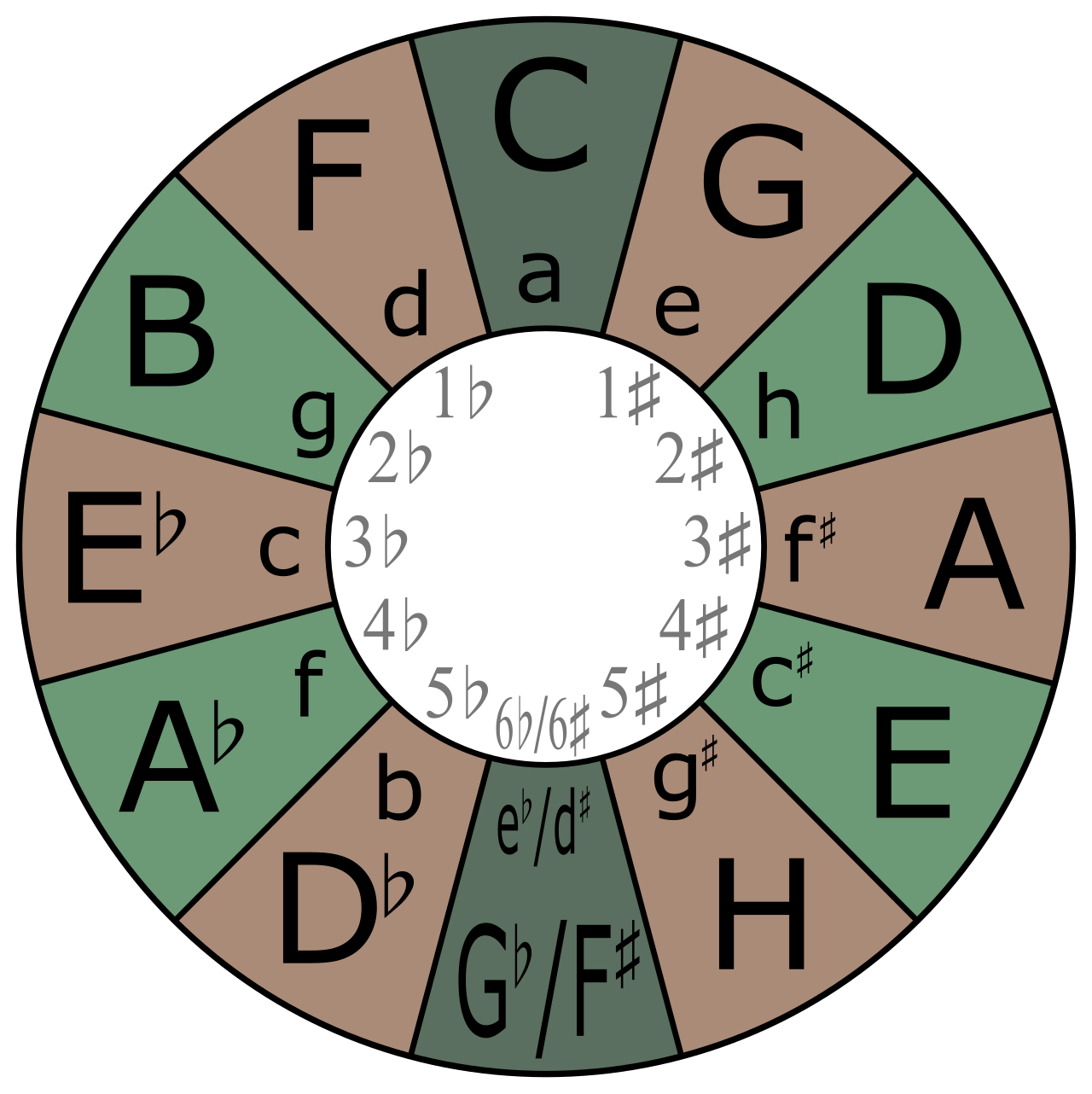
The circle is usually drawn with pitches and their corresponding keys arranged clockwise. Moving counterclockwise shows the same relationships as a circle of fourths. In Western music, harmonic progressions often use keys that are next to each other on the circle, making it a handy tool for composition and harmony. At the top sits the key of C major, which has no sharps or flats. Going clockwise, pitches rise by fifths, and key signatures gain sharps: G has one sharp, D has two, and so on. Going counterclockwise from the top, pitches fall by fifths, and key signatures gain flats: F has one flat, B♭ has two, and so forth. Some keys near the bottom can be written using either sharps or flats.
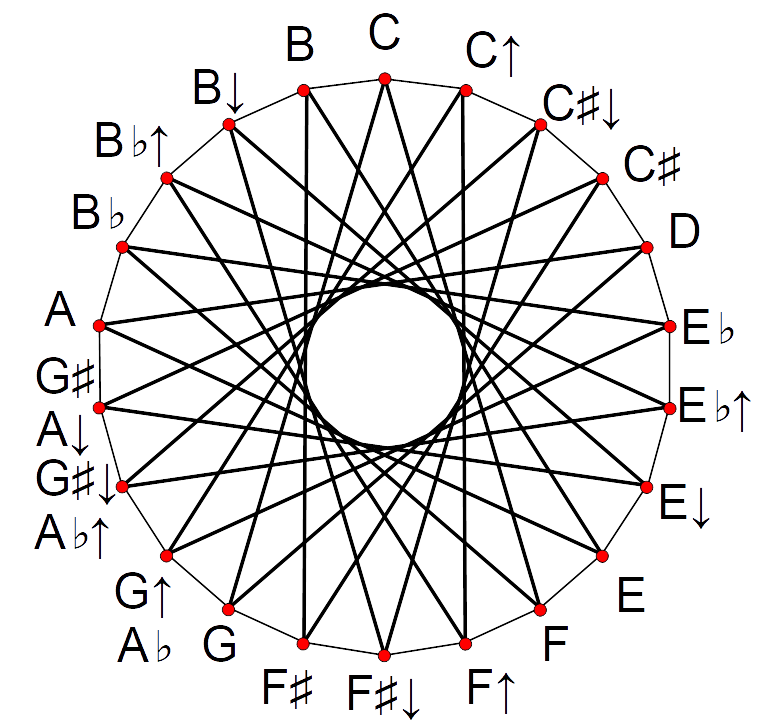
Starting from any note and moving up by fifths will eventually hit every tone before returning to the original pitch class. A pitch class includes all notes with the same letter name, regardless of octave—all C’s, for instance. Moving counterclockwise lowers a pitch by a fifth, but going up by a perfect fourth reaches the same note an octave higher, so it belongs to the same pitch class. For example, moving counterclockwise from C can be seen as descending a fifth to F or ascending a fourth to F.
When notating the circle, one note is replaced with its enharmonic equivalent. In the clockwise sequence, a perfect fifth above A♯ would be E♯, but it is written as F, which sounds the same. This creates a diminished sixth between A♯ and F. In the counterclockwise direction, a perfect fifth below G♭ should be C♭, but it is replaced with B, also forming a diminished sixth.
Each pitch can act as the tonic for a major or minor key, and each key has its own diatonic scale. The circle diagram shows how many sharps or flats are in each key signature: capital letters for major keys, lower-case for minor keys. Major and minor keys sharing the same key signature are called relative major and relative minor.
Tonal music often shifts to a new tonal center whose key signature differs by only one sharp or flat. These closely related keys are a fifth apart, so they sit next to each other on the circle. Chord progressions also frequently move between chords whose roots are a perfect fifth apart, which makes the circle useful for showing the harmonic distance between chords. The circle helps organize and describe the harmonic function of chords. Chords can move in a pattern of ascending perfect fourths (or descending perfect fifths) in what is called functional succession. In this view, the tonic is the endpoint of a progression derived from the circle.
Richard Franko Goldman, in *Harmony in Western Music*, notes that the IV chord is, in simple diatonic relationships, the farthest from I. On the descending circle of fifths, it leads away from I rather than toward it. He says the progression I–ii–V–I (an authentic cadence) feels more final than I–IV–I (a plagal cadence). Goldman agrees with Nattiez, who argues that in the progression I–IV–viio–iii–vi–ii–V–I, the chord on the fourth degree appears long before the chord on II, and is also farther from the tonic there. (In these articles, upper-case Roman numerals stand for major triads, lower-case for minor triads.)
Using the exact 3:2 frequency ratio for a perfect fifth (just intonation) does not bring you back to the starting pitch class after going around the circle. Twelve-tone equal temperament, however, produces fifths that return to a tone exactly seven octaves above the starting tone, and it makes the chromatic semitone and diatonic semitone the same size. The standard tempered fifth has a frequency ratio of 2^(7/12), about 1.498307077, which is roughly two cents narrower than a justly tuned fifth. Ascending by twelve justly tuned fifths fails to close the circle by about 23.46 cents—roughly a quarter of a semitone—an interval known as the Pythagorean comma.
- field
- Music theory
- known_for
- Organizing pitch classes and key signatures in a cycle of perfect fifths
- related_tuning_systems
- 12-tone equal temperament, well temperaments, Pythagorean tuning, quarter-comma meantone
Lore & Background
The circle of fifths is a visual representation of the twelve pitch classes of the chromatic scale arranged in a cycle of ascending perfect fifths. When moving clockwise from the top, starting on C, the sequence proceeds through G, D, A, E, B, F, and back to C, with enharmonic substitutions such as F for E and B for C creating diminished sixths at the closure. Moving counterclockwise, the pitches descend by fifths, which is equivalent to ascending by perfect fourths, and is sometimes called the circle of fourths. The diagram places key signatures with the closest harmonic relationships adjacent to one another: the key of C Major, with no sharps or flats, sits at the top; clockwise, each step adds one sharp, while counterclockwise adds one flat. Major keys are shown in capital letters, with their relative minor keys in lower-case letters alongside. The circle illustrates that tonal music commonly modulates to keys a fifth apart, and chord progressions often move by perfect fifths, making it a tool for understanding harmonic distance and functional succession, such as the ii–V–I progression. In just intonation, ascending by twelve perfect fifths with a 3:2 ratio does not return to the starting pitch class but overshoots by the Pythagorean comma. To close the circle, tuning systems like well temperaments and 12-tone equal temperament adjust the fifth ratio, with the standard tempered fifth being approximately two cents narrower than the justly tuned fifth.
Reader's Guide
The circle of fifths is a central reference for musical composition and harmony. It shows the most closely related key signatures adjacent to one another, making it useful for modulation and chord progression. Tonal music often modulates to a new tonal center whose key signature differs from the original by only one flat or sharp; these closely-related keys are a fifth apart and adjacent in the circle. Chord progressions also often move between chords whose roots are related by perfect fifth. The circle is used to organize and describe the harmonic or tonal function of chords, with the tonic considered the end point of a progression derived from the circle. Using the exact 3:2 ratio of frequencies to define a perfect fifth (just intonation) does not quite result in a return to the starting pitch class after going around the circle; the overshoot is the Pythagorean comma. Twelve-tone equal temperament tuning produces fifths that return to a tone exactly seven octaves above the initial tone. The term circle of fifths is sometimes used more generally for any tuning system in which the interval representing a perfect fifth may be stacked repeatedly to eventually reach the starting pitch class, such as 31 equal temperament or 53 equal temperament.
Did You Know?
- Ascending by twelve justly tuned perfect fifths overshoots the starting pitch class by an interval known as the Pythagorean comma, approximately 23.46 cents.
- Some sources imply the circle of fifths was known in antiquity by Pythagoras, but this is a misunderstanding and an anachronism.
- In the circle, moving counterclockwise from C could be thought of as descending by a fifth to F, or ascending by a fourth to F.
The Geometry of Fifths and the Pythagorean Problem
At its core, the circle of fifths is a mathematical statement about how pitch classes relate to one another. Starting from any tone and repeatedly ascending by a perfect fifth—defined in just intonation by the frequency ratio of 3:2—generates every one of the twelve chromatic pitch classes before theoretically returning to the starting point. In practice, however, twelve such fifths overshoot the original pitch by a small but significant interval called the Pythagorean comma, measuring roughly 23.46 cents, or about a quarter of a semitone. This tiny discrepancy meant that early musicians who transposed or modulated through multiple keys encountered increasingly out-of-tune intervals. To resolve the problem, theorists developed tempering systems that slightly altered the pure 3:2 ratio so the circle would close perfectly. The most widely adopted solution, twelve-tone equal temperament, produces a fifth with a frequency ratio of 2^(7/12), approximately 1.4983, just two cents narrower than the just fifth. This compromise allows the chromatic semitone and diatonic semitone to share an identical ratio, making the instrument playable across all keys without the accumulated drift that pure tuning would impose.
The Visual Map of Key Signatures
The circle is most commonly drawn as a ring with C Major positioned at the twelve-o'clock location, carrying no sharps or flats in its key signature. Moving clockwise, each successive key adds one sharp: G Major has one, D Major has two, and the pattern continues through A, E, and B. Moving counterclockwise from C, each step introduces a flat instead—F Major gains one flat, B-flat Major gains two, and so on. At the bottom of the circle, certain keys can be notated equivalently in sharps or flats, creating the familiar enharmonic pairs. Each position on the ring also carries a relative minor key, indicated by a lowercase letter, sharing the same key signature as its major counterpart. For instance, the key signature with two sharps belongs equally to D Major and B minor. This dual labeling makes the diagram an instantly readable reference for any composer or theorist who needs to identify how many accidentals a given key requires, or to quickly locate the closest tonal neighbors of a chosen tonic.
Harmonic Function and the Logic of Progression
In tonal Western music, the circle of fifths serves as a map of harmonic distance. When a piece modulates, it most naturally shifts to a key whose signature differs by just one sharp or flat—exactly one step along the circle. This adjacency reflects the fact that such keys share the greatest number of common tones. Chord progressions follow a similar logic: roots related by a perfect fifth, or equivalently a perfect fourth, create the strongest sense of forward motion. Theorist Richard Franko Goldman emphasized that the IV chord sits at the greatest harmonic distance from the tonic in simple diatonic relationships, leading away from I rather than toward it. This explains why an authentic cadence (I–ii–V–I) feels more decisively resolved than a plagal cadence (I–IV–I). In Goldman's framework, the tonic is the destination of a progression that traces the circle, and chords closer to the dominant on that path exert a stronger gravitational pull back home. The circle thus encodes not just pitch relationships but the very grammar of musical tension and release.
The Enharmonic Stitch and the Wolf Fifth
Despite its elegant circular appearance, the diagram contains a subtle notational seam. A perfect fifth above A-sharp would logically be E-sharp, yet standard notation substitutes F, producing an interval that is technically a diminished sixth rather than a true fifth. The same substitution occurs in the counterclockwise direction, where the fifth below G-flat should be C-flat but is written as B, again creating a diminished sixth. These enharmonic patches are necessary to keep the circle readable within the twelve-letter alphabet, but they reveal that the geometry is not perfectly seamless. The problem becomes audible in non-equal tuning systems. If one builds a scale from twelve justly tuned fifths, the final interval needed to close the loop is a markedly narrow, dissonant diminished sixth—so out of tune that it was nicknamed the wolf fifth, a playful allusion to a wolf howling an off-pitch note. Historical well temperaments distributed this unpleasantness across several intervals rather than concentrating it in one, while equal temperament eliminated it entirely by narrowing every fifth by a few cents.
Gallery
Frequently Asked Questions
Who is Circle of fifths?
The circle of fifths is a foundational diagram in Western music theory that arranges all twelve pitch classes of the chromatic scale into a loop built on ascending perfect fifths. It serves as a visual map for understanding how keys, chords, and harmonies relate to one another.
What are Circle of fifths's powers/role?
Its primary function is to display the relationships between key signatures, showing how many sharps or flats each major and minor key contains. Composers and theorists also use it to predict smooth chord progressions and modulations by moving clockwise or counterclockwise around the cycle.
How does Circle of fifths's story end?
Because it is a closed loop, traveling around the entire circle brings you back to the starting pitch class, completing a full octave of chromatic notes. This cyclical structure means there is no true ending—the pattern simply repeats infinitely.
Why is Circle of fifths important?
It provides an intuitive, visual framework for understanding harmonic relationships that would otherwise require memorizing dozens of individual key signatures. From beginner piano students to advanced composers, it remains one of the most practical tools for navigating tonal music in the Western tradition.
What tuning systems does Circle of fifths connect to?
The circle is most naturally expressed in 12-tone equal temperament, where each step around the ring corresponds to one semitone. It also finds expression in earlier systems such as Pythagorean tuning, quarter-comma meantone, and various well temperaments, each of which renders the constituent fifths with slightly different interval sizes.
More in Music Theory And Composition 1-24
Spotted an error? Know more?
This is a living reference — every entry is fact-audited, and reader corrections feed straight into our audit queue. Suggest an edit · See this site's audit record