
Bar (music)
Segment of music bounded by bar lines, indicating recurring beats.

Miguel Discart · CC BY-SA 2.0
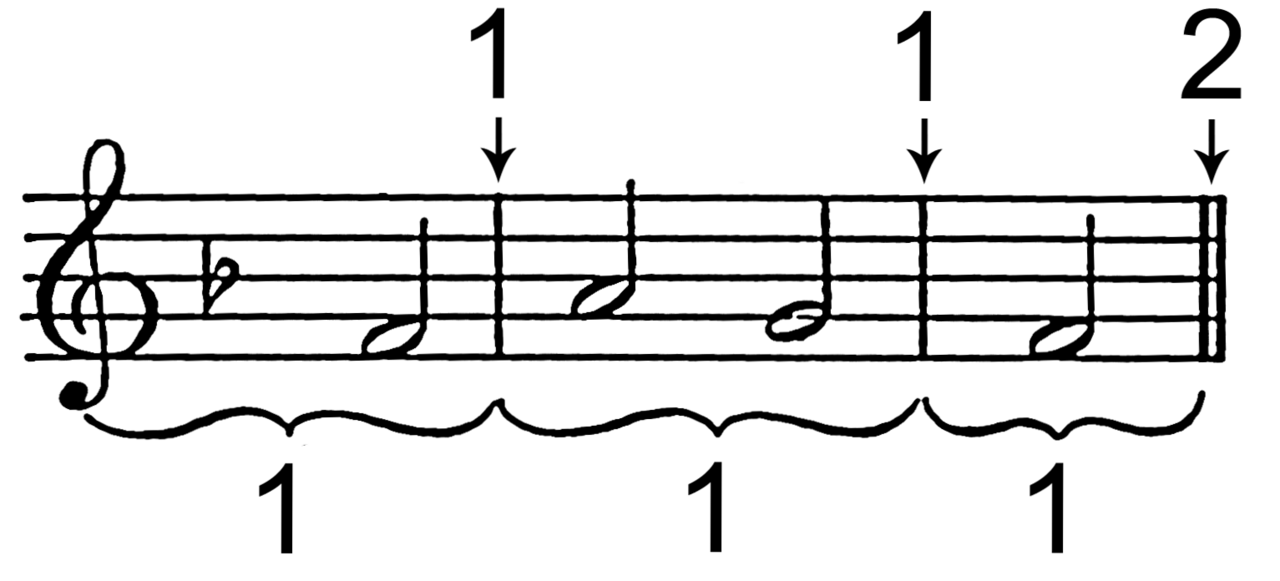
In musical notation, a bar (or measure) is a section of music set apart by vertical lines called bar lines, typically marking one or more recurring beats. The bar’s length—how many note values it holds—is usually shown by the time signature. **Types of bar lines** A regular bar line is a thin vertical line running from the top to the bottom of the staff, and it may extend between staves in a grand staff or orchestral score. A double bar line consists of two single bar lines placed close together, separating sections within a piece, or a bar line followed by a thicker one to mark the end of a piece or movement. (Double bar refers to the line type, not to a measure.) A double bar is often used before a new key signature, even if it doesn’t start a new section. A repeat sign looks like an end-of-piece bar line but has two dots, one above the other, indicating that the preceding section should be repeated. The start of the repeated passage may be marked by a begin-repeat sign; if none appears, the repeat is understood to begin at the start of the piece or movement. A begin-repeat sign at the beginning of a staff does not act as a bar line, since no bar precedes it—it only marks where the repeat starts. A mensurstrich is a bar line that runs only between staves, not through each staff; editors of early music use it to help modern musicians navigate music originally written without bar lines. Lines that go only partway through a staff are rare, sometimes used to guide the reader in very long measures with complex time signatures or as brief section breaks in Gregorian chant. Some composers use dashed or dotted bar lines; others (like Hugo Distler) place bar lines at different spots in different parts to show varying stress patterns. If many consecutive bars contain only rests, they may be replaced by a single bar with a multirest; the number above indicates how many bars are replaced. **Bars and stresses** Whether the music has a regular meter or mixed meters, the first note of a bar (the downbeat) is usually given a slight stress compared to the others. Igor Stravinsky said: “The bar line is much, much more than a mere accent, and I don't believe that it can be simulated by an accent, at least not in my music.” Bars and bar lines also show grouping—rhythmically of beats within and between bars, within and between phrases, and on higher levels such as meter. **Numbering bars** The first metrically complete bar in a piece is called “bar 1” or “m. 1.” If the piece starts with an anacrusis (an incomplete bar), “bar 1” is the following bar. Bars inside first or second endings are numbered consecutively. **History** The earliest bar lines, used in keyboard and vihuela music in the 15th and 16th centuries, did not reflect a regular meter—they were only section divisions or, in some cases, marked every beat. Bar lines began appearing in ensemble music in the late 16th century but were used irregularly. Not until the mid-17th century were bar lines used in the modern style, with every measure the same length, and they became linked to time signatures. Modern editions of early music originally notated without bar lines sometimes use a mensurstrich as a compromise. **Hypermeasure** A hypermeasure (or large-scale measure, or measure-group) is a metric unit where each regular measure acts as one beat (a hyperbeat) of a larger meter. So a beat is to a measure as a measure/hyperbeat is to a hypermeasure. Hypermeasures must be larger than a notated bar, be perceived as a unit, consist of a pattern of strong and weak beats, and, along with adjacent hypermeasures of the same length, create a sense of hypermeter. The term was coined by Edward T. Cone in *Musical Form and Musical Performance* (1968) and is similar to the less formal idea of a phrase.
- field
- Musical notation
- known_for
- Segmenting music into measures bounded by bar lines, indicating recurring beats and time signatures
Lore & Background
In musical notation, a bar (or measure) is a segment of music bounded by vertical lines known as bar lines, which usually indicate one or more recurring beats. The length of the bar, determined by the number of note values it contains, is normally specified by the time signature. Regular bar lines are thin vertical lines extending from the top to the bottom of the staff, and in grand staffs or orchestral scores, they may extend between staves. A double bar line consists of two single bar lines drawn close together, used to separate sections within a piece, or a bar line followed by a thicker line to indicate the end of a piece or movement; it is a type of bar line, not a type of bar. A repeat sign resembles the music end but includes two dots, one above the other, indicating that the preceding section is to be repeated; the beginning of the repeated passage may be marked by a begin-repeat sign, which at the start of a staff does not act as a bar line. A mensurstrich is a bar line that stretches only between staves, not through each staff, used in editions of early music originally written without bar lines. Lines extending only partway through the staff are rare, sometimes used in very long measures with complex time signatures or as brief section divisions in Gregorian chant. Some composers use dashed or dotted bar lines, and others place bar lines at different positions in different parts to indicate varied stress patterns. The first note in a bar, the downbeat, is usually stressed slightly. The first metrically complete bar is called "bar 1"; if the piece begins with an anacrusis, bar 1 is the following bar. Bars within first or second endings are numbered consecutively.
Reader's Guide
The bar is a fundamental unit in Western musical notation, organizing rhythm and meter. Regular bar lines are thin vertical lines extending from the top to the bottom of the staff. A double bar line separates sections or indicates the end of a piece or movement. Repeat signs, with two dots, indicate that a section is to be repeated. A mensurstrich, a bar line stretching only between staves, is used in editions of early music originally written without bar lines. The first note in a bar, the downbeat, is usually stressed slightly. Igor Stravinsky noted that the bar line is much more than a mere accent. Bars also indicate grouping of beats within and between phrases. The first metrically complete bar is called bar 1; if the piece begins with an anacrusis, bar 1 is the following bar. Hypermeasures are metric units larger than a notated bar, perceived as a unit with strong and weak beats, coined by Edward T. Cone.
Did You Know?
- The earliest bar lines in the 15th and 16th centuries did not reflect regular meter but were only section divisions or marked off every beat.
- A double bar line refers to a type of bar line, not a type of bar (measure).
- A mensurstrich is a bar line that stretches only between staves, not through each staff.
The Three Faces of Music Theory
Music theory resists a single definition. The Oxford Companion to Music identifies three interrelated meanings that together capture the field's breadth. The narrowest sense covers the basic building blocks a student needs to read notation fluently—key signatures, time signatures, and the conventions of rhythmic writing. A second, broader sense treats music theory as a historical discipline, tracing how scholars across millennia have interpreted and explained what music is and does. The third sense positions it as a branch of musicology that aims to articulate universal processes and principles underlying musical practice. What distinguishes this musicological approach from straightforward musical analysis is its starting point: rather than examining a single composition or performance, it begins with the raw materials—intervals, scales, rhythmic structures—from which all works are constructed. In this way, the discipline moves from the concrete score to the abstract grammar that makes the score possible, bridging the gap between what a listener hears and what a composer intends.
Clay Tablets and Bamboo Pipes: The Deepest Roots
The oldest surviving evidence of systematic musical thought comes not from Europe but from the ancient Near East. Sumerian and Akkadian clay tablets, some dating to before 1500 BCE, contain lists of intervals and tuning systems. Scholar Sam Mirelman has noted that these Mesopotamian texts predate comparable musical reasoning from any other culture by roughly a thousand years, and that a shared musical terminology persisted across more than a millennium of writing. In East Asia, a parallel tradition took a numerical form. Chinese theory is organized around three key numbers: twelve (the pitches available for scale construction), five (the pentatonic scale), and eight (the categories of instruments classified by material—metal, stone, silk, bamboo, gourd, clay, leather, and wood). The Lüshi chunqiu, composed around 238 BCE, preserves the legend of Ling Lun, who, on the Yellow Emperor's command, fashioned twelve bamboo pipes by matching the tones of singing phoenixes, establishing the lülü pitch system that would anchor Chinese musical practice for centuries.
From Oral Tradition to Written Treatise
Music theory is not confined to academic institutions. In its most fundamental sense, it lives in the hands of instrument makers, the memories of oral traditions, and the physical artifacts left behind by past civilizations. Prehistoric instruments recovered from archaeological sites around the world reveal not only what sounds were produced but also hints of the theoretical frameworks their creators employed. In ancient and living cultures alike, the deep roots of musical thinking are embedded in how instruments are built, how songs are passed down, and how communities organize their sonic world. Many of these cultures also formalized their knowledge through written treatises and notation systems, and the boundary between practical and scholarly tradition is porous: a composer's handbook may cite earlier treatises in much the same way a modern researcher cites prior studies. The medieval European Quadrivium offers a striking example of theory divorced from practice—music was studied as an abstract system of numerical proportions, carefully examined at a remove from actual performance. Yet that very abstract discipline later became the foundation for the tuning systems that still underpin modern musical practice.
Theorists, Methods, and the Academic World
In contemporary universities, music theory occupies a specific niche as a subfield of musicology, the broader study of musical cultures and their histories. The discipline's intellectual foundations were laid in the late nineteenth century, when Guido Adler, in a foundational text for musicology, argued that the science of music emerged simultaneously with the art of sounds. His reasoning was elegant: music only becomes music once pitches are measured and compared, and therefore every culture that possesses an art of sound necessarily also possesses a science of sound. In modern practice, a music theorist draws on a wide toolkit—mathematics, graphic analysis, and especially techniques enabled by Western notation—alongside comparative, descriptive, and statistical approaches. In the United States and Canada, a tenure-track position in music theory typically demands a master's or doctoral degree. Standard textbooks weave together musical acoustics, the mechanics of notation, and the techniques of tonal composition, including harmony and counterpoint, reflecting the field's insistence on connecting abstract principle to the concrete act of making music.
Gallery




Frequently Asked Questions
What is a Bar (music)?
A bar, often called a measure, is a defined segment of written music enclosed between two vertical bar lines. It typically holds a fixed number of beats as set by the piece's time signature.
What role does a Bar play in musical notation?
Bars chop a continuous stream of notes into manageable rhythmic units so performers can easily track beats and accent patterns. They also signal where phrases or structural sections begin and end.
How does a Bar connect to the time signature?
The time signature dictates exactly how many beats—or what combination of note values—each bar must hold. This keeps every measure in a given section the same rhythmic length, giving the piece a steady pulse.
Why are Bar lines important for composers and performers?
Bar lines create a visual grid that organizes rhythm, highlights recurring stress patterns, and marks structural divisions within a composition. Without them, reading and performing written music would be far more disorienting.
How many beats does a Bar typically contain?
A bar holds whatever number of beats the time signature prescribes—four in 4/4 time, three in 3/4, and so on. The essential rule is that every bar in a given passage maintains the same beat count for rhythmic consistency.
More in Music Theory And Composition 1-24
Spotted an error? Know more?
This is a living reference — every entry is fact-audited, and reader corrections feed straight into our audit queue. Suggest an edit · See this site's audit record