
Accidental (music)
Symbols indicating pitch alteration in musical notation.

HeavyD14 · Public domain
In music notation, an accidental is a symbol used to change the pitch of a note. The most frequent ones are the flat (♭), which lowers a note by a semitone, and the sharp (♯), which raises it by a semitone, along with the natural (♮), which cancels a previous sharp or flat. These symbols apply to individual notes within a piece, but the sharps or flats already written in the key signature are not considered accidentals.
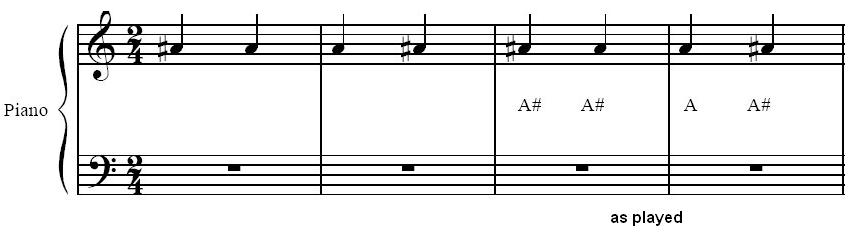
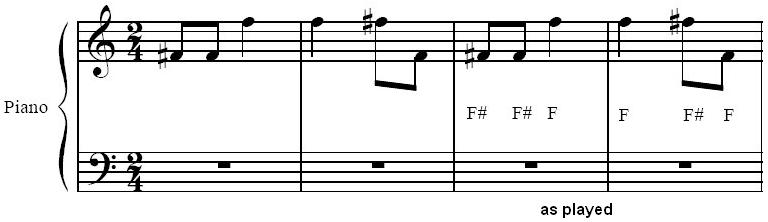
An accidental affects only the note it directly precedes and any repetition of that same note within the same measure, unless another accidental cancels it. If a note with an accidental is tied across a barline, the accidental continues to apply to the tied note but not to any subsequent notes in the new measure. When a note with an accidental is repeated in a different octave, modern notation usually requires a new accidental for clarity, though older notation sometimes assumed the accidental carried across octaves. In rare cases like a mid-measure clef change or octave sign, the accidental is canceled as if at a barline, and a courtesy accidental may be added to avoid confusion.
The shapes of modern accidentals come from two forms of the lowercase letter "b" used in Gregorian chant to distinguish the two versions of the note B—the only pitch that could be altered. The round "b" became the flat sign, while the square "b" evolved into both the sharp and natural signs.
In standard practice, a sharp raises a note by one semitone, a flat lowers it by one semitone, and a natural cancels any previous sharp or flat. Accidentals work alongside the key signature, whose effect lasts for the whole piece until a new key signature appears. An accidental can also override a previous accidental or reinstate the key signature’s flats or sharps. Once a barline is crossed, the accidental’s effect ends, except for tied notes that carry it into the next measure—but that carried-over accidental does not apply to any other notes after the tie.
For example, in a passage with three measures: measure 1 has G natural, then G sharp, then another G sharp (the sharp carries over). Measure 2 starts with G natural (with a courtesy accidental), then G flat, then another G flat (the flat carries over). Measure 3 begins with a G flat tied from the previous note, then a G sharp, then a G natural (the natural cancels the sharp).
This convention works well for tonal music but can become cumbersome in atonal music, which often uses many accidentals. An alternative system, described by Kurt Stone, uses note-for-note accidentals to reduce clutter: accidentals only affect the note they immediately precede; they are not repeated on tied notes unless the tie crosses a line or page; they are not repeated for repeated notes unless a different pitch or rest intervenes; a natural is used if a sharp or flat is followed directly by its natural form; and courtesy accidentals in parentheses may clarify ambiguities but are kept minimal. Since seven of the twelve chromatic notes are naturals (like the white keys on a piano), this system cuts down on the number of naturals needed. Occasionally, an accidental can change a note by more than a semitone—for instance, if a G sharp is followed by a G flat in the same measure, the flat means the note is two semitones lower than its natural position. In some atonal scores, especially by composers of the Second Viennese School, every note gets its own accidental, including naturals and repeated pitches, because they treat each pitch as equal and independent, not just an altered version of a natural note.
Double flats and double sharps alter a note by two semitones. For example, an F double sharp is a whole step above F, sounding the same as G. These alterations apply to the note as if it were natural, ignoring the key signature. If a double sharp or double flat is followed by a single sharp or flat on the same note, modern notation uses just the single accidental, while older notation may first cancel the double accidental with a natural sign. Changing a double accidental to a natural can be done with a single natural (modern) or a double natural (older). Triple flats and triple sharps, which alter a note by three semitones, are extremely rare. In tunings that don’t use standard 12-tone equal temperament, enharmonic equivalents differ, so accidentals behave differently—for instance, F might not be the same pitch as G, and double or triple accidentals would have distinct effects.
In modern scores, a barline cancels an accidental, except when a tied note carries it across. Courtesy accidentals are sometimes added in parentheses to prevent confusion, especially after a barline or a clef change.
- field
- Music notation
- known_for
- Symbols that alter pitch (flat, sharp, natural, double flat, double sharp)
- origin
- Derived from two forms of the lower-case letter b in Gregorian chant manuscripts
Lore & Background
The modern accidental signs derive from the two forms of the lower-case letter b used in Gregorian chant manuscripts to signify the two pitches of B, the only note that could be altered. The 'round' b became the flat sign, while the 'square' b diverged into the sharp and natural signs. The three principal symbols indicating whether a note should be raised or lowered in pitch are derived from variations of the small letter b: the sharp (♯) and natural (♮) signs from the square 'b quadratum', and the flat sign (♭) from the round 'b rotundum'.
An accidental is a symbol in musical notation that alters the pitch of a given note. The most common accidentals are the flat, which lowers a note by a semitone, and the sharp, which raises it by a semitone. The natural cancels a previous sharp or flat. Double flats and double sharps alter a note by two semitones; triple flats and triple sharps, altering by three semitones, are extremely rare. An accidental applies to the note immediately following it and to all subsequent instances of that same pitch within the same measure, unless canceled by another accidental. This effect ends at a barline, except when a note with an accidental is tied to the same note across the barline; in that case, the accidental continues for the tied note but does not apply to any later notes. If a note with an accidental is repeated in a different octave, modern notation requires a new accidental for clarity, though older conventions sometimes assumed the initial accidental applied across octaves. In atonal music, an alternative system is often used where accidentals affect only the note they directly precede, and naturals are not repeated for tied notes unless the tie spans a line or page break. Courtesy accidentals, often placed in parentheses, may be used to resolve ambiguities, such as after a mid-measure clef change or octave sign.
Reader's Guide
Accidentals are fundamental to Western musical notation, allowing composers to specify pitches outside the key signature. A sharp raises a note's pitch by a semitone, a flat lowers it by a semitone, and a natural cancels a previous accidental or reinstates the key signature. Double flats and double sharps alter the pitch by two semitones. Accidentals apply to subsequent notes on the same staff position for the remainder of the measure, unless canceled by another accidental or a barline, except when a note is tied across a barline. In atonal music, an alternative system of note-for-note accidentals is sometimes used, where accidentals affect only the notes they immediately precede. Courtesy accidentals, often in parentheses, may clarify ambiguities. Microtonal music has developed additional notation systems, such as those used by Turkish musicians to represent intervals smaller than a tempered semitone.
Did You Know?
- The modern accidental signs derive from the two forms of the lower-case letter b used in Gregorian chant manuscripts.
- A double flat or double sharp alters the pitch of a note by two semitones.
- In some atonal scores, an accidental is notated on every note, including natural notes and repeated pitches.
- Turkish musicians refined the European accidental system to notate scales using intervals smaller than a tempered semitone.
The Language of the Staff
Musical notation operates as a comprehensive symbolic language, where marks on a page encode virtually every dimension of performance. Beyond the basic pitch and duration of notes, the system communicates dynamics, articulation, tempo, metre, and structural form such as whether a section should be repeated. It even specifies granular performance details: which fingers to use, which keys or pedals to engage, whether a string should be bowed or plucked, and the direction of bow movement. The clef system anchors this language by assigning a specific pitch to a specific line of the staff, effectively defining the tessitura of the music. While historically clefs could sit on any line or even a space, modern practice has narrowed the palette to treble, bass, alto, and tenor clefs. A clef typically appears at the leftmost position on a staff, though a change in register can introduce a different clef elsewhere in the line.
Accidentals, Key Signatures, and the Microtonal Frontier
Accidentals serve as temporary pitch modifiers, altering the note that follows them on the same staff position within a measure unless a subsequent accidental cancels the effect. Key signatures take a broader approach, declaring which notes are to be played as sharps or flats throughout the music that follows, accommodating up to seven sharps or flats. A key signature with B-flat means every B in every octave becomes B-flat, eliminating the need for individual accidentals on those notes. A signature with no sharps or flats typically signals C major or A minor, though it can also simply mean accidentals will be applied as needed. Beyond the standard twelve-tone system, microtonal music presents a notation challenge with no universally accepted standard. Quarter tones are commonly indicated by a fraction one-quarter beside an upward or downward arrow, while 19 equal temperament—dividing a whole tone into three steps—avoids nonstandard symbols entirely by making sharps and flats non-enharmonic.
Rhythm, Duration, and the Pulse of Measures
In American musical parlance, note and rest values carry names that express their length as a fraction of a whole note—a half note spans half that duration, a quarter note one quarter, and so on. These rhythmic values slot into measures, the fundamental units of a uniform pulse. Time signatures govern this structure: the top number declares how many beats fill each measure, while the bottom number identifies which note value constitutes a single beat. Although any number of beats is theoretically possible, the overwhelming majority of music employs multiples of two or three, making 2, 3, 4, and 6 the most frequent top numbers. Similarly, while any note length could define a beat, the quarter note (bottom number 4) and eighth note (bottom number 8) dominate practice. This framework provides performers with a consistent grid for organizing rhythmic flow, and breaks in the notation signal pauses within that grid.
Fingers, Pedals, and the Particulars of Each Instrument
Musical notation extends well beyond the universal staff into instrument-specific conventions. Guitarists encounter a fingerpicking system derived from Spanish or Latin finger names, written above, below, or beside the relevant note. Piano players see pedal marks for sustain, applicable to the piano, vibraphone, and chimes, and may encounter English fingering in pre-1940 British tutors, where a plus sign denotes the thumb followed by numbers 1 through 4. Harp notation mirrors piano fingering but omits the number 5, since the little finger is not used in playing the harp. Cello and bass players use a circle-with-a-line symbol, or rarely a T, for thumb positions. Mallet percussion for four-mallet and six-mallet setups employs numbered indicators that may be reversed. Organ notation draws on a variety of abbreviations for its keyboards, varying across European languages.
Gallery




Frequently Asked Questions
What is an accidental in music notation?
An accidental is a symbol placed before a note to temporarily change its pitch within a measure. It signals that the note should be played a semitone higher or lower than the default pitch indicated by the key signature.
What are the most common accidental symbols?
The flat (♭) lowers a pitch by one semitone, the sharp (♯) raises it by one semitone, and the natural (♮) cancels a previously applied sharp or flat. Less frequently, double flats and double sharps alter a pitch by two semitones.
How is an accidental different from the sharps or flats in a key signature?
Key signature symbols apply to every note of that letter throughout the piece, while an accidental only affects the specific note it is written next to within a single measure. The two serve distinct roles: one sets the overall tonal context, the other makes a one-off alteration.
Where did the accidental symbols originate historically?
They evolved from two different forms of the lower-case letter b that scribes used in medieval Gregorian chant manuscripts to indicate pitch modifications. Over centuries those handwritten b-variants gradually standardized into the sharp, flat, and natural glyphs used today.
Why are accidentals important for a composer or performer?
They let a writer introduce chromatic notes, modulate, or correct a pitch without rewriting the entire key signature. For a performer, reading accidentals correctly is essential to playing the intended pitch rather than defaulting to the key's established tone.
More in Music Theory And Composition 1-24
Spotted an error? Know more?
This is a living reference — every entry is fact-audited, and reader corrections feed straight into our audit queue. Suggest an edit · See this site's audit record