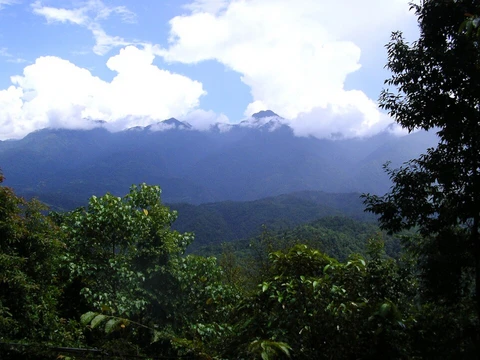
Tunkinsky National Park
National park in Russia, part of the system of protected areas.

Tunkinsky National Park is a protected area in Russia, located in the Republic of Buryatia. The source does not provide specific details about Tunkinsky National Park, so this entry is based solely on the general information about Russian national parks given in the source. According to the source, national parks in Russia are areas of land and water devoted to nature protection, ecological education, and scientific research. They contain sites of particular ecological, historical and aesthetic value, and regulated tourism is permitted. The area of each park is divided into zones, including a strictly protected area managed as a zapovednik, as well as recreational and buffer zones where economic activity such as tourism, traditional land use, and benign forms of agriculture and forestry are allowed.
- location
- South central Siberia, Republic of Buryatia
- climate
- Subarctic continental (Köppen Dwc)
- notable_for
- Biodiversity hotspot, endangered species, hot springs
Verified Timeline
Lore & Background
The source does not provide specific lore about Tunkinsky National Park. However, it notes that the oldest parks in Russia are Sochinsky and Losiny Ostrov (1983); Samarskaya Luka (1984); Mariy Chodra (1985); Bashkiriya, Prielbrusye, Pribaykalsky, and Zabaykalsky (1986). The concept of natural parks in the USSR was influenced by a 1961 trip by Soviet geographers, headed by Innokenti Gerasimov, to the United States, where they visited Yellowstone National Park and the Great Smoky Mountains National Park. In 1966, Gerasimov and Vladimir Preobrazhensky published an article in Komsomolskaya Pravda discussing the need for a system of natural parks in the USSR, which were seen as places for tourists to relax and to protect animals and plants in areas not accessible without a guide.
Reader's Guide
The source does not provide specific information about Tunkinsky National Park's location, ecosystems, or activities. However, based on the general description of Russian national parks, visitors can expect a park divided into functional zones. A strictly protected area, managed like a zapovednik, is off-limits without a guide, serving to protect animals and plants. Recreational and buffer zones allow regulated tourism, traditional land use, and benign forms of agriculture and forestry. The park is under the responsibility of the Ministry of Natural Resources and Environment (Russia). As with all Russian national parks, the park's purpose includes nature protection, ecological education, and scientific research, with sites of particular ecological, historical, and aesthetic value.
Did You Know?
- The source does not provide specific facts about Tunkinsky National Park. However, it states that Russian national parks are currently the responsibility of the Ministry of Natural Resources and Environment (Russia).
- According to the source, there are currently 71 national parks in Russia, covering over 150,000 square kilometers (58,000 sq mi).
- The source notes that the oldest parks in Russia are Sochinsky and Losiny Ostrov, established in 1983.
- The source mentions that in 2001, Vodlozersky National Park received UNESCO Biosphere Reserve status, followed by Smolenskoye Poozerye and Ugra National Park in 2002, and Valdaysky and Kenozersky in 2004.
- The source indicates that the idea for natural parks in the USSR was sparked by a 1961 visit to Yellowstone National Park and the Great Smoky Mountains National Park by Soviet geographers led by Innokenti Gerasimov.
Frequently Asked Questions
Who is Tunkinsky National Park?
Tunkinsky National Park is a protected wilderness area in south central Siberia, situated within the Republic of Buryatia. It stretches across the mountainous Tunka Valley along the Irkut River, sitting between Lake Baikal and Lake Khövsgöl.
What are Tunkinsky National Park's powers/role?
The park's primary role is safeguarding a biodiversity hotspot where taiga, steppe, alpine forest, and lake ecosystems converge. It protects endangered species, dramatic rift and glacial valleys, and natural hot springs across roughly 11,837 square kilometers.
How does Tunkinsky National Park's story end?
As a living, ongoing protected area rather than a narrative, Tunkinsky National Park has no fixed ending. Its continuing 'story' is the long-term conservation of its subarctic continental landscapes and the species that depend on them.
Why is Tunkinsky National Park important?
It occupies the entire Tunkinsky District and represents a rare meeting point of four distinct ecosystem types in one region. Its elevation range from 668 to 3,172 meters creates habitat diversity that supports numerous endangered species and makes it a critical biodiversity hotspot in Siberia.
What makes Tunkinsky National Park unique compared to other Siberian reserves?
Its position straddling the boundary between Lake Baikal and Mongolia's Lake Khövsgöl gives it a transitional character few other reserves share. The combination of glacial valleys, hot springs, and a subarctic continental climate across over a million hectares makes it a one-of-a-kind landscape in the region.
More in Mountain And Alpine Reserves 1-19
Spotted an error? Know more?
This is a living reference — every entry is fact-audited, and reader corrections feed straight into our audit queue. Suggest an edit · See this site's audit record