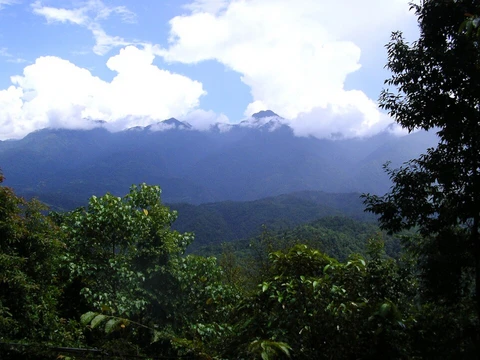
Putorana Nature Reserve
The largest and oldest specially protected natural area in the Caucasus, founded in 1924.

Caucasus Nature Reserve is a Russian zapovednik (strict ecological reserve) covering a heavily mountainous section of the Northwest Caucasus Mountains. It is the largest and oldest in the territory of specially protected natural area in the Caucasus, having been created in 1924 as the Caucasian Bison Reserve. In 1979, the site was named a UNESCO Biosphere Reserve, and in 1999 included in a UNESCO World Heritage Site. In 2008 it was officially renamed after Khachatur (Christopher) G. Shaposhnikova the biologist who founded the reserve. The area is situated in the Mostovsky District of Krasnodar Krai, covering an area of 280,335 ha (2,803.35 km2; 1,082.38 mi2).
- headquarters
- Sochi
- ecoregion
- Caucasus mixed forests
- climate
- Humid subtropical (Köppen Cfa), with severe tundra at highest elevations
Verified Timeline
Reader's Guide
The Caucasus Reserve was created in 1924 as the Caucasian Bison Reserve, making it the largest and oldest specially protected natural area in the Caucasus. In 1979, it was named a UNESCO Biosphere Reserve, and in 1999 it was included in a UNESCO World Heritage Site. In 2008, the reserve was officially renamed after Khachatur (Christopher) G. Shaposhnikova, the biologist who founded it. The reserve covers 280,335 ha (2,803.35 km2; 1,082.38 mi2) in the Mostovsky District of Krasnodar Krai. Its terrain is heavily mountainous, with altitudes ranging from 260 to 3,360 m (850 to 11,020 ft). The reserve is bounded on the south by Sochi National Park and the ridge of the Caucasus bordering Georgia (Abkhazia). The main office is in the city of Sochi. As a strict nature reserve, it is mostly closed to the general public, though scientists and those with 'environmental education' purposes can make arrangements with park management for visits. Several 'ecotourist' routes are open to the public but require permits obtained in advance. These routes include the Zoo (a captive animal complex), Khosta Yew-Tree Grove, Devil's Gate Canyon (50 meter walls with 5 meter width), Nature Reserve and Dolmen (a single-chamber monolithic tomb), and Rope Adventure Park (family activities with rope bridges).
Did You Know?
- The reserve was created in 1924 as the Caucasian Bison Reserve.
- In 2008, it was officially renamed after Khachatur (Christopher) G. Shaposhnikova, the biologist who founded it.
- The coniferous yew trees in the Khosta sector can reach an age of over 2,000 years.
- The reserve has recorded 1,500 species of vascular plants, of which 20% are endemic to the Caucasus.
- Bird life includes 248 species, with 112 that nest within the borders of the reserve.
Geography & Topography
The Caucasus Reserve protects mountainous terrain. It is bounded on the south by Sochi National Park and the ridge of the Caucasus bordering on the Georgia (Abkhazia). Altitudes range from 260 to 3,360 m (850 to 11,020 ft).
Climate & Ecoregion
Caucasus is located in the Caucasus mixed forests ecoregion. This ecoregion is located along the Caucasus Mountains between the Black Sea and the Caspian Sea. The region has one of the highest levels of species endemism and diversity in the world: 23% of vascular species, and 10% of vertebrates. The climate of Caucasus is humid subtropical (Köppen climate classification Cfa), a climate characterized by hot, humid summers and cool winters. In the Caucasus Reserve, however, the high range of altitudes leads to severe tundra climate at the highest elevations. The average temperature in January is 4.3 C degrees, in July it is 21 C degrees. Annual precipitation is 700 – 1,200 mm.
Flora & Fauna
The plant life of the reserve is characterized by high biodiversity, reflecting the position of the site at the meeting point of several floral zones (temperate and sub-tropical) and with the widest range of altitude zones (from forested river valleys to mountain top tundra). The reserve has recorded 1,500 species of vascular plants, of which 20% are endemic to the Caucasus. Most of the territory is forested, with sub-alpine and alpine meadows at the higher elevations. The coniferous yew trees in the Khosta sector can reach an age of over 2,000 years. The typical trees of the lower elevations are oak and alder. The upper forest levels are more dark fir and spruce. The rest of the Caucasus Reserve differ from those of northern Europe by the presence of vines. The animal life of the reserve is noteworthy for the large number of species, particularly of large mammals. Scientists on the reserve have recorded 89 species of mammal, 15 species of reptile, 9 of amphibian, 21 of fish, over 100 species of mollusc, and more than 10,000 species of insect. Bird life is also prolific, with 248 species of bird, including 112 that nest within the borders of the reserve.
Conservation & Human Interaction
As a strict nature reserve, the Caucasus Reserve is mostly closed to the general public, although scientists and those with 'environmental education' purposes can make arrangements with park management for visits. There are several 'ecotourist' routes in the reserve, however, that are open to the public, but require permits to be obtained in advance. These routes are: The Zoo (a captive animal complex), Khosta Yew-Tree Grove, Devil's Gate Canyon (50 meter walls with 5 meter width), Nature Reserve and Dolmen (a dolmen is a single-chamber monolithic tomb), and Rope Adventure Park (family activities with rope bridges, etc.). The main office is in the city of Sochi.
Frequently Asked Questions
What is Putorana Nature Reserve?
It is a strict Russian zapovednik (nature reserve) that protects the Putorana Plateau and its surrounding subarctic and arctic landscapes. It earned UNESCO World Heritage status in the very same year it was created.
How large is Putorana Nature Reserve?
The protected area covers roughly 1.89 million hectares of plateau, tundra, and waterways, making it one of the largest strict reserves in the country.
Why is Putorana Nature Reserve important?
It preserves some of the most untouched subarctic tundra ecosystems in the Taimyr-Central Siberian ecoregion, including deep fjord-like lake systems and what is considered Russia's tallest waterfall. Its strict zapovednik status prohibits any resource extraction within its borders.
More in Mountain And Alpine Reserves 1-19
Spotted an error? Know more?
This is a living reference — every entry is fact-audited, and reader corrections feed straight into our audit queue. Suggest an edit · See this site's audit record