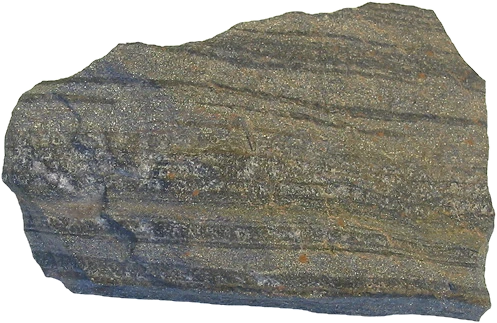
Stibnite
A sulfide mineral and key source of antimony.

Stibnite, also known as antimonite, is a sulfide mineral that serves as the primary ore of the metalloid antimony. Its name traces back through Latin *stibium* to the Greek *stibi*, the ancient term for both the mineral and the element. Chemically, it is antimony trisulfide (Sb₂S₃). This soft, metallic grey crystalline substance possesses an orthorhombic crystal structure. Freshly exposed surfaces are grey, but they can darken to black upon exposure to air due to oxidation. The mineral’s structure resembles that of arsenic trisulfide, with pyramidal, three-coordinate antimony centers linked by bent, two-coordinate sulfide ions. However, some studies indicate that the antimony atoms actually exhibit higher coordination numbers—specifically (3+4) at one site and (5+2) at another—with secondary bonds contributing to the material’s cohesion and packing.
Stibnite has a band gap of 1.88 eV at room temperature and acts as a photoconductor. It is toxic if ingested, producing symptoms akin to arsenic poisoning. Historically, its use dates back to at least 3000 BC, when powdered stibnite was mixed with fat or other materials to create kohl, a cosmetic used in the Mediterranean and beyond for darkening eyebrows, eyelashes, and the eye’s perimeter. In ancient Egypt, it served both as a cosmetic and a medication. The mineral also appears in alchemical literature; the 17th-century alchemist Eirenaeus Philalethes (George Starkey) described it as a precursor to philosophical mercury, a hypothetical step toward the philosopher’s stone. In modern times, antimony trisulfide is employed in pyrotechnics, particularly in glitter and fountain mixtures. Needle-like crystals, known as “Chinese needles,” are used in glitter compositions and white stars, while a “dark pyro” version enhances the sensitivity and sharpens the report of flash powders. It is also a component of safety matches. Its former use in flash compositions was discontinued due to toxicity and sensitivity to static electricity.
Stibnite forms in hydrothermal deposits, often alongside minerals such as realgar, orpiment, cinnabar, galena, pyrite, and calcite. While small deposits are common, large ones are rare. The world’s largest antimony deposit, the Xikuangshan mine, yields high-quality crystals with calcite. Notable occurrences are found in Canada, Mexico, Peru, Japan, Germany, Romania, Italy, France, England, A
- category
- Mineral
- chemical_formula
- Sb2S3
- crystal_system
- Orthorhombic
- band_gap
- 1.88 eV at room temperature
- primary_use
- Source of antimony; historically used as kohl and in pyrotechnics
Lore & Background
Stibnite has a structure similar to that of arsenic trisulfide, with pyramidal three-coordinate Sb(III) centers linked by bent two-coordinate sulfide ions. Some studies suggest the actual coordination polyhedra of antimony are SbS7, with (3+4) coordination at the M1 site and (5+2) at the M2 site. The mineral is grey when fresh but can turn black due to oxidation in air. Pastes of Sb2S3 powder have been used since c. 3000 BC as eye cosmetics in the Mediterranean and farther afield, where it is called kohl. It was also used in ancient Egypt as a medication and cosmetic. The 17th century alchemist Eirenaeus Philalethes described stibnite in his alchemical commentary, using it as a precursor to philosophical mercury. Stibnite occurs in hydrothermal deposits and is associated with various minerals. The world's largest deposit is the Xikuangshan mine. Historically, the Romans used stibnite mined in Dacia to make colourless glass.
Reader's Guide
Stibnite holds significance as the primary ore of antimony, a metalloid used in various industrial applications. Its historical use as kohl for eye cosmetics dates back to around 3000 BC, and it was employed in ancient Egypt both as a cosmetic and medication. The mineral also played a role in alchemy, with figures like Eirenaeus Philalethes using it in attempts to create the philosopher's stone. In modern times, stibnite is used in pyrotechnic compositions, safety matches, and as a photoconductor. Its toxicity, with symptoms similar to arsenic poisoning, has led to reduced use in flash powders. The mineral's large crystals, some measuring up to 60×5×5 cm, are prized by collectors, and the Xikuangshan mine in China represents the world's largest antimony deposit. The mineral's structure, with disputed coordination polyhedra, continues to be studied.
Did You Know?
- Stibnite is sometimes called antimonite.
- The name derives from the Greek στίβι stibi through the Latin stibium.
- Historically, the Romans used stibnite mined in Dacia to make colourless glass.
More in Minerals & Ore Deposits 1-24
Spotted an error? Know more?
This is a living reference — every entry is fact-audited, and reader corrections feed straight into our audit queue. Suggest an edit · See this site's audit record