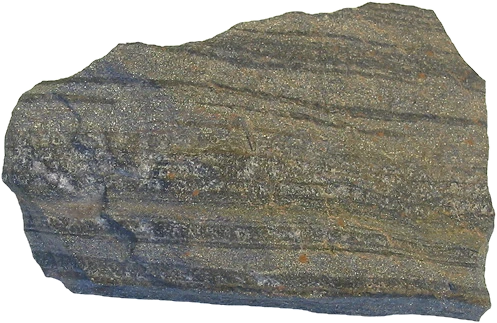
Perovskite
Mineral whose structure enables diverse engineered materials.

Perovskite is an orthorhombic calcium titanium oxide mineral with the chemical formula CaTiO₃. The mineral was first discovered in the Ural Mountains of Russia in 1839 by Gustav Rose, who named it after the Russian mineralogist Lev Perovski. Its distinctive crystal structure was initially described by Victor Goldschmidt in 1926 through his work on tolerance factors, and later refined in 1945 by Helen Dick Megaw using X-ray diffraction data from barium titanate. In nature, perovskite occurs in the Earth’s mantle and is found in silica-undersaturated ultramafic rocks and foidolites, such as those at the Khibina Massif, where it forms small anhedral to subhedral crystals filling spaces between rock-forming silicates. It is also present in contact carbonate skarns at Magnet Cove, Arkansas, in altered limestone blocks from Mount Vesuvius, in chlorite and talc schist in the Urals and Switzerland, and as an accessory mineral in alkaline and mafic igneous rocks, nepheline syenite, melilitite, kimberlites, and rare carbonatites. Perovskite is a common component of calcium-aluminum-rich inclusions in chondritic meteorites. Its stability in igneous rocks is limited by a reaction with sphene, and the two minerals are not found together in volcanic rocks except in an etindite from Cameroon. Rare-earth-bearing varieties include knopite, found in alkali intrusive rocks of the Kola Peninsula and near Alnö, Sweden, and a niobium-bearing variety called dysanalyte, which occurs in carbonatite near Schelingen, Germany. In stars and brown dwarfs, perovskite grain formation depletes titanium oxide in the photosphere; at temperatures below 2000 K, TiO becomes undetectable, marking the transition between cool M-dwarf stars and colder L-dwarfs.
- discoverer
- Gustav Rose
- location
- Ural Mountains, Russia
- crystal_system
- Orthorhombic (pseudocubic)
- chemical_formula
- CaTiO3
- notable_for
- Perovskite structure class; used in photovoltaics
Quick Facts
- Category
- Oxide minerals
- Formula
- CaTiO3
- Imasymbol
- Prv
- Molweight
- 135.96 g/mol
- Strunz
- 4.CC.30
- System
- Orthorhombic
- Class
- Dipyramidal (mmm) / H-M symbol: (2/m 2/m 2/m)
- Symmetry
- Pbnm
- Habit
- Pseudo cubic – crystals show a cubic outline
- Cleavage
- [100] good, [010] good, [001] good
- Twinning
- complex penetration twins
- Fracture
- Conchoidal
Facts from the source article.
Lore & Background
Perovskite is an orthorhombic calcium titanium oxide mineral with the composition of calcium titanate. Its defining characteristic is its crystal structure, which serves as the namesake for a broader class of compounds known as the perovskite structure. This structure is nearly cubic, with a general formula of ABO₃ for chalcogen perovskites or ABX₃ for halogen perovskites, the latter being common in modern photovoltaics. In this arrangement, the A-site ion, typically an alkaline earth or rare-earth element, sits at the center of the lattice in twelve-fold coordination with anions, while the B-site ion, a transition metal, occupies the corners in six-fold coordination. The mineral itself crystallizes in the orthorhombic system with space group Pbnm, though crystals often appear pseudocubic. Its appearance varies widely: colors include black, brown, gray, and orange to yellow, with a sub-metallic to metallic luster, a colorless streak, and imperfect cleavage with brittle tenacity. Perovskite can be mistaken for galena, but galena has a better metallic luster, greater density, perfect cleavage, and true cubic symmetry. The mineral occurs in the Earth’s mantle and is found in silica-undersaturated ultramafic rocks and foidolites, such as at the Khibina Massif, where it forms small anhedral to subhedral crystals between rock-forming silicates. It also appears in contact carbonate skarns, altered limestone blocks from Mount Vesuvius, chlorite and talc schist, and as an accessory mineral in alkaline and mafic igneous rocks, nepheline syenite, melilitite, kimberlites, and rare carbonatites. Perovskite is common in Ca-Al-rich inclusions in chondritic meteorites. Its stability in igneous rocks is limited by a reaction with sphene; the two are not found together in volcanic rocks except in an etindite from Cameroon. Rare-earth-bearing varieties include knopite, found in alkali intrusive rocks of the Kola Peninsula and Sweden, and niobium-bearing dysanalyte, occurring in carbonatite near Schelingen, Germany. In stars and brown dwarfs, perovskite grains form at low temperatures, depleting titanium oxide in the photosphere; the absence of TiO bands defines the transition from cool M-dwarf stars to colder L-dwarfs.
Reader's Guide
Perovskite is significant as the namesake for a broad class of compounds with the same crystal structure, which can accommodate a wide variety of cations. This structural flexibility has enabled the development of engineered materials for applications including photovoltaics, where halogen perovskites are used in photodiodes and solar panels. The mineral itself occurs in diverse geological settings, from the Earth's mantle to chondritic meteorites, and its formation in stars and brown dwarfs depletes titanium oxide in their photospheres, defining the transition between cool M-dwarf stars and colder L-dwarfs. The perovskite structure's stability is characterized by the Goldschmidt tolerance factor, and its derivatives, such as double perovskites, exhibit ordering that modifies electronic, magnetic, and transport properties, leading to functional materials for magnetism, ferroelectricity, catalysis, and energy conversion.
Did You Know?
- Perovskite formation in stars depletes titanium oxide, defining the transition between M-dwarf and L-dwarf stars.
- A rare-earth-bearing variety of perovskite, knopite, is found in alkali intrusive rocks in the Kola Peninsula.
Frequently Asked Questions
Who discovered Perovskite and where was it first found?
Gustav Rose identified this calcium titanate mineral in the Ural Mountains of Russia. It crystallizes in an orthorhombic system that often looks nearly cubic at first glance.
What is Perovskite's chemical formula?
The mineral's composition is CaTiO3, making it a calcium titanium oxide. That deceptively simple formula underpins an entire family of compounds that share the same crystal architecture.
What is the 'perovskite structure' and why is it so versatile?
It is a crystal lattice described by the general formula A2+B4+(X2−)3 for chalcogen variants or A1+B2+(X1−)3 for halogen variants. Because the framework can swap in many different cations without collapsing, it serves as a template for engineering a wide range of functional materials.
How does Perovskite connect to modern solar-panel technology?
The structural flexibility of the perovskite lattice lets scientists tune compositions for efficient light absorption and charge transport. That is why perovskite-based compounds are now central to next-generation photovoltaics such as photodiodes and thin-film solar cells.
What crystal system does Perovskite belong to?
It forms in the orthorhombic system, though its unit cell frequently appears almost cubic, a trait often called pseudocubic. That near-symmetry is one reason the lattice tolerates so many substitutions.
More in Minerals & Ore Deposits 1-24
Spotted an error? Know more?
This is a living reference — every entry is fact-audited, and reader corrections feed straight into our audit queue. Suggest an edit · See this site's audit record