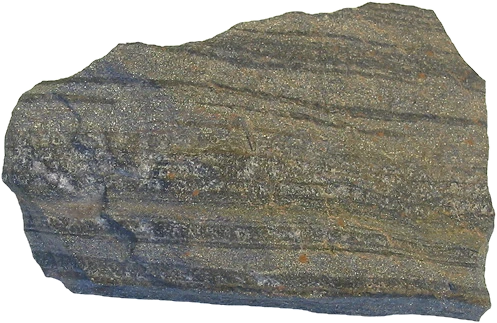
Rutile
Common titanium dioxide mineral with high refractive index and optical uses.

Rutile is an oxide mineral composed of titanium dioxide (TiO2) and is the most common natural form of this compound, with rarer polymorphs including anatase, akaogiite, and brookite. Its name comes from the Latin word for red, a reference to the deep red color visible in some specimens when light passes through them. First described in 1803 by Abraham Gottlob Werner, the type locality for rutile is Horcajuelo de la Sierra, Madrid, Spain. The mineral possesses one of the highest refractive indices at visible wavelengths of any known crystal, along with notably large birefringence and high dispersion. These optical properties make it valuable for manufacturing certain optical elements, particularly polarization optics, for use at longer visible and infrared wavelengths up to about 4.5 micrometres. Natural rutile can contain up to 10% iron, as well as significant amounts of niobium and tantalum. Thermodynamically, rutile is the most stable polymorph of TiO2 at all temperatures, with a lower total free energy than anatase or brookite, meaning the transformation of those metastable phases to rutile is irreversible. It has the lowest molecular volume of the three main polymorphs, making it the primary titanium-bearing phase in most high-pressure metamorphic rocks, especially eclogites. Rutile is a common accessory mineral in high-temperature and high-pressure metamorphic rocks and in igneous rocks, particularly plutonic ones, though it also appears in extrusive rocks like kimberlites and lamproites that originate from deep mantle sources. Large specimen crystals most frequently occur in pegmatites, skarns, and granite greisens. In groups of acicular crystals, rutile is often seen penetrating quartz. The Republic of Sierra Leone had a production capacity of 23% of the world's annual rutile supply in 2005, rising to about 30% in 2008.
- category
- Mineral
- composition
- Titanium dioxide (TiO2)
- crystal_system
- Tetragonal
- hardness
- 6 on Mohs scale
- refractive_index
- One of the highest at visible wavelengths
- type_locality
- Horcajuelo de la Sierra, Madrid, Spain
Quick Facts
- Category
- Oxide minerals
- Boxbgcolor
- #5e5048
- Boxtextcolor
- #fff
- Formula
- TiO / 2
- Imasymbol
- Rt
- Strunz
- 4.DB.05
- System
- Tetragonal
- Class
- Ditetragonal dipyramidal (4/mmm) / H-M symbol: (4/m 2/m 2/m)
- Symmetry
- P4 / 2 · mnm
- Unit Cell
- a = 4.5937 Å, c = 2.9587 Å; Z = 2
- Habit
- Acicular to Prismatic crystals, elongated and striated parallel to [001]
- Twinning
- Common on {011}, or {031}; as contact twins with two, six, or eight individuals, cyclic, polysynthetic
Facts from the source article.
Lore & Background
Rutile is an oxide mineral composed of titanium dioxide (TiO₂) and is the most common natural form of this compound. Its name comes from the Latin word for red, referencing the deep red color seen in some specimens when viewed with transmitted light. The mineral was first described in 1803 by Abraham Gottlob Werner, with the type locality being Horcajuelo de la Sierra, Madrid, Spain. Rutile possesses one of the highest refractive indices of any known crystal for visible light, along with strong birefringence and high dispersion, making it valuable for optical elements such as polarization optics. Natural specimens can contain up to 10% iron, as well as notable amounts of niobium and tantalum. Rutile is a common accessory mineral in high-temperature and high-pressure metamorphic rocks, particularly eclogites, and in igneous rocks. Thermodynamically, it is the most stable polymorph of TiO₂ at all temperatures, and its transformation from metastable phases like anatase or brookite is irreversible. Large crystals are most frequently found in pegmatites, skarns, and granite greisens. The mineral typically exhibits a prismatic or acicular growth habit, often oriented along its c-axis. In groups of needle-like crystals, it is frequently seen penetrating quartz.
Reader's Guide
Rutile is significant as the most common natural form of titanium dioxide and as a key industrial mineral. Its high refractive index, birefringence, and dispersion make it valuable for polarization optics and other optical elements for visible and infrared wavelengths up to about 4.5 micrometres. Finely powdered rutile is a brilliant white pigment used in paints, plastics, paper, and foods, and nanoscale particles are used in sunscreens for UV absorption. Rutile is also used in welding electrode coverings, as a part of the ZTR index for classifying weathered sediments, and in the manufacture of refractory ceramics and titanium metal. Small rutile needles in gems cause asterism, creating valuable 'star' gems. As a large band-gap semiconductor, rutile is researched for photocatalysis and dilute magnetism. Its crystal structure is a classic reference motif adopted by many other oxides.
Did You Know?
- Rutile derives its name from the Latin 'rutilus' meaning red, due to the deep red color in some specimens.
- Rutile has one of the highest refractive indices at visible wavelengths of any known crystal.
- Synthetic rutile, sold as 'Titania', is used as a diamond substitute but has a hardness of only about 6 on the Mohs scale.
Frequently Asked Questions
Who is Rutile?
Rutile is a tetragonal oxide mineral whose chemical formula is titanium dioxide (TiO2). It holds the distinction of being the most abundant naturally occurring form of TiO2 in the Earth's crust.
What are Rutile's powers/role?
Rutile possesses one of the highest refractive indices at visible wavelengths among all known crystals, paired with pronounced birefringence and high dispersion. These optical traits make it a sought-after material for precision optical elements.
How does Rutile's story end?
Since Rutile is a mineral rather than a narrative character, its lasting legacy is practical: it serves as a primary natural source of TiO2 and as a component in specialized optical components.
Why is Rutile important to the mineral world?
Beyond being the most common natural TiO2 mineral, Rutile's extraordinary optical behavior distinguishes it in both scientific research and industrial applications. It also rates 6 on the Mohs hardness scale, giving it reasonable durability for handling and display.
Where does Rutile's name and origin come from?
The name traces back to the Latin word "rutilus" (red), a nod to the deep crimson hue visible in certain specimens when light passes through them. Its type locality is Horcajuelo de la Sierra, Madrid, Spain.
More in Minerals & Ore Deposits 1-24
Spotted an error? Know more?
This is a living reference — every entry is fact-audited, and reader corrections feed straight into our audit queue. Suggest an edit · See this site's audit record