Psilomelane
A group of hard black manganese oxides used as ore.

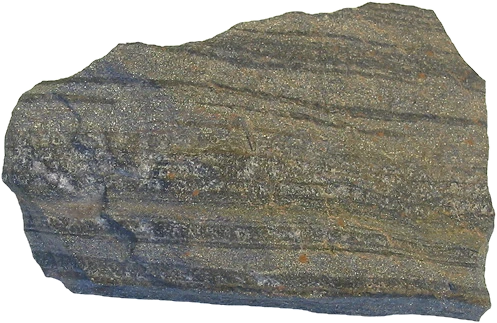
Psilomelane is a group name applied to a variety of hard, black manganese oxides, notably including the minerals hollandite and romanechite. Its chemical composition is that of a hydrous manganese oxide, but it lacks a fixed formula, as it contains variable amounts of barium and potassium. The manganese content is high, typically corresponding to 70–80% manganous oxide, with 10–15% available oxygen. The mineral is sometimes considered a hydrous manganese manganate, though its exact composition remains uncertain. It is occasionally, and incorrectly, referred to as black hematite, but it bears no relation to true hematite, which is an iron oxide.
In terms of physical characteristics, psilomelane occurs in botryoidal and stalactitic masses with a smooth, shining surface and a submetallic luster. It is notably harder than other hydrous manganese oxides such as manganite or wad, with a Mohs hardness of 5 to 6, and its specific gravity ranges from 3.7 to 4.7. The streak is brownish black, and the fracture is smooth. The mineral frequently contains impurities, such as iron hydroxides, and it dissolves in hydrochloric acid, releasing chlorine gas.
The name psilomelane dates back to 1758 and derives from the ancient Greek *psilos* (meaning naked, smooth, or bald) and *melas* (black). A Latinized form is *calvonigrite*, from *calvo* (bald, smooth) and *negri* (black). It is a common and important ore of manganese, found under the same conditions and used for the same commercial applications as pyrolusite. Notable localities that have yielded typical botryoidal specimens include the Restormel iron mine at Lostwithiel in Cornwall, the Brendon Hills in Somerset, Hoy in Orkney, Sayn near Coblenz, Hout Bay near Cape Town, and Crimora in Augusta County, Virginia. Along with pyrolusite, it is extensively mined in Vermont, Virginia, Arkansas, and Nova Scotia.
- field
- Mineralogy
- known_for
- Common and important ore of manganese
- hardness
- 5 to 6
- specific_gravity
- 3.7 to 4.7
- streak
- Brownish black
Lore & Background
Psilomelane is a group name encompassing hard black manganese oxides such as hollandite and romanechite, composed of hydrous manganese oxide with variable amounts of barium and potassium. Its generalized formula is uncertain, sometimes considered a hydrous manganese manganate, with manganese content corresponding to 70–80% manganous oxide and 10–15% available oxygen. The mineral has no definite chemical composition and typically appears as botryoidal and stalactitic masses featuring a smooth, shining surface and submetallic luster. Its streak is brownish black, its fracture smooth, and it is readily distinguished from other hydrous manganese oxides like manganite and wad by its greater hardness of 5 to 6, with specific gravity ranging from 3.7 to 4.7. Psilomelane often contains admixed impurities such as iron hydroxides and is soluble in hydrochloric acid with the evolution of chlorine gas. Erroneously and uncommonly known as black hematite, it is unrelated to true hematite, an iron oxide. The name, dating to 1758, derives from ancient Greek *psilos* (naked, smooth, bald) and *melas* (black); a Latinized form is *calvonigrite*. Psilomelane is a common and important manganese ore, occurring under the same conditions and with the same commercial applications as pyrolusite. Notable localities yielding typical botryoidal specimens include the Restormel iron mine at Lostwithiel in Cornwall, Brendon Hills in Somerset, Hoy in Orkney, Sayn near Coblenz, Hout Bay near Cape Town, and Crimora in Augusta County, Virginia. It is extensively mined with pyrolusite in Vermont, Virginia, Arkansas, and Nova Scotia.
Reader's Guide
Psilomelane is a common and important ore of manganese, occurring under the same conditions and having the same commercial applications as pyrolusite. It is found at many localities, including the Restormel iron mine at Lostwithiel in Cornwall, Brendon Hills in Somerset, Hoy in Orkney, Sayn near Coblenz, Hout Bay near Cape Town, and Crimora in Augusta county, Virginia. With pyrolusite it is extensively mined in Vermont, Virginia, Arkansas, and Nova Scotia. Its generalized formula may be represented as Ba(Mn2+)(Mn4+)8O16(OH)4 or as (Ba,H2O)2Mn5O10, though it is sometimes considered to be a hydrous manganese manganate of doubtful composition. The amount of manganese present corresponds to 70-80% of manganous oxide with 10-15% of available oxygen. The mineral is readily distinguished from other hydrous manganese oxides (manganite and wad) by its greater hardness of 5 to 6.
Did You Know?
- Psilomelane is erroneously, and uncommonly, known as black hematite, despite not being related to true hematite.
- Psilomelane has no definite chemical composition and occurs as botryoidal and stalactitic masses.
- It is soluble in hydrochloric acid with evolution of chlorine gas.
Frequently Asked Questions
What is Psilomelane?
Psilomelane is a collective name for a family of hard, black manganese oxide minerals that includes species such as hollandite and romanechite. It is a hydrous manganese oxide with variable barium and potassium content, and it has no single fixed chemical formula.
What is Psilomelane used for?
Its main significance is as a common and economically important ore source of manganese. Rather than being prized as a gem or collector specimen, it is valued industrially for the manganese it yields.
What does Psilomelane look like and how hard is it?
It appears as a hard, black mineral with a brownish-black streak and a specific gravity between roughly 3.7 and 4.7. On the Mohs scale it rates 5 to 6, placing it in the moderately hard range for a manganese oxide.
Is Psilomelane the same as black hematite?
No—labeling it "black hematite" is a well-known but incorrect misnomer. True hematite is an iron oxide, while Psilomelane is a manganese oxide, so the two are chemically unrelated despite the overlapping dark appearance.
What is the chemical composition of Psilomelane?
Because it is a group name rather than a single mineral species, Psilomelane has no definite chemical formula. It is essentially hydrous manganese oxide containing fluctuating amounts of barium and potassium that vary from sample to sample.
More in Minerals & Ore Deposits 1-24
Spotted an error? Know more?
This is a living reference — every entry is fact-audited, and reader corrections feed straight into our audit queue. Suggest an edit · See this site's audit record