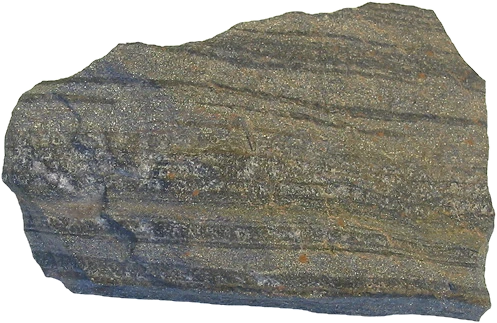
Spodumene
A pyroxene mineral and major source of lithium.

Spodumene, a pyroxene mineral with the formula LiAl(SiO3)2, is a key commercial source of lithium. It forms prismatic crystals, often enormous—single crystals up to 14.3 meters long have been found in South Dakota’s Black Hills. The mineral appears in several gem varieties: colorless to yellowish, purplish, or lilac kunzite, and yellowish-green to emerald-green hiddenite. Its low-temperature form, α-spodumene, has a monoclinic crystal system; above 900 °C it converts to β-spodumene, which is tetragonal. Crystals are typically heavily striated along their main axis, with etched faces marked by triangular pits.
First described in 1800 from Utö, Sweden, spodumene was identified by Brazilian naturalist José Bonifácio de Andrada e Silva. Its name comes from the Greek *spodumenos* (“burnt to ashes”), referencing the ash-gray look of industrial-grade material. It occurs in lithium-rich granite pegmatites and aplites, often alongside quartz, albite, petalite, eucryptite, lepidolite, and beryl. Transparent specimens have long been cut as gemstones, with kunzite and hiddenite noted for strong pleochroism. Major sources include the Democratic Republic of Congo (DRC), Afghanistan, Australia, Brazil, Madagascar, Pakistan, Canada’s Québec, and the U.S. states of North Carolina and California.
As of 2018, the DRC held the world’s largest hard-rock spodumene lithium deposit, in the Manono region of Tanganyika Province. By 2021, Australian company AVZ Minerals was developing the Manono Lithium and Tin project there, estimating 400 million tonnes of high-grade ore at 1.65% lithium oxide from the Roche Dure pegmatite. The second-largest high-grade resource is Mount Marion, with 71 million tonnes of spodumene, owned by Mineral Resources and Jiangxi Ganfeng Lithium.
Lithium from spodumene is used in ceramics, mobile phones, batteries (including for vehicles), medicine, Pyroceram, and as a flux. Around half of the world’s lithium came from mineral ores (mostly spodumene) as of 2019. Spodumene’s advantage over brine sources is its higher lithium concentration, though extraction costs are greater. Recovery typically involves roasting to β-spodumene, then dissolving in acid or using other reagents. In 2016, spodumene concentrate was forecast to stay at $500–600 per ton, but prices spiked above $800 in early 2018 before falling to $400 by September 2020 due to oversupply. Global lithium production via spodumene was about 80,000 metric tonnes per year in 2018, mainly from Western Australia’s Greenbushes pegmatite, plus Chinese and Chilean sources. The Talison Minerals mine at Greenbushes (involving Tianqi Lithium, Albemarle Corporation, and Global Advanced Metals) was reported in 2012 as the world’s second-largest, with the highest ore grade at 2.4% Li2O. By 2020, Australia had expanded spodumene mining to become the leading lithium-producing country. A key economic product is spodumene concentrate 6 (SC6), a high-purity ore with about 6% lithium, used as raw material for lithium-ion batteries in electric vehicles.
Refining spodumene—often SC6—is difficult because lithium is tightly bound in the crystal structure. Traditional methods in the 2010s involved acid leaching, impurity precipitation, concentration, and conversion to lithium carbonate or hydroxide, generating large volumes of caustic waste. Reagents include alkali metal sulfates, sodium carbonate, chlorine, or hydrofluoric acid. An alternative pyrometallurgical process roasts SC6 above 800 °C to convert α-spodumene to the more open β-structure, then uses hydrometallurgical steps. Some approaches use noncaustic reagents and reduce waste, potentially enabling closed-loop refining. Tesla developed a similar 6–8 step process (operational at scale by 2025) that avoids acids: sodium chloride is mixed with β-spodumene concentrate and water, then agitated at high temperature to produce a lithium-rich slurry, which is filtered and purified into lithium hydroxide. Waste products—analcime, sands, and limestone—can be repurposed as construction materials. Tesla’s refinery on 1,200 acres in Robstown, Texas, began partial operation in December 2024, chosen for its proximity to the Port of Corpus Christi for convenient spodumene imports.
- type locality
- Utö, Södermanland, Sweden
- discoverer
- Jose Bonifacio de Andrada e Silva
- crystal system (α-spodumene)
- monoclinic
- crystal system (β-spodumene)
- tetragonal
- chemical formula
- LiAl(SiO3)2
- name origin
- Greek spodumenos, meaning 'burnt to ashes'
Lore & Background
The name is derived from the Greek spodumenos, meaning 'burnt to ashes', owing to the opaque ash-grey appearance of material refined for use in industry. It occurs in lithium-rich granite pegmatites and aplites, associated with quartz, albite, petalite, eucryptite, lepidolite, and beryl. Transparent material has long been used as a gemstone with varieties kunzite and hiddenite noted for their strong pleochroism. Source localities include the Democratic Republic of Congo, Afghanistan, Australia, Brazil, Madagascar, Pakistan, Québec in Canada, and North Carolina and California in the U.S. Single crystals of 14.3 m (47 ft) in size are reported from the Black Hills of South Dakota, United States. Mount Marion contains the world's second-biggest high-grade lithium mineral resources, with an estimated 71 million tonnes of the mineral spodumene.
Reader's Guide
Spodumene is an important source of lithium, for use in ceramics, mobile phones and batteries (including for automotive applications), medicine, Pyroceram, and as a fluxing agent. Lithium is recovered from spodumene by dissolution in acid, or extraction with other reagents, after roasting to convert it to the more reactive β-spodumene. The advantage of spodumene as a lithium source compared to brine sources is the higher lithium concentration, but at a higher extraction cost. An important economic concentrate of spodumene, known as spodumene concentrate 6 or SC6, is a high-purity lithium ore with around 6% lithium content being produced as a raw material for the subsequent production of lithium-ion batteries for electric vehicles. Extraction of lithium from spodumene is challenging due to the tight binding of lithium in the crystal structure. Traditional refining involves acid leaching, while alternative methods use pyrometallurgical processing to convert α-spodumene to β-spodumene. Tesla has developed a process that mixes sodium chloride with β-spodumene concentrate and water, producing a lithium-rich slurry that can be filtered and purified into lithium hydroxide, with waste products repurposed as construction materials.
Did You Know?
- Single crystals of spodumene up to 14.3 m (47 ft) in size have been reported from the Black Hills of South Dakota.
- The name spodumene comes from the Greek spodumenos, meaning 'burnt to ashes'.
More in Minerals & Ore Deposits 1-24
Spotted an error? Know more?
This is a living reference — every entry is fact-audited, and reader corrections feed straight into our audit queue. Suggest an edit · See this site's audit record