Nepheline
A feldspathoid mineral used in glass and ceramics.
Last updated
Nepheline, also called nephelite, is a rock-forming mineral belonging to the feldspathoid group. It is a silica-undersaturated aluminosilicate that occurs in intrusive and volcanic rocks with low silica, as well as in their associated pegmatites. The mineral is used in glass and ceramic manufacturing and has been investigated as an ore of aluminium.
Description and properties
Nepheline is an uncommon mineral that crystallizes in the hexagonal system, often forming short, six-sided prisms capped by a flat base. Despite appearing more symmetrical, the crystals are actually hemimorphic and tetartohedral, with only a single polar hexad axis of symmetry, as revealed by artificial etching. It is usually found in compact, granular masses and can be white, yellow, gray, green, or reddish. With a Mohs hardness of 5.5 to 6 and a specific gravity between 2.60 and 2.65, it is often translucent and has a greasy luster.
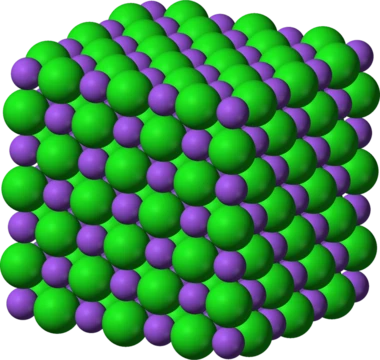
Its refractive index and weak double refraction are very similar to quartz, but the negative sign of its double refraction sets it apart under a microscope. Hydrochloric acid easily breaks down nepheline, producing gelatinous silica and salt cubes; a clear crystal turns cloudy in the acid. It readily changes into zeolites, sodalite, kaolin, or compact muscovite.
Structure and composition
The aluminosilicate backbone of nepheline consists of interlocked six-member rings, resembling the structure of tridymite but with aluminum substituting for every other silicon atom. This creates one nearly hexagonal interstitial site and three irregular interstitial sites per unit cell.
In ideal nepheline, potassium ions occupy the hexagonal sites and smaller sodium ions fill the irregular sites, giving a sodium-to-potassium atomic ratio of 3:1 and an ideal K₂O weight percentage of 8.1%. Natural nepheline compositions range from 3% to 12% K₂O, and small amounts of calcium may also be present. At elevated temperatures, nepheline forms a complete solid solution series with kalsilite; below about 1000°C, a wide miscibility gap exists, and compositions within this gap undergo exsolution upon cooling, forming separate microscopic lamellae of nepheline and kalsilite.
Occurrence
Nepheline is a mineral that forms in igneous rocks low in silica, such as nepheline syenite, foidite, and phonolite. It typically appears alongside leucite, sodalite, potassium feldspars, and sodium-rich plagioclase, amphiboles, or pyroxenes, while quartz is almost never present.
Significant rock exposures occur on the Kola Peninsula, in Norway and South Africa, and at Litchfield, Maine; Magnet Cove, Arkansas; and Beemerville, New Jersey. Near Bancroft, Ontario, syenites hold large amounts of high-purity nepheline. A massive, translucent variety called elaeolite has a darker color and a greasy shine.
Uses
Nepheline that is free of iron is prized for glassmaking as a replacement for feldspar, with Ontario being the main source. A byproduct from apatite mining on the Kola Peninsula, this mineral finds use in ceramics, leather, rubber, textiles, wood, and the oil industry. It also acts as a filler in paints, plastics, and foam rubber, as well as a sorbent. In Russia’s Kemerovo Region, the Kiya Shaltyr deposit yields nepheline used as a raw material for producing aluminium.
More in Minerals & Crystals
Sources
Compiled from Wikipedia and the sources listed below. Text from Wikipedia is available under CC BY-SA 4.0; this entry is adapted from it.
- Wikipedia: Nepheline (CC BY-SA 4.0).
- Word definitions: the , each quoted from its Wikipedia article.
Spotted an error? Know more?
Reader corrections go straight into our review queue. Suggest an edit · How this site is sourced