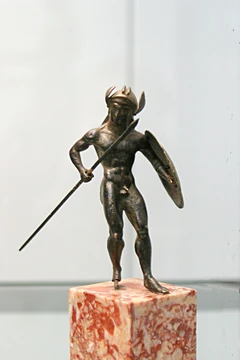
Battle of Thermopylae

In 480 BC, the Battle of Thermopylae was fought between the Achaemenid Persian Empire, led by Xerxes, and an alliance of Greek city-states commanded by Sparta under King Leonidas I. This three-day engagement was a key event in the second Persian invasion of Greece and the broader Greco-Persian Wars.
The battle took place at the same time as the naval Battle of Artemisium, between July and September of 480 BC. Xerxes’ invasion was a delayed follow-up to the first Persian invasion, started by Darius I, which ended in 490 BC with a Greek victory at Marathon. A decade later, Xerxes gathered a huge land and naval force to conquer all of Greece. In response, the Athenian politician and general Themistocles proposed that the allied Greeks block the Persian army at the pass of Thermopylae while also blocking the Persian navy at the Straits of Artemisium.
As the invasion began, a Greek force of about 7,000 men—including an estimated 300 Spartans—led by Leonidas marched north to hold the pass. Ancient writers greatly exaggerated the size of the Persian army, claiming millions, but modern scholars estimate it between 120,000 and 300,000 soldiers. The Persians reached Thermopylae in late August or early September. The outnumbered Greeks held them off for seven days, including three days of direct battle, before their rear-guard was wiped out in a famous last stand. For two full days, the Greeks blocked the only road through the narrow pass. After the second day, a local named Ephialtes told the Persians about a path that led behind the Greek lines. Realizing his force was being outflanked, Leonidas dismissed most of the Greek army and stayed to guard their retreat with 300 Spartans and 700 Thespians. Others also remained, including up to 900 helots and 400 Thebans. Except for the Thebans, most of whom surrendered, the Greeks fought to the death.
Themistocles, commanding the Greek navy at Artemisium, learned that the Persians had taken the pass. Since the Greek plan required holding both Thermopylae and Artemisium, the fleet withdrew to the island of Salamis. The Persians then overran Boeotia and captured the evacuated city of Athens. The Greek fleet sought a decisive victory and defeated the Persian navy at the Battle of Salamis later in 480 BC. Fearing being trapped in Europe, Xerxes withdrew most of his army to Asia, reportedly losing many troops to starvation and disease, and left the commander Mardonius to continue the campaign. The next year, a Greek army decisively defeated Mardonius at the Battle of Plataea, ending the second Persian invasion.
Ancient and modern writers have used Thermopylae as a key example of the power of an army defending its homeland. The Greek defenders’ performance also illustrates how training, equipment, and terrain can act as force multipliers.
- Location
- Thermopylae
- Combatants
- Achaemenid Persian Empire vs. alliance of Greek city-states
- Greek Commander
- Leonidas I of Sparta
- Persian Commander
- Xerxes I
- Greek Force Size
- Approximately 7,000 men, including an estimated 300 Spartans
Lore & Background
The Battle of Thermopylae took place at a narrow coastal pass in central Greece, a location chosen specifically to negate the numerical superiority of the invading force. The pass itself, flanked by steep mountains and the sea, served as a natural chokepoint, forcing the massive Persian army—estimated by modern scholars at between 120,000 and 300,000 soldiers—into a confined space where their numbers could not be brought to bear. The Greek defenders, numbering approximately 7,000 men including an elite contingent of 300 Spartans under King Leonidas, held this position for seven days, with three of those days involving direct combat. The defining characteristic of the battle was the Greeks’ ability to block the only road through the pass for two full days of fighting, using superior training, equipment, and terrain to inflict heavy casualties on the Persians. The battle’s outcome was ultimately decided not by force of arms but by betrayal: a local resident named Ephialtes revealed a mountain path that allowed Persian forces to outflank the Greek position. Upon learning of this encirclement, Leonidas dismissed the bulk of the Greek army to retreat, while he and a rearguard of 300 Spartans, 700 Thespians, and others—including up to 900 helots and 400 Thebans—remained to delay the Persian advance. Most of the Thebans reportedly surrendered, while the remaining Greeks fought to the death, creating one of history’s most famous last stands. The battle occurred simultaneously with the naval engagement at Artemisium, and its loss forced the Greek fleet to withdraw to Salamis, leading to the eventual Persian capture of Athens.
Reader's Guide
The Battle of Thermopylae is one of the most famous last stands in history. Both ancient and modern writers have used it as a flagship example of the power of an army defending its native soil. The performance of the Greek defenders is also used as an example of the advantages of training, equipment, and use of terrain as force multipliers. The battle's outcome allowed the Persians to overrun Boeotia and capture Athens, but the Greek fleet later won at Salamis, and the following year a Greek army decisively defeated the Persians at Plataea, ending the second invasion. The primary source is Herodotus, with additional accounts from Diodorus Siculus, Ctesias, and others.
Did You Know?
- The battle lasted three days, but the Greeks held the pass for seven days total.
- A local resident named Ephialtes revealed a path that allowed the Persians to outflank the Greeks.
- The battle occurred simultaneously with the naval Battle of Artemisium.
Frequently Asked Questions
What is the Battle of Thermopylae?
It was a three-day engagement fought at the narrow mountain pass of Thermopylae during the second Persian invasion of Greece. A coalition of Greek city-states, led by Sparta, held the chokepoint against the vastly larger Achaemenid army under Xerxes I. The fight is one of the most iconic confrontations in the broader Greco-Persian Wars.
Who commanded the Greek side at Thermopylae?
King Leonidas I of Sparta led the Greek alliance, bringing with him an estimated 300 Spartan hoplites as part of a combined force of roughly 7,000 men drawn from multiple Greek city-states. On the Persian side, the campaign was directed by Emperor Xerxes I himself.
How did the Battle of Thermopylae end?
After two days of repelling waves of Persian infantry, the Greeks were outflanked when a local guide revealed a mountain trail that let Xerxes' forces bypass the narrow pass. Leonidas and the rearguard were ultimately overwhelmed, though the stand had already bought critical time for the wider Greek defense.
Why is the Battle of Thermopylae so important?
It became a lasting symbol of standing firm against overwhelming odds, shaping how Western culture remembers courage and sacrifice. Strategically, the three-day delay helped the Greek naval and land forces reorganize ahead of the decisive engagement at Salamis.
How large was the Greek force compared to the Persians?
The Greek coalition numbered around 7,000 troops, including the famous contingent of roughly 300 Spartans. They faced the Achaemenid Persian army, which was many times their size, making the narrow terrain at Thermopylae the Greeks' only realistic chance to contest the advance.
More in Military History & Battles 1-20
Spotted an error? Know more?
This is a living reference — every entry is fact-audited, and reader corrections feed straight into our audit queue. Suggest an edit · See this site's audit record