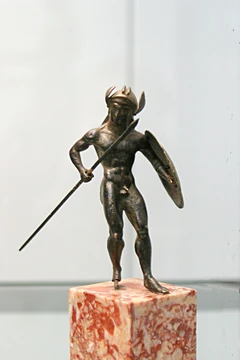
Ancient warfare
Organized armies emerged from agricultural surplus and city-states.

Ancient warfare covers the period from the start of written history through the close of the ancient era. What set it apart from prehistoric conflict was less about new weapons and more about how societies organized themselves. The rise of city-states and later empires fundamentally changed the nature of fighting. In Mesopotamia, states began producing enough extra food to support full-time rulers and military leaders. Although most soldiers were still farmers, societies could now set aside time each year for military campaigns, leading to the first truly organized armies. These armies, in turn, helped states expand and centralize their power.
Different regions mark the end of antiquity in different ways. In Europe and the Near East, it is often tied to the fall of Rome in 476 AD, the wars of the Eastern Roman Empire along its southwestern Asian and North African borders, and the start of Muslim conquests in the 7th century. In China, the ancient period fades with the growing importance of mounted warriors to counter northern threats in the 5th century and the rise of the Tang dynasty in 618 AD. In India, it ends with the decline of the Gupta Empire in the 6th century and the beginning of Muslim conquests there in the 8th century. In Japan, the ancient period closes with the rise of feudalism during the Kamakura period in the 12th and 13th centuries.
Early ancient armies still relied on bows and spears—weapons used for hunting in prehistoric times. Evidence from the site of Nataruk in Turkana, Kenya, has been interpreted as showing early inter-group conflict, though this view is disputed. Armies in Egypt and China followed a similar pattern, using massed infantry armed with bows and spears. Infantry dominated warfare at this stage, partly because the camel saddle and stirrup had not yet been invented. These infantry forces were split into ranged and shock units. Shock troops would charge to break enemy lines or hold their ground, while ranged units provided supporting fire. Ideally, these forces worked together, forcing an enemy into a tough choice: bunch up and become vulnerable to arrows, or spread out and risk being overrun by shock troops. This balance shifted as technology introduced chariots, cavalry, and artillery to the battlefield.
There is no clear dividing line between ancient and medieval warfare. Key features of medieval fighting, like heavy cavalry and siege engines such as the trebuchet, first appeared in Late Antiquity. The major split within the ancient period comes with the Iron Age, which brought cavalry (leading to the decline of chariots), naval warfare (seen with the Sea Peoples), and an industry based on ironworking that allowed mass production of metal weapons and the equipping of large standing armies. The first military power to take full advantage of these innovations was the Neo-Assyrian Empire, which achieved an unprecedented level of centralized control and became the first "world power" to stretch across the entire Fertile Crescent—Mesopotamia, the Levant, and Egypt.
As states grew, the speed of mobilization became critical, since central authority could not survive if rebellions were not crushed quickly. The first solution was the chariot, used in the Middle East from around 1800 BC. Initially pulled by oxen and donkeys, chariots allowed rapid movement across the region's flat terrain and were light enough to be floated across rivers. Better horse training soon allowed horses to pull them, possibly as early as 2100 BC, making them even faster and more powerful. Their main limitation was terrain: chariots worked well on flat, hard, open ground but struggled on rough ground, among trees or bushes, across small ravines or streams, or in marshland. In such conditions, foot soldiers and later cavalry were more maneuverable.
Chariots became the key weapon in the Ancient Near East during the 2nd millennium BC. A typical chariot carried two men: a bowman who fired at the enemy and a driver. Over time, chariots were built to carry up to five warriors. In China, chariots became the central weapon of the Shang dynasty, helping them unify a large area. Although chariots have been compared to modern tanks for their shock role on the battlefield, scholars dispute this, noting that chariots were fragile and vulnerable, needed level ground, and could not handle rough terrain like tanks. Their real advantage was the tactical mobility they gave bowmen. Infantry usually fought in tight formations for control and mutual protection, but chariots could stand off at long range and rain arrows down on them. Any attempt to charge the chariots could be easily evaded due to their speed. If infantry spread out to reduce arrow damage, they lost mutual protection and risked being overrun. This tactical dilemma made chariots indispensable, but they were complex and required specialized craftsmen to maintain, making them expensive.
- period
- From the beginning of recorded history to the end of the ancient period
- key_region
- Mesopotamia, Europe, Near East, China, India, Japan
- dominant_force
- Infantry
- key_innovation
- Chariot
Lore & Background
Early ancient armies continued to primarily use bows and spears, the same weapons developed in prehistoric times for hunting. Infantry was the dominant form of war, partially because the camel saddle and stirrup had not yet been invented. Infantry was divided into ranged and shock forces, ideally combined to present opponents with a tactical dilemma. While the Neo-Assyrian Empire famously utilized cavalry and iron weapons, earlier powers such as the Hittites had already employed iron metallurgy and chariotry. The Neo-Assyrians did achieve a vast empire, but they never held unchallenged centralized control over the entire Fertile Crescent—parts of southern Mesopotamia and the Levant remained contested or independent.
Reader's Guide
Ancient warfare marks the transition from prehistoric tribal conflict to organized state military forces. The development of agricultural surplus in Mesopotamia enabled full-time commanders and standing armies, which in turn allowed states to centralize and expand. Naval warfare emerged in the Mediterranean, with the first documented naval battle depicted in a relief at Medinet Habu showing Ramses III's victory over the Sea Peoples. The trireme later became a major innovation. No clear line separates ancient and medieval warfare, as heavy cavalry and siege engines like the trebuchet were introduced in Late Antiquity.
Did You Know?
- The first documented physical evidence of a naval battle is a relief painting in the temple of Medinet Habu, near Luxor, Egypt.
- Chariots were light enough to be easily floated across rivers.
- The Akkadian Empire under Sargon of Akkad controlled much of the Fertile Crescent centuries before the Neo-Assyrian Empire, making it an earlier 'world power' in the region.
From Farming to Full-Time War
The shift from prehistoric to ancient warfare was less about new weapons and more about new social structures. When the earliest city-states emerged in Mesopotamia, they generated enough agricultural surplus to support people who did not farm. This surplus allowed ruling elites and dedicated military commanders to exist as full-time figures. The majority of soldiers remained farmers, but each year a portion of the population could be set aside for military service. This simple yet transformative arrangement produced the first truly organized armies. These armies, in turn, enabled states to expand their territory and centralize their authority. The cycle was self-reinforcing: larger states needed larger armies, and larger armies made larger states possible. What had been small-scale, localized conflict became a structured instrument of state power, laying the groundwork for everything that followed in the ancient military world.
The Chariot and the Tactical Dilemma
The chariot transformed the battlefield of the ancient Near East during the second millennium BC, becoming the dominant weapon of that era. A typical chariot crew consisted of two men: a bowman and a driver, though some designs carried up to five warriors. Their greatest tactical advantage was not shock force—scholars dispute the comparison to modern tanks—but the mobility they gave archers. A chariot force could stand at long range and shower tightly packed infantry with arrows, then evade any countercharge. If the infantry spread out to reduce arrow damage, they lost mutual protection and became vulnerable to being overrun. This created an inescapable tactical dilemma for any opposing force, making chariots indispensable.
The Social Architecture of War
The ownership and maintenance of war-making technology shaped the political structures of ancient societies in profound ways. Chariots, for instance, required specialized craftsmen and were expensive to produce, meaning they could not simply be issued to every soldier. When individuals within a society owned their own chariots, this tended to generate a warrior class of specialists and a feudal social order, a pattern visible in Homer's Iliad. Conversely, when chariots were publicly owned by the state, they reinforced and helped establish a strong central government, as seen in the New Egyptian Kingdom. The same logic applied to infantry organization: armies were divided into ranged and shock units, with shock infantry either charging to break enemy lines or holding their ground. The combination of these two roles presented opponents with a fundamental strategic choice—concentrate and risk arrow fire, or disperse and risk being overrun. These tactical and social structures, rooted in the economic realities of who could afford what, defined the character of ancient warfare far more than any single weapon or battle.
The Iron Age and the First World Power
The transition into the Iron Age marked a decisive rupture in ancient military history. The introduction of cavalry rendered chariot warfare increasingly obsolete, while the emergence of naval combat—exemplified by the Sea Peoples—opened an entirely new dimension of conflict. Perhaps most consequential was the development of ferrous metallurgy, which enabled the mass production of metal weapons and, for the first time, the equipment of large standing armies. These innovations did not appear in isolation; they converged to create a new tier of military capability. The Neo-Assyrian Empire was the first power to harness all of these advances simultaneously, achieving a degree of centralized control that had no precedent. Its dominion stretched across the entire Fertile Crescent—encompassing Mesopotamia, the Levant, and Egypt—making it the first entity that can reasonably be called a world power. The boundaries between ancient and medieval warfare remain blurred, since hallmark medieval features like heavy cavalry and trebuchets actually first appeared in Late Antiquity, but the Assyrian achievement stands as the clearest marker of ancient warfare reaching its apex.
Frequently Asked Questions
What time period does ancient warfare cover?
Ancient warfare spans from the earliest recorded history all the way through the close of the ancient period, encompassing conflicts across Mesopotamia, Europe, the Near East, China, India, and Japan.
What made ancient warfare different from prehistoric fighting?
The shift was less about new technology and more about organization. The rise of city-states and empires created the political and economic structures needed to field coordinated, large-scale armies rather than small tribal skirmishes.
What was the dominant military force in ancient warfare?
Infantry served as the primary fighting force throughout the ancient world, forming the backbone of most armies across every major region.
What was the key military innovation of the ancient period?
The chariot stands out as the defining technological breakthrough, transforming how armies projected power on the battlefield and reshaping tactics across the ancient world.
Where did the first organized armies emerge and why?
Mesopotamia is credited with producing the earliest structured military forces, because its agricultural surplus freed up enough people to become full-time commanders and soldiers, enabling states to centralize and expand their armies.
More in Military History & Battles 1-20
Spotted an error? Know more?
This is a living reference — every entry is fact-audited, and reader corrections feed straight into our audit queue. Suggest an edit · See this site's audit record