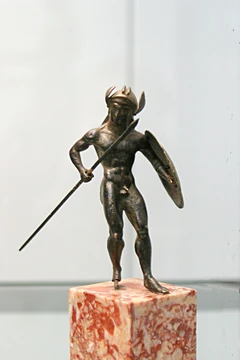
Battle of Actium
Naval battle that ended the Roman Republic.

The naval clash at Actium, fought on September 2, 31 BC, pitted Octavian’s fleet—commanded by Marcus Agrippa—against the joint naval forces of Mark Antony and Cleopatra. The engagement occurred in the Ionian Sea near the old Roman colony of Actium, Greece, and marked the peak of a rivalry between Octavian and Antony that had simmered for more than ten years.
In early 31 BC, Antony and Cleopatra had set up a temporary base in Greece. Antony anchored his camp at Actium with 500 ships and 70,000 infantry, while Octavian—commanding 400 ships and 80,000 troops—arrived from the north and seized Patrae and Corinth. With Agrippa’s help, Octavian cut off Antony’s southern supply line to Egypt through the Peloponnese. Octavian had already won an earlier victory in Greece, where Agrippa’s navy ferried troops across the Adriatic. Landing on the mainland opposite the island of Corcyra (modern Corfu), Octavian marched south.
Stuck on land and sea, Antony’s army began to lose men to desertion, while Octavian’s forces grew confident enough to prepare for battle. Antony’s fleet sailed out through the straits of Actium in a desperate bid to break the blockade. They fought but were routed by Octavian’s smaller, more agile ships. Antony and his remaining forces were saved only by a last-minute intervention from Cleopatra’s fleet, which had been waiting nearby. Octavian chased them and crushed their forces at Alexandria on August 1, 30 BC. Shortly after, Antony and Cleopatra killed themselves.
Octavian’s win let him consolidate power over Rome and its territories. He took the title *Princeps* (“first citizen”), and in 27 BC the Senate awarded him the name *Augustus* (“revered”), by which he is known today. Though he kept the appearance of a restored republican leader, historians see his consolidation and these honors as the end of the Roman Republic and the start of the Roman Empire.
**Background**
The alliance of Octavian, Antony, and Lepidus—the Second Triumvirate—was renewed for five years at Tarentum in 37 BC. It fell apart when Octavian saw Caesarion, the claimed son of Julius Caesar and Cleopatra, as a threat to his power. This happened after Antony left his wife, Octavian’s sister Octavia Minor, and moved to Egypt to begin a long romance with Cleopatra, becoming Caesarion’s de facto stepfather. Octavian and most of the Roman Senate viewed Antony as leading a separatist movement that endangered the Republic’s unity.
Octavian’s prestige and his legions’ loyalty were boosted by Julius Caesar’s will of 44 BC, which officially adopted him as Caesar’s only son and sole heir to his vast wealth. Antony had been Caesar’s most important senior officer (*magister equitum*) and, thanks to his military record, commanded substantial support from Caesar’s veterans. Both men had fought together against their common enemies in the civil war that followed Caesar’s assassination.
After years of loyal cooperation, Antony began acting independently, making Octavian suspect he wanted sole control of Rome. When Antony left Octavia Minor and moved to Alexandria to become Cleopatra’s official partner, many Roman politicians feared he aimed to become the unchecked ruler of Egypt and other eastern kingdoms while still commanding Roman legions in the East. To challenge Octavian’s prestige, Antony tried to have Caesarion recognized as Caesar’s true heir, even though the will did not mention him. In 34 BC, Antony and Cleopatra formally elevated the 13-year-old Caesarion to power, giving him the title “King of the Kings” (the Donations of Alexandria). This was seen as a threat to Roman republican traditions, and it was widely believed Antony had once offered Caesarion a diadem. Octavian then began a propaganda war, denouncing Antony as an enemy of Rome and claiming he planned to set up a monarchy over the Roman Empire on Caesarion’s behalf, bypassing the Senate. It was also said Antony intended to move the imperial capital to Alexandria.
When the Second Triumvirate formally expired on the last day of 33 BC, Antony wrote to the Senate that he did not wish to be reappointed. He hoped the Senate would see him as its champion against Octavian’s ambition, assuming Octavian would not give up his own position. Mutual grievances had piled up. Antony complained that Octavian had overstepped by deposing Lepidus, taking over lands held by Sextus Pompeius, and enlisting soldiers without sending half to him. Octavian complained that Antony had no authority to be in Egypt, that his execution of Sextus Pompeius was illegal, that his treachery toward the king of Armenia disgraced Rome, that he had not sent half the spoils to Rome as agreed, and that his relationship with Cleopatra and recognition of Caesarion as Caesar’s son degraded his office and threatened Octavian.
In 32 BC, one-third of the Senate and both consuls—Gnaeus Domitius Ahenobarbus and Gaius Sosius—allied with Antony. The consuls decided to hide the full extent of Antony’s demands. Ahenobarbus seemed to want to keep quiet, but on January 1...
- date
- 2 September 31 BC
- location
- Ionian Sea, near Actium, Greece
- commanders
- Octavian (via Marcus Agrippa) vs. Mark Antony and Cleopatra
- forces
- Octavian: 400 ships, 80,000 infantry; Antony: 500 ships, 70,000 infantry
- outcome
- Octavian victory
Lore & Background
The battle was the climax of over a decade of rivalry between Octavian and Mark Antony. In early 31 BC, Antony and Cleopatra were stationed in Greece. Octavian, with the help of Marcus Vipsanius Agrippa, cut Antony's southward communications with Egypt via the Peloponnese. Trapped on both land and sea, Antony's army saw portions desert to Octavian's side. Antony's fleet sailed out through the straits of Actium in a desperate attempt to break free of the naval blockade, but was routed by Octavian's smaller, more maneuverable ships. During the battle, Cleopatra's squadron fled, and Antony followed her, abandoning his remaining forces.
Reader's Guide
The Battle of Actium was decisive in ending the long rivalry between Octavian and Mark Antony. Octavian's victory enabled him to consolidate his power over Rome and its dominions. He adopted the title of Princeps ('first citizen'), and in 27 BC was awarded the title of Augustus ('revered') by the Roman Senate. This became the name by which he was known in later times. As Augustus, he retained the trappings of a restored Republican leader, but historians generally view his consolidation of power and the adoption of these honorifics as the end of the Roman Republic and the beginning of the Roman Empire. The battle thus marked a pivotal transition in Roman history, from a republic to an imperial system.
Did You Know?
- The battle took place on 2 September 31 BC in the Ionian Sea, near the former Roman colony of Actium, Greece.
- Octavian's fleet was led by Marcus Agrippa and consisted of smaller, more maneuverable ships than Antony's.
- Antony and Cleopatra took their own lives after Octavian defeated their forces in Alexandria on 1 August 30 BC.
- Octavian later adopted the title of Augustus and is considered by historians to have ended the Roman Republic.
The Political Fracture and Propaganda War
The alliance that bound Octavian, Mark Antony, and Lepidus together as the Second Triumvirate had been renewed at Tarentum in 37 BC for a five-year term, but the arrangement crumbled under mounting personal and political grievances. The rupture accelerated when Antony abandoned his wife Octavia Minor and relocated to Egypt, becoming Cleopatra's official partner. Octavian, who had been officially adopted as Julius Caesar's sole legitimate heir in 44 BC and thus carried the weight of Caesar's legacy, perceived the young Caesarion—Cleopatra's son and Antony's de facto stepson—as an existential threat to his authority. In 34 BC, Antony and Cleopatra formally elevated the thirteen-year-old to power with the title "King of the Kings" during the Donations of Alexandria, an act that struck at the heart of Roman republican tradition. Octavian launched a fierce propaganda campaign, painting Antony as a would-be monarch who intended to move Rome's capital to Alexandria and rule through Caesarion while bypassing the Senate. By the time the triumvirate's term lapsed at the end of 33 BC, both men had accumulated a long list of mutual accusations, and the political architecture of the Republic was already in ruins.
The Blockade and the Decisive Naval Engagement
By early 31 BC, the military confrontation had crystallized along the western coast of Greece. The decisive strategic advantage went to Octavian's camp through the work of Marcus Agrippa, who had already demonstrated his naval skill by ferrying troops across the Adriatic in a preliminary campaign. Agrippa then severed Antony's supply lines southward to Egypt through the Peloponnese, effectively sealing him in. Trapped on land and at sea, Antony's army began to fracture, with soldiers deserting and crossing to Octavian's side, which emboldened the victor's forces to prepare for a final engagement. On 2 September 31 BC, Antony's fleet attempted a desperate breakout through the narrow straits of Actium. They met Octavian's smaller, more agile ships and were decisively routed. Antony and his remaining forces escaped only because Cleopatra's fleet, positioned nearby, made a last-ditch intervention to cover their withdrawal.
The Final Pursuit and the End of an Era
The naval defeat at Actium did not end the conflict so much as set its final course. Octavian gave chase, tracking Antony and Cleopatra back toward Egypt. Their remaining forces were ultimately defeated in Alexandria on 1 August 30 BC, a date that marked the definitive end of the eastern power that had challenged Rome for over a decade. In the aftermath, both Antony and Cleopatra took their own lives, extinguishing the last major rival to Octavian's dominion. The collapse of Antony's army had been hastened by the psychological shock of the naval rout; soldiers who had once served under the most celebrated general of Caesar's legions now saw their cause as lost and fled to the victor's camp. This mass desertion, combined with the strategic strangulation of supply routes through the Peloponnese, had turned what began as a stalemate into a rout. The deaths in Alexandria closed a chapter that had opened with the assassination of Julius Caesar in 44 BC, when both Octavian and Antony had fought side by side against the Liberators. Now, with the last of their shared enemies and allies gone, only one of the two remained.
From Princeps to Augustus: The Birth of an Empire
With his sole rival eliminated, Octavian moved swiftly to reshape the political landscape of Rome. He adopted the title Princeps, meaning "first citizen," a designation that allowed him to retain the outward trappings of a restored Republican leader while concentrating unprecedented authority in his own hands. In 27 BC, the Roman Senate formally awarded him the honorific Augustus, a word meaning "revered," which became the name by which he would be remembered for all subsequent centuries. Historians broadly interpret this consolidation of power and the adoption of these new titles as the effective end of the Roman Republic and the inauguration of the Roman Empire. The transformation was made possible by the military loyalty Octavian had inherited through Caesar's 44 BC will, which named him sole heir, and by the decisive victories at Actium and Alexandria that removed any remaining institutional check on his ambition. The man who had once been the adopted son of a murdered dictator now stood as the unchallenged master of Rome and its vast dominions, wearing the mask of republican virtue over a reality of autocratic rule.
Frequently Asked Questions
What was the Battle of Actium?
It was a decisive naval engagement fought in 31 BC between Octavian's fleet, tactically commanded by Marcus Agrippa, and the combined warships of Mark Antony and Cleopatra. The clash took place in the Ionian Sea off the Greek coast and marked the final armed confrontation in their long political rivalry.
Who led the opposing fleets at Actium?
On Octavian's side, Marcus Agrippa served as the effective fleet commander with roughly 400 ships and 80,000 troops. Antony and Cleopatra fielded a numerically larger force of about 500 ships and 70,000 infantry, but were ultimately outmaneuvered.
How did the Battle of Actium end?
Octavian's fleet secured a clear victory, compelling Antony and Cleopatra to break off the engagement and flee. That defeat sealed their political and personal downfall within the following year.
Why is the Battle of Actium a turning point in Roman history?
Octavian's win eliminated his last major rival, letting him absorb Antony's territories and consolidate sole authority over Rome. Historians generally treat the battle as the moment the Roman Republic effectively gave way to the imperial system.
Where and when was the Battle of Actium fought?
The engagement occurred on 2 September 31 BC in the Ionian Sea, close to the former Roman colony of Actium on the western coast of Greece.
More in Military History & Battles 1-20
Spotted an error? Know more?
This is a living reference — every entry is fact-audited, and reader corrections feed straight into our audit queue. Suggest an edit · See this site's audit record