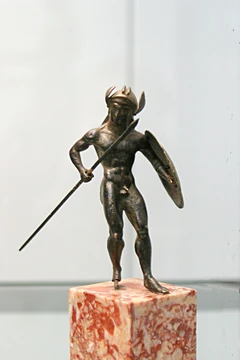
Battle of Lake Trasimene
Hannibal ambushed and destroyed a Roman army at Lake Trasimene.

A Carthaginian army led by Hannibal caught a Roman force under Gaius Flaminius in a trap on 21 June 217 BC, during the Second Punic War. The fight happened along the northern shore of Lake Trasimene, south of Cortona, and ended in a severe Roman loss.
The war between Rome and Carthage had started early in 218 BC. Hannibal, who ruled Carthaginian lands in southeastern Iberia, marched his army through Gaul, crossed the Alps, and reached northern Italy by the end of that year. Rome sent reinforcements north from Sicily, but they suffered a major defeat at the Battle of the Trebia.
The next spring, the Romans placed one army on each side of the Apennine Mountains. They were caught off guard when a Carthaginian force of more than 50,000 men crossed the range using a difficult, unguarded path. The Carthaginians moved south into Etruria, plundering, burning villages, and killing every man they found. Flaminius, commanding the nearest Roman army, chased after them. Hannibal set up an ambush on the north shore of Lake Trasimene and trapped the Romans. With the Carthaginians attacking suddenly from the flank and rear—possibly in poor visibility—the Romans had no chance to form even a basic battle line. After three hours of hard fighting, 15,000 Romans were killed. The trap did not close on the 6,000 men at the front of the column, who escaped. Later that day, they were surrounded by pursuing Carthaginians and surrendered. In total, nearly all 25,000 Romans in Flaminius's army were either killed or captured. This complete destruction of an entire army through an ambush is widely seen as a unique event. A few days later, the Carthaginians wiped out the entire cavalry force of the second Roman army, which had not yet learned of the earlier disaster.
The Carthaginians then marched toward southern Italy, hoping to win over some of the Greek and Italic city-states there. News of the defeat caused panic in Rome and led to the election of Quintus Fabius Maximus Verrucosus as dictator. Impatient with his cautious strategy of avoiding major battles, the Romans elected Lucius Paullus and Gaius Varro as consuls the following year. These more aggressive commanders fought Hannibal at the Battle of Cannae in 216 BC, which resulted in a third and even worse disaster for Rome, followed by thirteen more years of war.
- location
- North shore of Lake Trasimene, south of Cortona, Etruria
- combatants
- Carthage vs. Rome
- commanders
- Hannibal (Carthage), Gaius Flaminius (Rome)
- result
- Decisive Carthaginian victory
- significance
- Unique instance of an entire army destroyed by ambush
Lore & Background
The Battle of Lake Trasimene occurred on the north shore of the lake, south of Cortona, where a Carthaginian army under Hannibal ambushed a Roman force commanded by Gaius Flaminius. The defining characteristic of this engagement is that it represents a unique instance in military history where an entire army was destroyed as a direct result of an ambush by another army. The Carthaginians, having crossed the Apennine Mountains by a difficult and unguarded route with a force exceeding 50,000, moved into Etruria, plundering villages and killing all men encountered. Flaminius pursued them. Hannibal arranged his ambush along the lake’s northern shore, and when the Romans entered the trap, the Carthaginians attacked unexpectedly from the flank and rear, possibly in poor visibility. The Romans had no chance to form even a rudimentary fighting line and were defeated after three hours of hard fighting, with 15,000 killed. The trap failed to enclose the 6,000 Romans at the front of the column, who escaped but were later surrounded and surrendered. Nearly all of the 25,000 Romans in Flaminius’s army were killed or captured.
Reader's Guide
The Battle of Lake Trasimene is a landmark in military history, primarily because it represents the only widely acknowledged instance in which an entire army was annihilated by an ambush. Hannibal’s success relied on his mastery of terrain and deception. After crossing the Apennine Mountains by an unguarded route with an army of more than 50,000, he marched south into Etruria, systematically plundering villages and killing all men to provoke a Roman response. The Roman commander, Gaius Flaminius, took the bait and pursued. Hannibal then concealed his forces on the north shore of Lake Trasimene. When the Roman column entered the narrow defile, Carthaginian troops attacked unexpectedly from the flank and rear, likely in poor visibility. The Romans could not form a fighting line and were slaughtered over three hours, with 15,000 killed. The 6,000 Romans at the front escaped the initial trap but were later surrounded and surrendered. In total, nearly all of Flaminius’s 25,000 men were killed or captured. The defeat caused panic in Rome and led to the appointment of Quintus Fabius Maximus Verrucosus as dictator. His cautious strategy of avoiding battle, known as the Fabian strategy, frustrated the Romans, who elected more aggressive commanders the following year. These commanders engaged Hannibal at Cannae, resulting in an even worse disaster and thirteen more years of war. The battle thus illustrates both the devastating potential of a well-executed ambush and the profound strategic consequences of a single tactical defeat.
Did You Know?
- The battle took place on the north shore of Lake Trasimene, to the south of Cortona.
- The 6,000 Romans at the front of the column escaped the initial trap but later surrendered.
The Ambush and the Trap
The Romans, moving in a long column, found themselves caught in a killing ground where poor visibility compounded the chaos. There was simply no time to deploy into even a basic battle line. For three hours, the fighting was brutal and one-sided. Fifteen thousand Romans fell dead on the field. At the head of the column, roughly six thousand men managed to break free of the encirclement, but they were not safe for long; later that same day, pursuing Carthaginian troops closed around them and they surrendered. In total, nearly all twenty-five thousand soldiers in Flaminius's army were either killed or taken prisoner. Military historians regard this as a singular event in ancient warfare: the complete destruction of one field army by another through the mechanism of ambush, rather than through a set-piece engagement.
The Road to Trasimene
The path to that fateful June morning stretched back more than two decades. After Carthage's defeat, Hamilcar Barca landed in the Iberian peninsula and built a vast autonomous territory for the Barcid family, complete with silver mines, shipyards, and agricultural wealth. His successors, Hasdrubal and then Hannibal, inherited this power base. The Battle of the Trebia followed, a devastating Roman loss.
Political Shockwaves and the Long War
The news of Flaminius's annihilation struck Rome with a force that reshaped its political and military leadership almost overnight. The panic in the capital was so severe that the Senate turned to Quintus Fabius Maximus Verrucosus, elevating him to the extraordinary office of dictator. Fabius adopted a strategy of deliberate avoidance, refusing to give Hannibal the large-scale engagement the Carthaginian needed. But the Roman public grew restless with what they saw as passive leadership. By the following year, they elected Lucius Paullus and Gaius Varro as consuls, men whose aggressive instincts would prove catastrophic. Trasimene, in this chain of events, was not merely a single battle but the hinge that broke Roman confidence and set the stage for Cannae. After Trasimene, the Carthaginians pushed further south into Italy, hoping to peel away the Greek and Italic city-states from Rome's alliance. The war that followed lasted thirteen more years, a grinding conflict that would test the endurance of the Roman state to its limits.
The Unprecedented Scale of Destruction
What made Trasimene stand apart from other engagements of the Second Punic War was not merely the casualty count but the totality of the loss. Nearly every one of the twenty-five thousand men in Flaminius's army perished or fell into Carthaginian hands. This was not a partial rout where a core of veterans reformed and withdrew; it was the erasure of an entire field army in a single afternoon. The six thousand who initially escaped the trap at the front of the column were rounded up later in the day and compelled to surrender, closing the net completely. The destruction was so absolute that it has been widely regarded as a unique occurrence in ancient warfare: one army annihilated by another through ambush rather than a conventional set-piece battle. The blow did not stop there. Just days after the lake-side massacre, Carthaginian forces located and destroyed the entire cavalry contingent of the second Roman army, which still had no knowledge of what had befallen Flaminius. Losing an army wholesale, followed immediately by the loss of another army's mounted arm, left Rome reeling and fundamentally altered the war's trajectory.
Frequently Asked Questions
What was the Battle of Lake Trasimene?
It was a Carthaginian ambush against a Roman army during the Second Punic War, in which Hannibal's forces set upon Gaius Flaminius's legionaries and annihilated them.
Who were the commanders at the Battle of Lake Trasimene?
Hannibal led the Carthaginian side, while the Roman army was under the command of Gaius Flaminius.
How did the Battle of Lake Trasimene end?
The engagement resulted in a decisive Carthaginian victory in which the entire Roman force was destroyed, making it one of the most lopsided defeats in Roman military history.
Why is the Battle of Lake Trasimene considered unique?
Historians widely regard it as the only known instance in which a full army was wiped out as a direct result of an ambush rather than a pitched battle.
Where did the Battle of Lake Trasimene take place?
The fighting occurred along the north shore of Lake Trasimene in Etruria, just south of the town of Cortona.
More in Military History & Battles 1-20
Spotted an error? Know more?
This is a living reference — every entry is fact-audited, and reader corrections feed straight into our audit queue. Suggest an edit · See this site's audit record