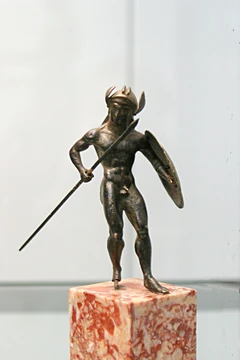
Battle of the Teutoburg Forest
A Germanic ambush destroyed three Roman legions, halting Roman expansion into Germania.

The Battle of the Teutoburg Forest, known to Roman historians as the Varian Disaster, took place from 8 to 11 September 9 CE, likely near what is now Kalkriese. A Germanic alliance ambushed three Roman legions and their auxiliaries, led by Publius Quinctilius Varus. The alliance was commanded by Arminius, a Germanic chieftain who had served as an officer in Varus’s auxilia. Because Arminius held Roman citizenship and had been trained in Roman military tactics, he could systematically trick the Romans and predict their battlefield moves. This defeat ranks among the worst Rome ever suffered. It ended the era of successful expansion under Emperor Augustus and stopped the Romans from trying to conquer Germania. As a result, it is often seen as a turning point in European history. Afterward, the provinces of Germania Superior and Germania Inferior—sometimes called Roman Germania—were set up in northeastern Roman Gaul, while lands east of the Rhine stayed independent. Tiberius and Germanicus led retaliatory campaigns that achieved some success, but the Rhine became the permanent border between the Roman Empire and the rest of Germania. Rome did not launch another major invasion of Germania until the Marcomannic Wars under Marcus Aurelius (r. 161–180). Some of the vassal kingdoms Augustus had tried to create in Germania—such as the Suebi, held by suzerainty—produced descendants who later invaded Rome in the fourth and fifth centuries. **Background**
**Geopolitical situation**
The Roman Republic expanded quickly in the first century BCE, especially under Julius Caesar. During the Gallic Wars (58–50 BCE), he conquered most of western Europe and parts of the British Isles. Most of his opponents were Gauls, but he also fought various Germanic tribes. Caesar crossed the Rhine twice, but neither engagement was decisive. His conquests stopped as Caesar’s civil war (49–45 BCE) approached. For the next two decades, Rome mostly ignored continental Europe because of internal power struggles. Troops once stationed in Gaul were withdrawn in 31 BCE for the showdown between Octavian and Mark Antony at the Battle of Actium. The Gauls quickly rebelled, and Rome did not regain control until 28 BCE. In 27 BCE, both Gaul and Rome underwent major changes. The Roman Republic became the Roman Empire, with Octavian as its first emperor. Renamed Augustus, he aimed to secure Gaul by splitting it into three smaller provinces, highlighting the strategic importance of the Rhine valley. Troops were kept near the Rhine, though Rome’s policy toward Germanic lands remains unclear. One theory holds that Augustus simply wanted to fix the Rhine as the empire’s northern border. Another suggests the border was more flexible, with troops focused on internal order rather than keeping Germans out. Either way, the Germans acted with apparent freedom, as shown by their crushing defeat of Rome in the Lollian disaster of 16 BCE. That disaster led to a reorganization of the legions in Gaul, completed by 12 BCE, when Augustus finally tried to subdue the Germanic tribes. He made his stepson Drusus I governor of Gaul. Drusus campaigned against the Germans from 11 to 9 BCE, winning a series of victories despite major obstacles, until he died in a riding accident in 9 BCE. His older brother, the future emperor Tiberius, took command of Germany in 8 BCE. Tiberius continued his brother’s campaign against the Sugambri, extending de facto (if not de jure) Roman rule, but he fell out of political favor and chose exile in 6 BCE. He was succeeded by Lucius Domitius Ahenobarbus, who had been consul in 16 BCE. Ahenobarbus put down several local uprisings and then crossed the Elbe River—the first and last Roman general to do so. As the century turned, the Romans felt secure about Germany, encouraged by thriving cross-border trade and relative peace. In early CE 6, Legatus Gaius Sentius Saturninus and Consul Legatus Marcus Aemilius Lepidus led a huge army of 13 legions and their support staff—about 100,000 men total (65,000 heavy infantry legionaries, 10,000–20,000 cavalry and archers, and 10,000–20,000 civilians)—against Maroboduus, king of the Marcomanni, a Suebian tribe. But Tiberius had to shift his attention to the Bellum Batonianum (the Great Illyrian Revolt), which erupted in the Balkan province of Illyricum. Led by Bato the Daesitiate, Bato the Breucian, Pinnes of Pannonia, and some Marcomanni, the revolt lasted nearly four years. Tiberius had to halt his campaign against Maroboduus and recognize him as king, freeing up eight legions to crush the rebellion in the Balkans. After Rome moved those forces to the Balkans, only three legions remained to face the Germanic tribes. This weakened position gave the Germans an opportunity to rebel. **Commanders and their armies**
**Publius Quinctilius Varus**
The Varian Disaster is named after Publius Quinctilius Varus, the commander of the remaining Roman forces in the region. Varus was a promising leader. Emperor Augustus appointed him quaestor in 22 BCE while he was still young, even though the office usually required the holder to be at least 30. He later commanded the XIX legion in 15 BCE and was elected junior consul. He became governor of Africa in 8 BCE and of Syria in 7 BCE. The Syrian post was prestigious and very difficult because of political struggles in the eastern empire and its border nations.
- Date
- 8–11 September 9 CE
- Location
- Possibly near modern Kalkriese
- Combatants
- Alliance of Germanic peoples vs. Roman Empire
- Roman Commander
- Publius Quinctilius Varus
- Germanic Commander
- Arminius
- Outcome
- Decisive Germanic victory; Roman legions annihilated
Lore & Background
The battle began with an ambush by the Germanic alliance on three Roman legions led by Publius Quinctilius Varus and their auxiliaries. The alliance was led by Arminius, a Germanic chieftain and officer of Varus's auxilia who had received Roman citizenship and a Roman military education, allowing him to deceive the Romans methodically and anticipate their tactical responses. Varus had been appointed to command in Germania in 7 CE, likely for his political acumen rather than military ability, and his forces included the XVII, XVIII, and XIX legions, which had previously been led by General Gaius Sentius Saturninus.
Reader's Guide
The Battle of the Teutoburg Forest is considered one of the most important defeats in Roman history, bringing the triumphant period of expansion under Augustus to an abrupt end. It dissuaded the Romans from pursuing the conquest of Germania, and so can be considered one of the most important events in European history. The provinces of Germania Superior and Germania Inferior were established in northeast Roman Gaul, while territories beyond the Rhine remained independent. Retaliatory campaigns by Tiberius and Germanicus enjoyed success, but the Rhine became the border between the Roman Empire and the rest of Germania. Rome made no major incursion into Germania until Marcus Aurelius during the Marcomannic Wars. Some descendants of the vassal kingdoms that Augustus tried to create in Germania were the ones that invaded Rome in the fourth and fifth centuries.
Did You Know?
- Arminius, the Germanic leader, had received Roman citizenship and a Roman military education.
- The battle is also called the Varian Disaster (Latin: Clades Variana) by Roman historians.
- Only three Roman legions (XVII, XVIII, and XIX) were under Varus's command at the battle.
- The battle possibly occurred near modern Kalkriese.
More in Military History & Battles 1-20
Spotted an error? Know more?
This is a living reference — every entry is fact-audited, and reader corrections feed straight into our audit queue. Suggest an edit · See this site's audit record