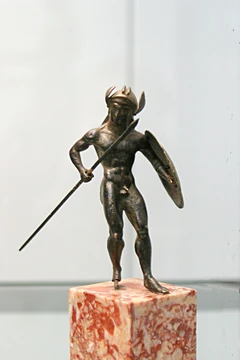
Battle of the Metaurus
Roman victory that ended Carthaginian hopes in Italy.

The Battle of the Metaurus, fought in 207 BC near the Metauro River in Italy, was a decisive clash of the Second Punic War. The Carthaginian force, commanded by Hasdrubal Barca—Hannibal’s brother—was meant to deliver siege equipment and reinforcements to Hannibal. Opposing them were two Roman consuls: Marcus Livius, later known as the Salinator, and Gaius Claudius Nero. Claudius Nero had just fought Hannibal at Grumentum, hundreds of kilometers to the south, and then executed a forced march north to join Livius, a move unnoticed by both Hannibal and Hasdrubal. This left the Carthaginians suddenly outnumbered. In the battle, the Romans used their numerical edge to outflank and rout the enemy, killing or capturing 15,400 Carthaginians, including Hasdrubal himself. The victory cemented Roman dominance over Italy. Without Hasdrubal’s army to support him, Hannibal was forced to abandon pro-Carthaginian towns in much of southern Italy under Roman pressure and retreat to Bruttium, where he remained for the next four years.
- Location
- Near the Metauro River, Italy
- Combatants
- Rome vs. Carthage
- Roman Commanders
- Marcus Livius (the Salinator) and Gaius Claudius Nero
- Carthaginian Commander
- Hasdrubal Barca
- Outcome
- Roman victory
Lore & Background
The Battle of the Metaurus was fought in 207 BC along the banks of the Metauro River in Italy, near the present-day town of Montemaggiore al Metauro. The Carthaginian force, commanded by Hasdrubal Barca—brother of Hannibal—included a significant contingent of Ligurians, who made up roughly one-third of his infantry, along with war elephants raised in Hispania. Hasdrubal had successfully crossed the Alps with these elephants, aided by the removal of the Gallic threat that had troubled Hannibal’s earlier crossing; the Gauls now feared the Carthaginians and many joined his ranks. The Roman armies were led by the consuls Marcus Livius (later nicknamed Salinator) and Gaius Claudius Nero. Claudius Nero had recently fought Hannibal at Grumentum, hundreds of kilometers to the south, and then executed a forced march north with 7,000 picked men—1,000 of them cavalry—to join Marcus Livius without being detected by either Hannibal or Hasdrubal. Hasdrubal, upon observing the enlarged Roman camp and hearing a second trumpet signaling an important arrival, correctly deduced he faced two consular armies and initially withdrew. His retreat was thwarted when his guides betrayed him, leaving his army disorganized, sleep-deprived, and trapped against the Metaurus River, with many of his Gallic troops drunk. In the ensuing battle, the Romans used their numerical superiority to outflank and rout the Carthaginians. Hasdrubal was killed, and 15,400 Carthaginians were lost killed or captured. The victory confirmed Roman supremacy over Italy, forcing Hannibal to abandon pro-Carthaginian towns in southern Italy and withdraw to Bruttium, where he remained for the next four years.
Reader's Guide
The Battle of the Metaurus was decisive in the Second Punic War. By defeating Hasdrubal Barca and killing him, the Romans prevented the reinforcement of Hannibal's army in Italy. This victory confirmed Roman supremacy over Italy and forced Hannibal to evacuate pro-Carthaginian towns in southern Italy and withdraw to Bruttium, where he remained for four years. The battle demonstrated the effectiveness of Roman strategic mobility and numerical superiority, as Claudius Nero's forced march from Grumentum allowed the Romans to outnumber the Carthaginians. The loss of Hasdrubal's army and the death of its commander ended any realistic Carthaginian hope of winning the war in Italy, shifting the conflict's focus to Africa.
Did You Know?
- Claudius Nero had just fought Hannibal at Grumentum, hundreds of kilometres south of the Metaurus, before his forced march north.
- Hasdrubal's guides betrayed him during his night retreat, leaving him lost along the banks of the Metaurus.
- Hasdrubal equipped his elephant mahouts with hammers and chisels to kill the beasts if they turned against their own troops.
More in Military History & Battles 1-20
Spotted an error? Know more?
This is a living reference — every entry is fact-audited, and reader corrections feed straight into our audit queue. Suggest an edit · See this site's audit record